Yarn Yardage for Scarf Calculator
Estimate scarf yarn from finished length, width, gauge, row gauge, yarn weight, stitch pattern texture, fringe, swatch yardage, skein yardage, skein grams, and planning buffer.
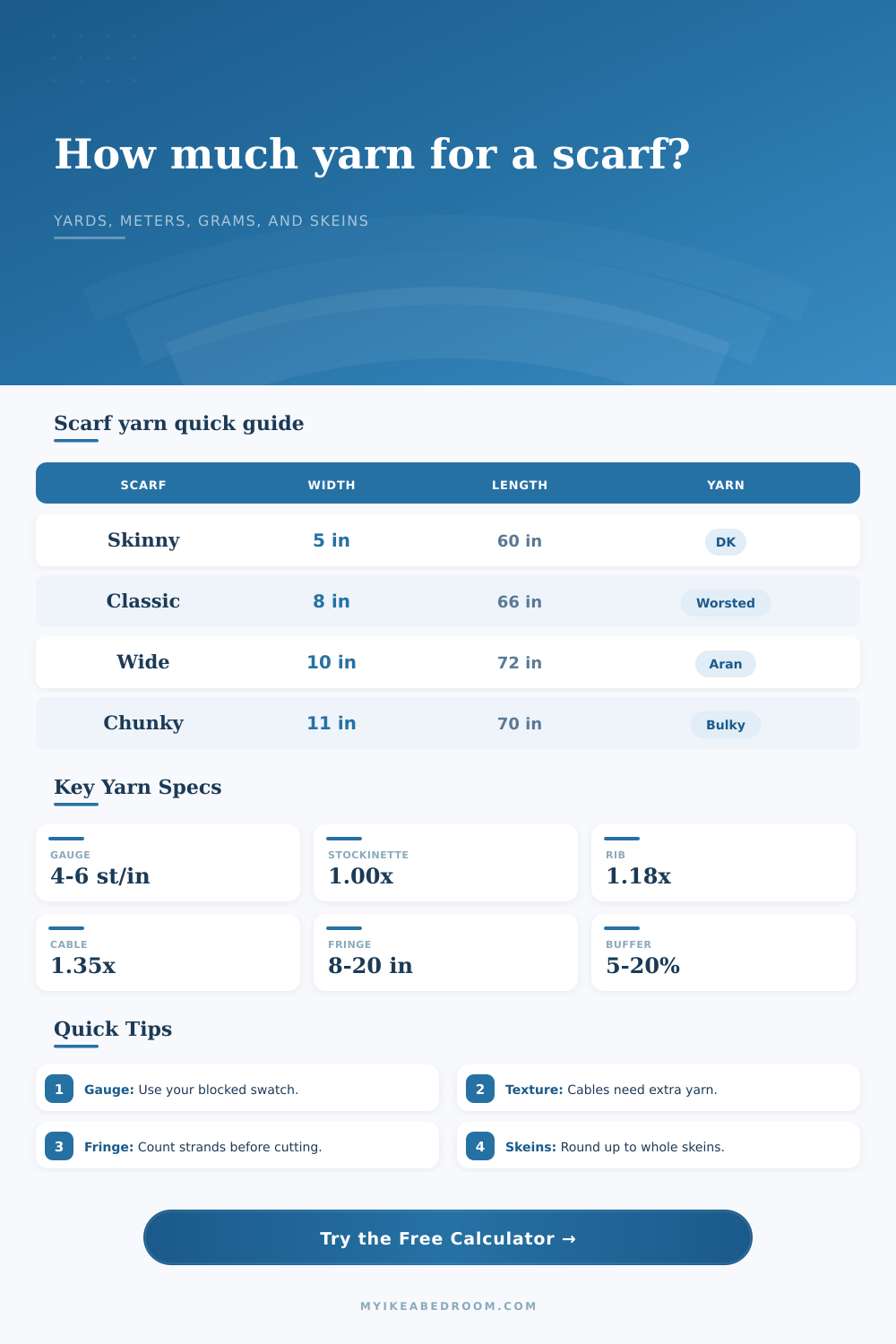
| Scarf style | Finished width | Finished length | Useful planning note |
|---|---|---|---|
| Skinny scarf | 4 to 6 in / 10 to 15 cm | 55 to 65 in / 140 to 165 cm | Small area, but narrow ribbing can still use extra yarn. |
| Classic adult scarf | 7 to 9 in / 18 to 23 cm | 60 to 72 in / 152 to 183 cm | Good default for worsted or DK yarn with a moderate buffer. |
| Wide winter scarf | 10 to 12 in / 25 to 30 cm | 68 to 78 in / 173 to 198 cm | Area rises quickly, so swatch yardage matters more than label guesses. |
| Wrap scarf | 14 to 18 in / 36 to 46 cm | 72 to 84 in / 183 to 213 cm | Plan as a shallow rectangle rather than a narrow scarf. |
| Kids scarf | 4 to 6 in / 10 to 15 cm | 36 to 50 in / 91 to 127 cm | Shorter length keeps yardage low, but fringe can be a large share. |
| Pattern type | Factor | Why yardage changes | When to raise buffer |
|---|---|---|---|
| Stockinette or plain crochet | 1.00x | Smooth fabric uses the baseline yarn length for its gauge. | Raise only if curling edges need extra border rows. |
| Garter stitch | 1.12x | Every row forms ridges, adding depth and yarn path. | Raise for very squishy fabric or oversized needles. |
| Ribbing | 1.18x | Alternating knits and purls pull the fabric inward. | Raise if the finished blocked width is uncertain. |
| Seed or moss stitch | 1.22x | Texture creates a denser surface than smooth fabric. | Raise for long scarves where row gauge may drift. |
| Cables or twisted stitches | 1.35x | Crossed stitches add yarn path and pull width inward. | Raise for large cable panels or matching end repeats. |
| Open lace | 0.82x | Yarn overs and open areas reduce fabric density. | Raise if blocking length is still unknown. |
| Dense crochet | 1.45x | Single crochet and firm hook sizes can use more yarn. | Raise when the fabric is stiff or tightly worked. |
| Yarn weight | Typical scarf gauge | Calculator factor | Estimating note |
|---|---|---|---|
| Lace | 7 to 9 stitches per inch | 0.40 yd per stitch-row unit | Fine yarn needs long yardage even when grams stay low. |
| Fingering | 6.5 to 8 stitches per inch | 0.34 yd per stitch-row unit | Best checked with a swatch because drape changes yardage. |
| Sport | 5.5 to 6.5 stitches per inch | 0.27 yd per stitch-row unit | Often used for lightweight indoor scarves. |
| DK | 5 to 6 stitches per inch | 0.22 yd per stitch-row unit | Works well for medium scarves and simple texture. |
| Worsted | 4 to 5 stitches per inch | 0.16 yd per stitch-row unit | Baseline choice for classic winter scarf math. |
| Aran | 3.5 to 4.5 stitches per inch | 0.13 yd per stitch-row unit | Often paired with cables, so pattern factor matters. |
| Bulky | 2.75 to 3.75 stitches per inch | 0.10 yd per stitch-row unit | Fast projects use fewer stitches but larger grams per yard. |
| Super bulky | 1.75 to 2.75 stitches per inch | 0.075 yd per stitch-row unit | Use a larger buffer for oversized fringe and loose ends. |
| Skein label example | Yards per gram | Grams per 100 yd | Calculator handling |
|---|---|---|---|
| 400 yd / 100 g fingering | 4.00 yd/g | 25 g | Total grams = total yards divided by yarn yards per gram. |
| 290 yd / 100 g sport | 2.90 yd/g | 34 g | Useful for lightweight scarves and small wraps. |
| 220 yd / 100 g worsted | 2.20 yd/g | 45 g | Default input for classic scarf planning. |
| 170 yd / 100 g aran | 1.70 yd/g | 59 g | Texture or cables can push a project into another skein. |
| 110 yd / 100 g bulky | 1.10 yd/g | 91 g | Short yardage per skein means rounded skein count matters. |
Use a blocked swatch: Scarf fabric stretches and relaxes. Measure the swatch after washing or steaming, then enter its area and yarn used for the most practical yardage estimate.
Separate fringe from fabric: Fringe can add a surprising amount of yarn. Count bundles across both ends and use the cut strand length before folding.
Match the stitch pattern: Ribbing, seed stitch, moss stitch, and cables consume more yarn than smooth fabric because the yarn path is longer and the fabric pulls inward.
Round by skein label: The calculator converts yards to meters and grams, then rounds skeins up from the yardage you enter so partial skeins are visible in the breakdown.
You have some time on your hands and you would realy like to wear something warm. You find a pattern that seem like it will use up two skeins, tops, maybe three at worst. You purchase your yarn. You knit for three nights and realize you are halfway through your project but already out of yarn.
Why? Because most people only estimate by length. They believe that a scarf of any given size require a certain amount of yarn. It doesn’t. A scarf is an area problem, not a linear one.
How to Calculate How Much Yarn You Need
If you plug your gauge and dimensions into the calculator above, it do the math for you. Saving you from guessing about how much additional yarn your exact stitch pattern requires. You need to understand one key thing: you are paying for width. Even if you have two panel that are both sixty inches in length, but one is very narrow while other is quite wide, the narrow piece will consume far less yardage.
In response, the tool lets you enter the number of stitches per inch (your stitch gauge), as well as how wide you’d like the final product to be. It takes all of this information and figures out exactly how many square inches of fabric you’ll end up with. That’s important because amount of yarn needed isn’t just proportional to the length between needles, it’s also proportional to actual stitches themselves. Looser knitting consumes more yarn per stitch; tighter knitting consume less. Your particular gauge connects these two sides. And thanks to it, your individual tension becomes a trustworthy estimate.
The other factor that changes the math is stitch pattern, which the reference table handles by using multipliers for different textures. Ribbing, for instance, makes the fabric tighter (it’s a denser surface area) so it takes more yarn to achieve the same amount of fabric. Then there’s cabling, which twists the direction of the yarn and therefore increases its length as it crosses over and under. The table on the page sets this all out: it assigns each texture a multiplier. Stockinette is the baseline. The garter stitch is x1.15. A cable is x1.6. Choose a complicated cable, and the tool will adjust the yardage upward automatically.
Nothing is worse than realizing halfway through a twist that your wool have run out. Keep in mind that these are averages, the numbers are estimates of tension. Depending on whether or not you work very loosely or very tightly, your results will be off a bit from the tool’s calculations.
Then there’s fringe. Fringe doesn’t stretch. Fringe doesn’t block. Fringe is pure dead weight when it comes to consuming materials. A few inch of dangling string on either end doesn’t seem like much. It is like a little extra something tacked onto the finished garment, but it add up quickly. The calculator prompts you for strands per bundle, the number of bundles, and the cut length of each strand. Then it totals it all up and adds it to the rest of your fabric yardage. For someone wanting a dramatic look with long, thick fringe, you’ve got to factor that in beforehand or you might find yourself buying out last skein. Because it separates this calculation out, you’re able to visualize exactly how much yarn goes into making it warm, rather than just looking pretty.
To make it even trickier, yarn weight matter. Bulky yarn has fewer yards per skein, but it covers more area in fewer stitches. Fingering weight have huge yardage, but it takes hundreds of stitches to cover the same area. The calculator accounts for this by having special factors for each weight class. Bulky yarn is not going to have as many yardage units per square inch as lace weight and it knows this. So you can compare apples to oranges. How many skeins do I need for a lightweight dk? How many of a heavy aran yarn? The gram conversion also helps with this because grams are more consistent measure of mass than yardage, which changes a lot depending on thickness.
Gauge. This one that many people overlook. Did you measure your swatch pre-wash? You wash your scarf and realize it has stretched out by ten percent? Your gauge may not match what you input into the calculator. I’m assuming your inputs are based off your blocked fabric. Add a bit extra if you’re not sure.
Enter the percentage error you want to account for (i.e. This includes your own errors, gauge differences, and dye lot matching. A safe bet for most scarves = ten percent. Go up to twenty percent if there will be a lot of fringe, or complicated cable patterns.
Now get knitting! Finally, a scarf is a rectangle of yarn held together by tension and hope. The amount of rectangle you have in your budget is what the math say. The calculator provides those numbers. Your swatch provides the truth. Listen to the swatch. Follow the gauge. Buy the extra skein if it’s close according to the math. You should of been glad later when you wrap up the last row and there’s some left over.