Wreath Ribbon Length Calculator
Estimate ribbon for the wreath wrap, overlap, bow loops, tails, hanger loop, accent spirals, total yards or meters, and rounded-up spool count.
Choose a common wreath setup, then adjust the ribbon width, overlap, bow, tails, and spool size to match your supplies.
Wreath ribbon estimate
The calculator combines circumference, style multiplier, overlap percent, bow loops, tails, hanger loop, accent spirals, and cutting reserve.
Formula: circumference = pi x diameter. Wrap ribbon = circumference x wrap style multiplier x (1 + overlap percent).
Bow formula: bow ribbon = loops x loop size x 2, then tails, hanger loop, accent spirals, and reserve are added before spool rounding.
Ribbon width notes appear after calculation.
Wired edge satin
Best for: crisp bows and visible loops.
Holds shape well and usually needs moderate overlap.
Velvet ribbon
Best for: plush holiday wreaths.
Looks full, but add reserve because it can crush at knots.
Burlap ribbon
Best for: farmhouse and natural wreaths.
Wide burlap covers quickly but frayed ends need extra trim.
Organza ribbon
Best for: translucent accent spirals.
Use higher overlap when the wreath base should stay hidden.
Grosgrain ribbon
Best for: small wreaths and neat tails.
Stable texture makes bow loops easy to size consistently.
Decorative mesh
Best for: high-volume wraps.
Use full coverage or double pass settings for a dense look.
Plaid cotton
Best for: casual seasonal wreaths.
Align pattern repeats before cutting tails or hanger loops.
Jute cord
Best for: hanger loops and rustic accents.
Pair with a wider bow ribbon instead of full wrapping.
| Wrap style | Multiplier | Best use | Overlap guidance |
|---|---|---|---|
| Flat face band | 1.00x circumference | One visible ribbon ring around the front face | Use 5-15% if ends meet under a bow |
| Loose diagonal wrap | 1.25x circumference | Open greenery or grapevine showing between bands | Use 10-20% for tidy spacing |
| Diagonal barber pole | 1.45x circumference | Balanced door wreath with even ribbon rhythm | Use 15-25% for most wired ribbon |
| Full coverage wrap | 1.85x circumference | Foam or straw base that should be hidden | Use 20-35% for clean coverage |
| Double pass spiral | 2.25x circumference | Two-color spiral, mesh layer, or very full wrap | Use 15-30%, then add reserve |
| Scenario | Typical diameter | Wrap and bow setup | Planning range |
|---|---|---|---|
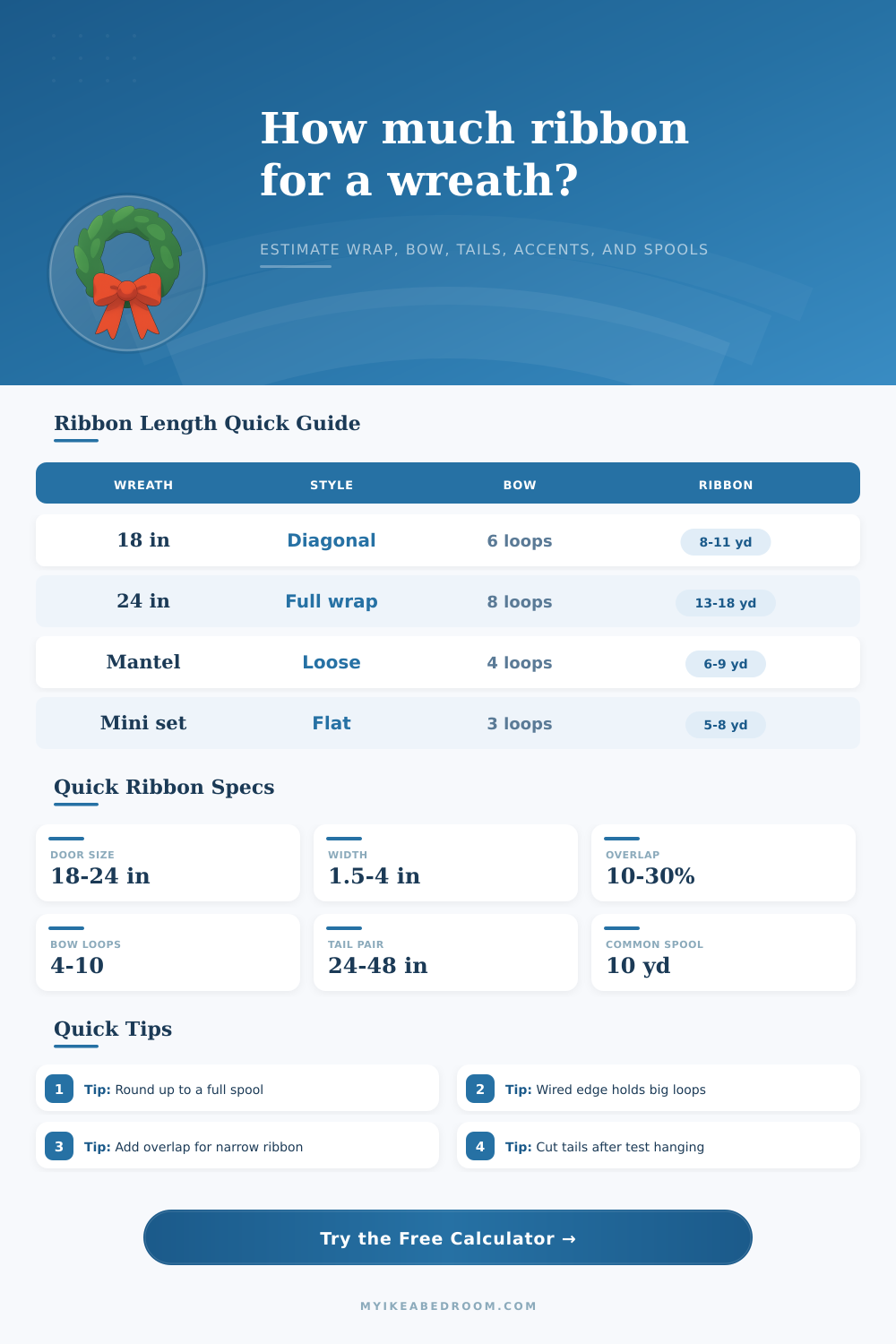
| 18 in door wreath | 18 in / 46 cm | Diagonal wrap, 6 loops, 18 in tails | About 10-12 yd / 9-11 m |
| 24 in holiday wreath | 24 in / 61 cm | Full coverage, 8 loops, accents | About 17-20 yd / 16-18 m |
| Mantel wreath | 16 in / 41 cm | Loose wrap, 4 loops, short tails | About 7-9 yd / 6-8 m |
| Mini wreath set | 10 in / 25 cm each | Flat band, 3 loops, no hanger ribbon | About 5-8 yd / 5-7 m per small set |
| Bow-heavy wreath | 22 in / 56 cm | Diagonal wrap, 12 loops, long tails | About 17-22 yd / 16-20 m |
| Bow style | Loop count | Loop size | Ribbon before tails |
|---|---|---|---|
| Simple bow | 2-4 loops | 3-5 in / 8-13 cm | About 1-2 yd / 1-2 m |
| Classic wreath bow | 6-8 loops | 4-6 in / 10-15 cm | About 2-3 yd / 2-3 m |
| Statement bow | 10-12 loops | 5-7 in / 13-18 cm | About 3-5 yd / 3-5 m |
| Layered bow | 12-16 loops | 4-7 in / 10-18 cm | About 4-6 yd / 4-5 m |
| Spool label | Metric equivalent | Good for | Leftover note |
|---|---|---|---|
| 3 yd spool | 2.74 m | Small bows, short tails, hanger loops | Buy multiples for wraps |
| 5 yd spool | 4.57 m | Mini wreaths or accent spirals | Useful second color length |
| 10 yd spool | 9.14 m | Common 18 in wreath projects | Often enough for simple wraps |
| 25 yd roll | 22.86 m | Large wreaths, sets, or bow-heavy work | Best when matching ribbon later matters |
There’s a certain sort of panic that sets in when you’re standing in front of your wreath, holding a half-used spool of ribbon up to look for more material, only to discover that there is none. The tail is awkwardly short by two inches and the bow is lopsided. And then you remember that you got the roll you have now from another store on a different day… last Tuesday.
Until you attempt to save a project with too little ribbon, measuring twice and buying three seems like overkill. Plan ahead; don’t let yourself get into the empty spool predicament ever again. You can usually estimate the circumference of the base, add some buffer room, and go from there.
How to Get Enough Ribbon for Your Wreath
But that is probably why most people gets this wrong. They do not account for the fact that the ribbon is going to travel across the form in a curved line, rather than just going straight across the front like a band would. Diagonally-wrapped ribbons (sometimes referred to as “barber pole” wraps) will be much longer, especially when measured along there actual route.
To help you not think about all that spiraling yourself, I’ve built a calculator above, which knows the size of your wreath and multiplies accordingly depending on how tightly or loosely you want to wrap it. Knowing the differences between an accent piece (diagonal line) and a full coverage wrap (covers all your greenery) will save you the hassle of purchasing 10 yards where you really just needed 6, or 6 yards where you actualy needed 12.
Most estimators fail when it comes to the bow section (or at least mine does), because the amount of ribbon needed for a loop is not the same as its visual size. For instance, a finished loop of five inches typically use about ten inches of ribbon. This is because you have to include the part folded back to the center knot. Eight large loops will use up a lot of ribbon before you even add the tail ends!
This calculator simplifies things by asking how many loops you’d like and what size they should be. It then figures out how much material goes into just the decor. It also has separate fields for the hanger loop and accent spirals, since these components is different from the rest of it. That way you can better visualize which component of your design is costing you all that ribbon.
The way the material behaves will also influence your margin for error; for example, wired satin keeps its form excellently, so a ten percent overlap may be enough to mask the base underneath. But burlap frays, so it cannot be cut precisely to size. Velvet crushes badly at the knot, so you have to add more fabric to get the total effect instead of having empty space in between. There’s a chart in the page that makes it clear… Some fabrics require a wider margin for error than others! It’s less about length and more about behavior.
If I have a slippery ribbon, it’ll slip off the pin quicker then a stiff grosgrain does. I’d need to re-pin it more often, which could lead to wasting more fabric if my stitch estimate was wrong.
Also don’t forget to round up to the nearest complete spool, and if you’re thinking you’ll need nine yards and each of your spools is ten yards, order two; why? Because no matter what brand, there will be slight variations between dye lots. What looks like the exact same color on the shelf might end up being just slightly lighter or darker in the store light. Matching a leftover yard from one roll to a new roll later on is a surefire way to make a mistake. Having a little extra for future projects is much better than staring at a mismatched repair.
Width of ribbon is also important (obviously): Narrow ribbons give precise results but take longer to make a bow; wide ones wrap up an area faster but are less easy to wriggle through a tiny knot. It’s worth noting that a three-inch wrap is fundamentally different than a one-and-a-half-inch accent… The calculator will adapt its suggestions accordingly.
It provides the overall total in both meters and yards, so you have something concrete to match against your local craft store purchases. It doesn’t take 5 minutes to plan and save an hour of stress later. Measure the diameter of your wreath and plan out how dense you want your wrapping to be. Decide what kind of bow you want to add. Figure that out before you cut anything!
Once you figure out which factors really impact cost, the math becomes easy. Once you add up the total, pick up the extra spool just in case. When you tie that last knot and have plenty of ribbon leftover for a little label or tag, you’ll be thankful you did. There won’t be any more mismatched rolls or panic; instead, you’ll just have a complete wreath that’s exactly like you imagined from the beginning.