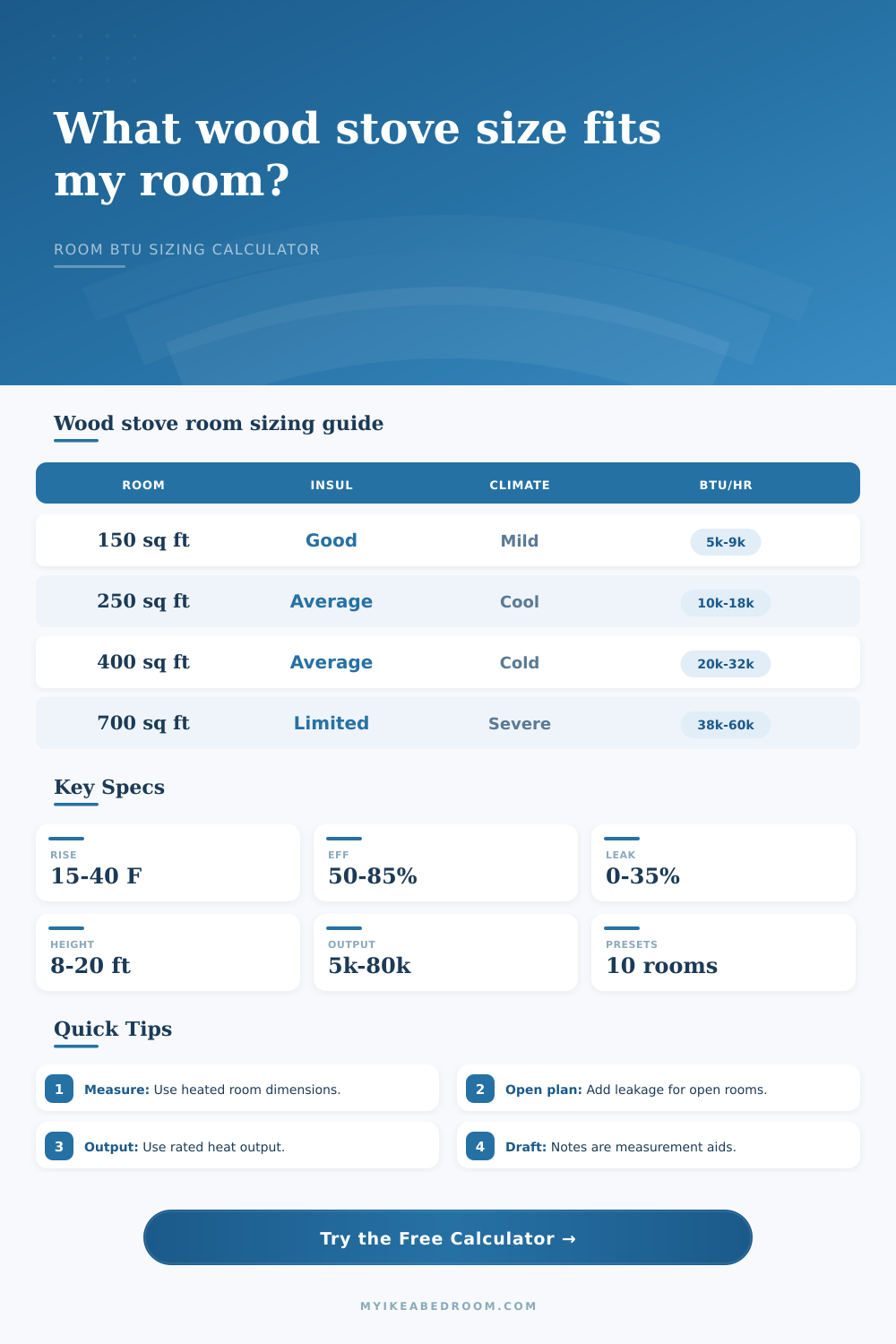
Wood Stove Size for Room Calculator
Estimate room heat load, useful BTU output range, stove clearance footprint, and chimney draft measurement notes from the room size, insulation, climate, leakage, efficiency, and temperature rise.
Pick the closest heated space, then adjust dimensions, insulation, climate severity, desired temperature rise, stove efficiency, clearances, and draft measurements.
Wood stove sizing result
| Condition | Multiplier | Typical room clues | Calculator field |
|---|---|---|---|
| Excellent envelope | 0.72 | Air sealed, modern windows, insulated roof | Insulation level |
| Good envelope | 0.85 | Insulated walls, modest drafts, normal ceiling | Insulation level |
| Average envelope | 1.00 | Mixed upgrades, some older windows or gaps | Insulation level |
| Limited envelope | 1.22 | Thin insulation, drafty trim, cooler floors | Insulation level |
| Poor envelope | 1.45 | Uninsulated surfaces or strong air movement | Insulation level |
| Open plan | 10-35% | Stairs, wide openings, connected halls | Leakage buffer |
| Climate option | Multiplier | Common design condition | Typical sizing effect |
|---|---|---|---|
| Mild winter | 0.85 | Light overnight freezes | Reduces calculated load |
| Cool winter | 1.00 | Regular cold nights | Baseline calculation |
| Cold winter | 1.18 | Long freezing periods | Raises output band |
| Severe winter | 1.38 | Deep cold snaps | Needs stronger reserve |
| Exposed site | 1.55 | Mountain, rural, windy location | Highest room load factor |
| Useful output band | Approx kW | Room volume clue | Sizing comment |
|---|---|---|---|
| 5,000-10,000 BTU/hr | 1.5-2.9 kW | Small tight room | Low load spaces |
| 10,000-20,000 BTU/hr | 2.9-5.9 kW | Bedroom or small den | Compact stove range |
| 20,000-35,000 BTU/hr | 5.9-10.3 kW | Living room zone | Medium stove range |
| 35,000-55,000 BTU/hr | 10.3-16.1 kW | Large open zone | Large stove range |
| 55,000+ BTU/hr | 16.1+ kW | Great room or workshop | High output range |
| Measurement | Used for | Strong reading | Watch reading |
|---|---|---|---|
| Side clearance | Footprint width | Matches listed value | Unknown label value |
| Rear clearance | Footprint depth | Matches listed value | Unmeasured rear space |
| Vertical flue height | Draft note | 15 ft or higher | Below 12 ft |
| Horizontal connector | Draft note | Under 25% of height | Long horizontal run |
| Elbow count | Draft note | 0-2 elbows | 4 or more elbows |
| Flue diameter | Draft note | Matches collar | Unconfirmed diameter |
Instead of considering just the size of the firebox, you want to pick out a wood stove based off the amount of heat that your space requires. While bigger isn’t necessarily better, it’s also true that if your stove are wrongly sized, the room can feel like a sauna one hour and a freezer the next. Size matters, but it is not about aesthetics; it is about thermodynamics.
The size need to match the heat required for the volume of air in the room while also considering amount of heat loss. The math starts with geometry, but has to adjusts for real-world situations. Because different buildings lose heat differently, just looking at volume won’t tell you much about how comfortable it will be. A big, well-insulated space loses less heat then a little poorly insulated one does.
How to Pick the Right Wood Stove
To make the math, the calculator above factor in your room’s cubic footage, plus a multiplier for climate and another for insulation. The tighter your house envelope or if you’re in a milder climate, the lower your heat load. If you are heating an old leaky cabin, a bigger volume take longer to warm up.
It’s also worth taking into account open-plan loss: Hallways and kitchens are all connected spaces which will draw heat into them making it harder for the stove to maintain warmth in main room. To take this into account, you can input a percentage of buffer air flow into the tool. This will alter its recommended output range, stopping you getting a stove which isn’t powerful enough for your space.
The label efficiency ratings is deceptive. Just because a stove has a high input doesn’t mean it outputs much heat. If a stove is only fifty percent efficient, half that heat goes up the chimney. If it’s not, half goes up the chimney. The calculator lets you compare input heat to delivered room heat so you know how much heat it gives off versus how much fuel it burns.
So you don’t get tricked into buying too big or small. Too small: It won’t warm your house but will burn full bore. Too big: It’ll burn too hot, waste fuel and make creosote.
Planning footprints are important too. Total protected areas (clearance from floors and walls) must be known. Use this reference table showing the square-footage of space that should of been kept free for a safe install. Just because you have a stove that will heat the room doesn’t mean it fits into your floor plan!
The last variable is chimney draft. Does the stove pull in enough air? How high is the chimney? What’s the horizontal run length? How many elbows does the path has? Inefficient burning and smoke spillage can result from poor draft. The tool tells you about your flue configuration with notes that call out potential problems before purchase. It isn’t meant to replace a pro inspection, though it just flags any obvious design flaws.
The trick to selecting a suitable wood stove is managing these competing factors. You have to balance different needs such as efficiency against heat output and physical size against the required safety clearances. Once you have the fundamentals dialed in, it’s up to the fire itself to do the heavy lifting. The goal is a stove that heats the house steadily overnight during cold nights, staying fed and attended to only enough to stay warm.