Wood Movement Calculator
Estimate solid wood expansion and shrinkage from moisture change, grain direction, board width, panel construction, and clearance allowance.
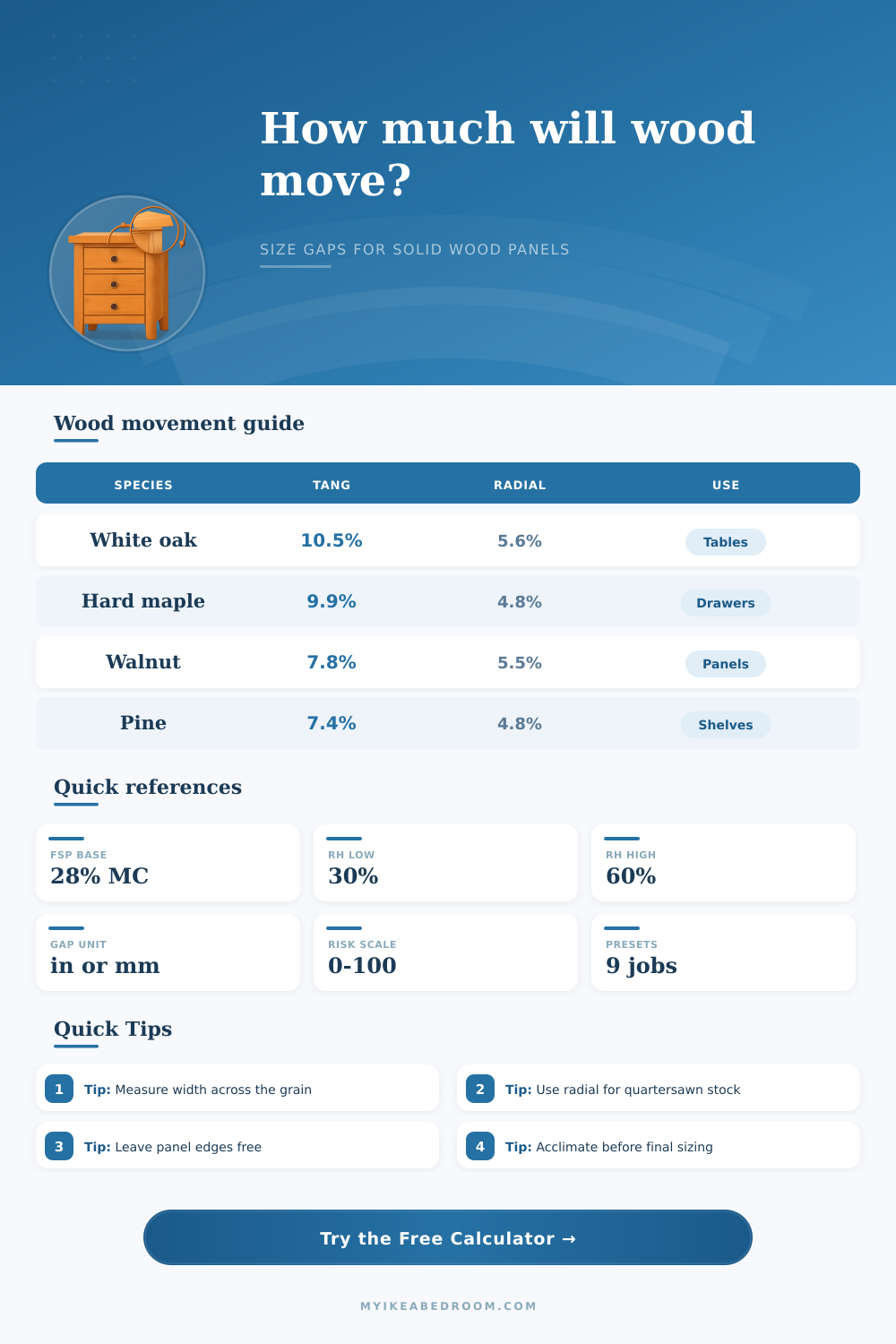
| Species | Tangential | Radial | T/R ratio | Typical furniture use |
|---|
| Direction | Model factor | Best use | Movement habit | Design note |
|---|---|---|---|---|
| Flat sawn | 90% tangential | Wide tabletops | Largest seasonal swing | Needs the most gap |
| Rift sawn | 60% tangential + 40% radial | Legs, fronts, rails | Moderate and predictable | Balanced visual grain |
| Quarter sawn | 80% radial | Doors and panels | Smaller width change | Good for tighter frames |
| Known tangent/radial | Direct coefficient | Measured stock | Uses selected axis | Best when grain is clear |
| Indoor RH | Approx. EMC | Seasonal read | Furniture concern | Planning response |
|---|---|---|---|---|
| 25% | 5.0% | Dry winter room | Shrinkage and gaps | Avoid tight capture |
| 35% | 6.9% | Conditioned interior | Stable for many homes | Size after acclimation |
| 50% | 9.2% | Moderate humid room | Noticeable expansion | Leave edge space |
| 65% | 12.0% | Humid season | Panel pressure rises | Increase float gap |
| 80% | 16.0% | Damp area | High movement risk | Use stable construction |
| Panel type | Movement freedom | Risk modifier | Use case | Watch point |
|---|---|---|---|---|
| Free board | High | 0.85x | Tabletop, loose shelf | Allow at fasteners |
| Floating panel | Good | 0.95x | Frame-and-panel door | Do not glue edges |
| Drawer or door front | Moderate | 1.05x | Applied fronts | Leave reveal room |
| Breadboard top | Partial | 1.18x | Dining or work top | Pin only at center |
| Captured in groove | Limited | 1.35x | Cabinet side panel | Gap can disappear |
| Cross-grain fixed | Poor | 1.70x | Risky repairs | Can split or buckle |
Wood will move because of the properties of wood to absorb or release moisture from an air around it. When wood absorbs moisture, the wood expand. When wood releases moisture, the wood shrink.
Wood continuously move due to these properties of the material, and such movement occurs throughout the years. Therefore, it is important to understand how wood movement can impact the project that you are creating. Such as causing gaps in the tabletop or causing the drawer front to become stuck in it’s frame.
How Wood Moves and What to Do
The amount of movement that will occur in the wood are dependent upon the width of the board. The wider the board, the more that the wood will move. The movement will be significant across the width of the board, but not significant across the length of the board.
Thus, it is important to consider the width of the boards that you are to be used in the project. The amount of movement that can occur with the wood is also dependent upon other factors, such as the species of the wood, the grain of the wood, and the moisture content of the wood. Each different species of wood will have a different movement rate.
For instance, white oak will move more than mahogany, and maple will move a different amount than pine. Thus, it is important to consider the species of the wood that you will use in the project. When using the calculator, it is possible to select the species of the wood that will be used in the project, which allows the calculator to determine the amount of movement that will occur.
The grain of the sawn wood can also impact the movement of the wood. Flat sawn wood will move more than quarter sawn wood. Flat sawn wood expand in the tangential direction, but quarter sawn wood expand in the radial direction.
Thus, it is important to consider the grain in which the wood will be sawn. In the calculator, you can also manipulate this setting to reflect the true movement of the wood that will be used. Wood will move as a result of changes in the moisture content of the wood.
As the moisture content in the wood increases, the wood will expand. As the moisture content of the wood decreases, the wood will shrink. Changes in the humidity of the air around the wood cause changes in the moisture content of the wood.
Thus, it is important to enter either the moisture content range of the wood or the relative humidity of the area in which the wood will be used. Each of these value can be entered into the calculator to determine how much the wood will move. The way in which you construct the project will also impact how the movement of the wood impact the project.
For instance, a tabletop that is allowed to expand and contract will have fewer movement related problems than a tabletop that is not allowed to move. Similarly, a floating panel will allow the panel to move more than a panel that is trapped in a groove. Thus, it is important to understand how much risk there is with the construction methods that you will use in the project.
The calculator can calculate this risk for the project. The information that the calculator will provide will include the amount of extra gap that should be provided in the project to account for the movement of the wood, as well as a joinery risk score. The extra gap that should be provided is used to ensure that the movement of the wood will not cause any damage to the project.
The joinery risk score will indicate whether or not the methods that you will use in the project are at risk of allowing the wood to move in a way that will cause damage to the project. It is important to remember that the wood will continue to exchange moisture with the air throughout the year. Thus, the moisture content in the wood will change with the changing moisture content in the air throughout the year in the home.
By calculating and understanding the amount that the wood will move, it is possible to account for this movement. Thus, the calculator can help woodworking professional avoid issues like split panels and stuck drawers. The goal is not to prevent the wood movement from occurring, but to ensure that the movement will not cause any damage to the furnitures that is created out of that wood.