
Wood can be damaged by dents or scratch. Wood can be damaged by dropping a hard object onto the wood or by using a vacuum cleaner on the wood’s surface. Many people selects wood based upon the color of the wood or the grain of the wood.
However, selecting wood based upon the color or grain of the wood are not always the most best method for ensuring the woods durability. Instead, you must understand the physical resistance of the wood in order to ensure that the wood remains in good condition. One tool for understanding the physical resistance of the wood is a Janka scale.
How to Choose Wood for Your Home
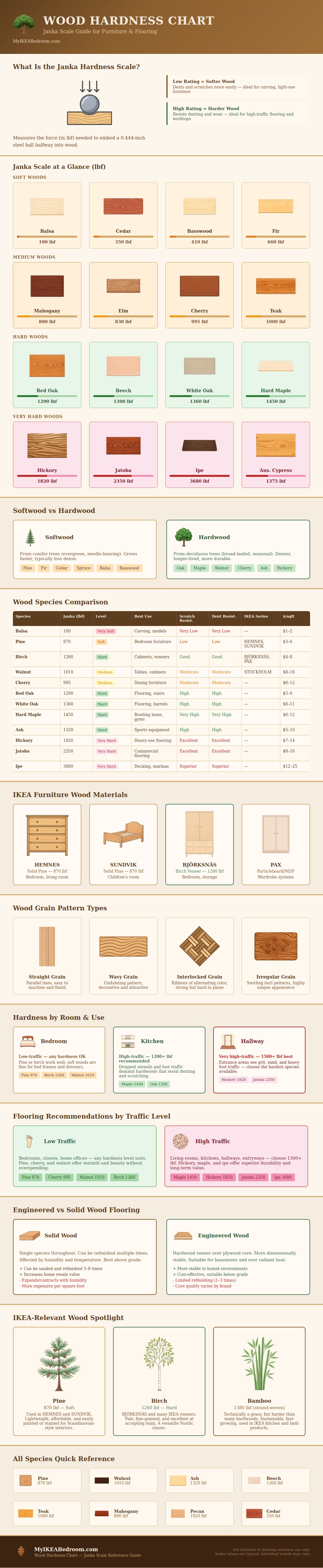
The Janka scale rates the force in pounds that is required to push a steel ball halfway into a piece of wood. The resulting rating of the wood will allow the individual to determine if the wood will resist dents from pets or if it will resist rings from liquid. There is a distinction between hardwoods and softwoods.
However, botany rather than the physical properties of the wood based off the distinction. Softwoods is derived from conifer trees and often grow quick, thus they are often used in the manufacture of affordable furnitures. Hardwoods are derived from deciduous trees that has broad leaves.
Hardwoods are generally denser and last longer than softwoods. However, because this classification is based upon botanical elements, some hardwoods may be softer than some softwoods. Thus, you should use the Janka scale to determine the actual hardness of the wood that is to be purchase.
When selecting wood for areas in a home that experience little traffic, there are many option for wood species to be used. For instance, guest bedrooms may feature pine wood, which is relatively affordable. Because pine is a soft wood, it will dent more easy than hardwoods.
However, the denticity of pine is unlikely to be a concern in the guest bedroom. However, in areas of the home that experience high traffic, such as kitchens or hallways, it is important to use woods that are highly resistant to grit and heavy foot traffic. Thus, woods such as soft woods will not be as suitable for placement in a high-traffic area such as a hallway.
For instance, woods such as Hard Maple and Hickory have high ratings on the Janka scale and would be good choice for placement in a hallway or another area of the home that will experience heavy foot traffic. In addition to the Janka scale and the type of hardwood or softwood that is selected for an area of the home, the grain of the wood should be considered. For instance, some type of wood have straight grains while other woods has grains that is wavy or interlocked.
Those with interlocked grains are generally the strongest type of wood but may be more difficult to sand if the wood is planed. Finally, another consideration is the difference between solid wood and engineered wood. Solid woods can be sanded numerous times to refinish the area of solid wood but may expand and contract in response to change in humidity levels.
Engineered wood features a layer of hardwood veneer over a core of plywood so engineered woods is more stable in damp areas of the home, such as basements. Thus, engineered woods may not last as long as solid woods if the woods are to be sanded multiple times, but they are more stable in areas that experience changes in humidity. Thus, by checking the Janka scale ratings of a type of wood, an individual can ensure that the wood that they purchase will be appropriate to the room in which it will be use.
