Wood Blind Slat Quantity Calculator
Estimate horizontal wood blind slat rows, spare slats, cut length, ladder tape positions, and stock strip requirements for one blind or a matched room set.
🏠Real Window Presets
📏Blind Slat Inputs
🪵Slat Profile Comparison
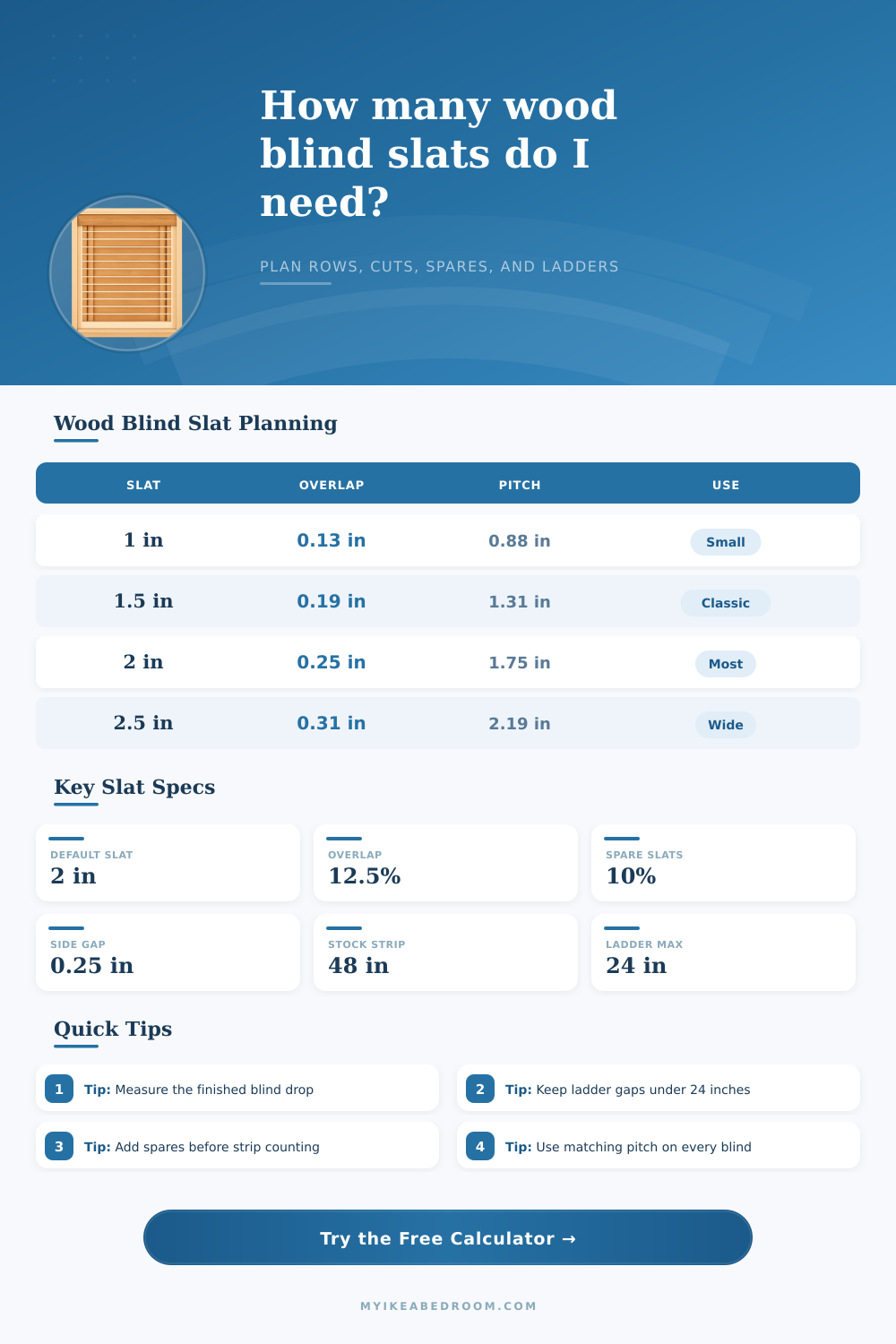
📊Slat Pitch Reference
| Nominal slat width | Typical closed overlap | Working pitch | Approx rows per 60 in drop |
|---|---|---|---|
| 1 in wood slat | 0.125 in, 3.2 mm | 0.875 in, 22.2 mm | 65 to 68 rows after rails |
| 1.5 in wood slat | 0.1875 in, 4.8 mm | 1.3125 in, 33.3 mm | 43 to 46 rows after rails |
| 2 in wood slat | 0.25 in, 6.4 mm | 1.75 in, 44.5 mm | 32 to 35 rows after rails |
| 2.5 in wood slat | 0.3125 in, 7.9 mm | 2.1875 in, 55.6 mm | 26 to 28 rows after rails |
✂Stock Strip Conversion
| Stock strip length | 24 in blind | 34 in blind | 48 in blind |
|---|---|---|---|
| 36 in strip | 1 slat per strip | 1 slat per strip | Not long enough |
| 48 in strip | 1 slat per strip | 1 slat per strip | 1 slat per strip |
| 72 in strip | 2 slats per strip | 2 slats per strip | 1 slat per strip |
| 96 in strip | 3 slats per strip | 2 slats per strip | 1 slat per strip |
🧵Ladder Tape and Cord Spacing
| Finished blind width | Recommended ladders | Typical spacing | Slat drilling note |
|---|---|---|---|
| Up to 30 in, 76 cm | 2 ladders | About 12 to 18 in apart | Keep holes centered in the slat length |
| 31 to 48 in, 79 to 122 cm | 3 ladders | About 14 to 20 in apart | Place center ladder on the midpoint |
| 49 to 72 in, 124 to 183 cm | 4 ladders | About 16 to 22 in apart | Use equal spacing from both ends |
| Over 72 in, 183 cm | 5 or more ladders | Keep gaps below 24 in | Add support before increasing slat length |
🖼Common Bedroom Window Sets
| Window set | Finished size | 2 in slat rows | Good spare allowance |
|---|---|---|---|
| Single bedroom window | 34 x 64 in | 36 rows per blind | 4 spare slats |
| Paired front windows | 2 blinds, 31 x 72 in | 80 rows total | 8 spare slats |
| Three-panel bay | 3 blinds, 28 x 58 in | 99 rows total | 10 spare slats |
| Patio door side lights | 2 blinds, 36 x 84 in | 94 rows total | 10 spare slats |
💡Slat Planning Notes
Planning a wood blind project require that you determine the total number of slats that will fit between the headrail and the bottom rail. The number of slats required will depend upon the size of the window in which the blinds will be installed, the width of each slat, and the amount of overlap between each of those slats. Furthermore, the amount of overlap between the slats will help to determine the pitch of the blinds, which will, in turn, determine the total row count of the slats.
If either the pitch or the row count of the blinds are incorrect, the blinds will either appear too open, or they will fail to fully close. Thus, calculating the quantity of slats that is necessary for the project is one of the first steps that must be taken in the planning of the project. Determining the total number of rows of slats that will be required for the project requires that you distinguish between the drop of the window and the visible drop of the window.
How to Count and Plan Slats for Wood Blinds
Each of the headrail and bottom rail will claim some of the height of the window in which the blinds will be installed. Thus, you will need to subtract the thickness of the headrail and the height of the bottom rail from the total drop measurement to determine the visible drop of the window. After determining the visible drop of the window, you can divide the visible drop by the effective pitch of the blinds (that determined by the width of the slat and the overlap of those slats).
Multiplying the results of this division by the number of slats per row will help to determine the total number of rows of slats that is required to cover the visible drop of the window. Because mathematical calculations often result in fractions of slats, it is recommended to add one extra row of slats to the total row count to ensure that the blinds will properly fit into the window. This total row count will be provided to you in the calculator to save you from performing these calculations manualy.
It is also important to provide for spare slats in the blind project. Wood blinds are susceptible to damage from bumping against the blinds, for example. Furthermore, blinds has cords that can become entangled.
Should any one of the slats of a blind be damaged, that set of blinds becomes unusable until you can replace the damaged slat. To avoid this type of delay in the completion of the blinds, it is common for customers to order a percentage of spare slats to incorporate into the project. Thus, providing for spare slats will help to avoid delays in the project, whether that project involves one or many window.
The cut length of the slats is not the same as the finished width of the wood blinds. The slat needs to be cut to allow for side clearance on each end of the slat to avoid interference between the slat and the window jamb. Additionally, you must cut the slat to allow for sanding of the end of the slat to create a smooth edge.
Thus, the cut length of the slat will be the length of each slat that is cut from the stock strips. If the stock strips are shorter than the required cut length of the slat, the entire strip of stock wood will be wasted. The calculator accounts for this relationship between the cut length of the slat and the length of the stock strips so that you are aware of the size of the wood stock required for the project.
The distance between the ladders can affect the ease with which the blinds will open and close, as well as the type of slat widths that can be utilized in the blinds. Blinds that are relatively narrow can have two ladders of slats, for example. However, blinds that are relatively wide require more ladder.
Furthermore, the distance between each of the ladders should not be more than two feet in distance to ensure that the blinds will remain even when opened. The distance between the ladders will affect the locations at which you will drill holes into each slat. The calculator will determine and report the number of ladders that will be required in the blinds, as well as the distance between each of those ladders.
The yield of stock strips can be determined by dividing the length of each strip of stock wood by the length of each slat that will be cut from the stock strips. The result of this division will indicate how many slats can be cut from each strip of stock. The remainder of this division will be the amount of stock that is wasted when cutting the slats.
If the length of the stock strips is too short, you will need to purchase more stock than the total number of slats that will be produced. The calculator will determine the number of stock strips that will be required, as well as the amount of length that will be wasted in cutting the slats. The profiles of the slats can alter the pitch and row count of the blinds.
If the slats are relatively narrow, there will be a relatively high pitch between rows of slats, which will result in the slats having a relatively high row count within the drop of the window. If the slats are relatively wide in width, however, there will be a relatively low pitch between the rows of slats, which will result in fewer rows of slats required for the blinds to cover the drop. Furthermore, wider slats will require stronger ladders to support the weight of the slats.
However, regardless of the profile of the slats, the percentage of the slats that are to overlap with the next row of slats will always be the same. The profile of the slats will impact the appearance of the blinds, as well as the total number of slats that is required to complete the project. The mount style for the blinds will impact the amount of side clearance that is required for the blinds.
If you are to mount the blinds on both sides of the window (an inside mount), then side clearance is required at each end of the blind. If you are to mount the blinds outside of the window (outside mount), then side clearance is not required. However, if you are to mount the blinds on a door or bay panel, additional side clearance will be required to account for the movement of the door.
The calculator will automatically adjust the side clearance according to the mount style that you select for your blinds. As with all windows, real windows are rarely rectangular in shape. Furthermore, many windows has trim that increases the complexity of the drop that will be created by the blinds.
Additionally, the jamb of the window may not be even. Thus, to avoid potentially damaging the blinds during installation, it is recommended to measure the drop of the window with the headrail and bottom rail in place. The tables within the blind calculator provide information regarding the relationship between the width of the slats, the percentage of those slats that overlap with the next row of slats, and the pitch of the blinds.
These tables provide information regarding the number of rows of slats that will fit into various drop heights of the windows once the height of the headrail and bottom rail are accounted for. These numbers can help you to plan the blinds for your project, but the calculator provides a more precise count of the total number of slats that will be required for the project. By performing these various calculations with the blinds project, you will have an idea of the total number of finished slats that will be required, the number of spare slats that will be required, and the total number of stock strips that will be required for the project.