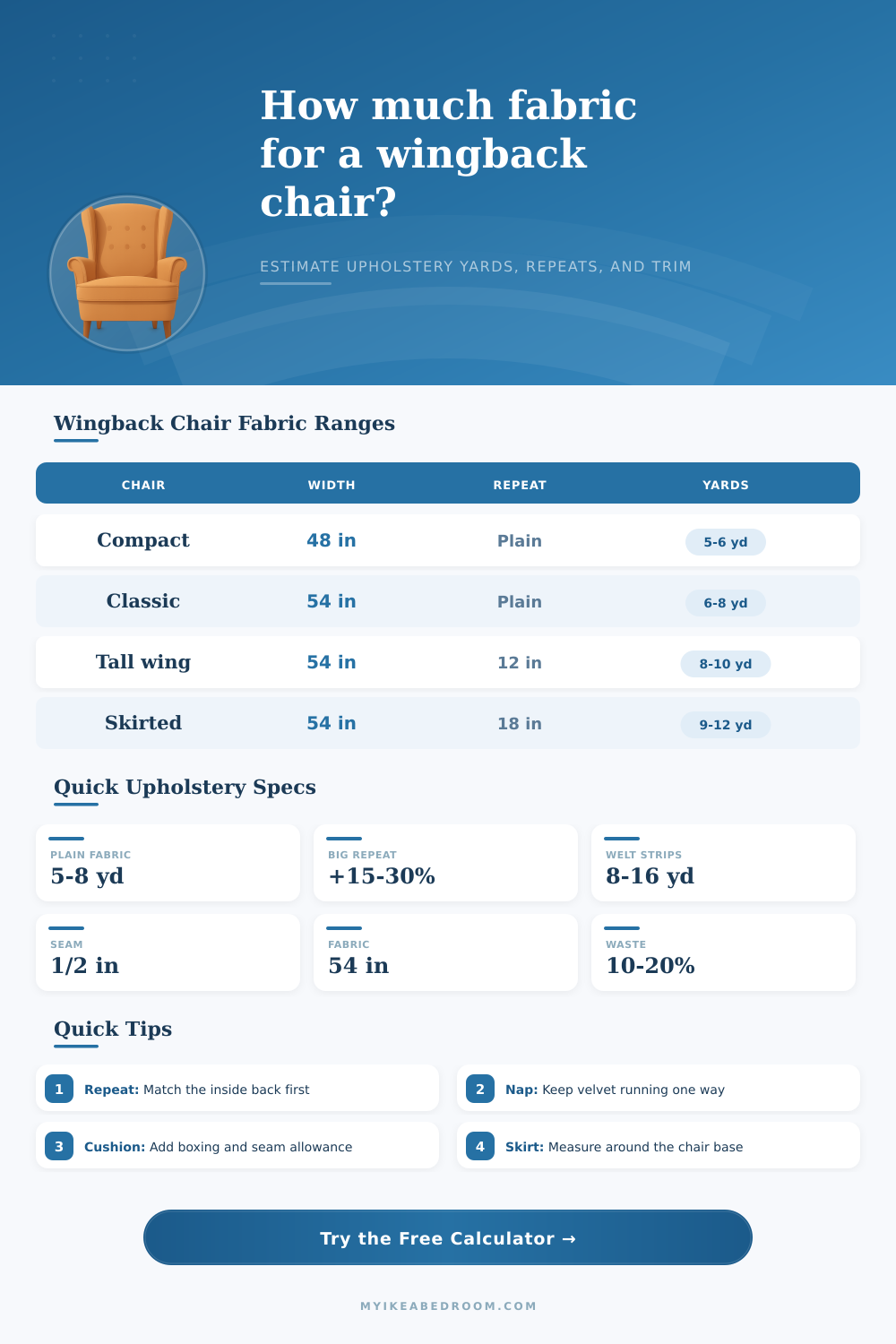
Upholstery yardage, repeat, and trim planner
Wingback Chair Fabric Calculator
Estimate fabric for the inside back, outside back, wings, arms, seat cushions, skirt panels, welt cord strips, pattern-repeat matching, and roll layout before cutting into upholstery cloth.
| Panel group | What it includes | Common cutting direction | Planning note |
|---|---|---|---|
| Inside back | Main visible back panel above the seat | Vertical | Center large motifs here before cutting wings or arms. |
| Outside back | Rear panel wrapping over the crest and shoulders | Vertical | Add extra height when the back rolls over at the top. |
| Wings | Inside and outside faces of the left and right wings | Vertical | Deep wings can consume nearly as much as the inside back. |
| Arms and apron | Outside arms, inside arm faces, and front rail | Mixed | Small pieces may nest beside cushion or back panels. |
| Cushion | Top, bottom, boxing, zipper flap, and pull-under | Front-to-back | Boxed cushions need perimeter length, not just top area. |
| Fabric width | Best use | Layout effect | Watch point |
|---|---|---|---|
| 45 in decorator fabric | Small chairs and plain fabrics | Fewer panels fit side by side | Expect more roll length for wings and arms. |
| 54 in upholstery fabric | Most wingback chairs | Often fits one back plus narrow nested pieces | Common quoted yardages assume this width. |
| 58 to 60 in wide fabric | Oversized seats or broad outside backs | Can reduce rows on wide panels | Confirm usable width after selvage removal. |
| Railroaded fabric | Skirts, long boxing, and broad runs | Pattern runs across the roll | Only use if nap and pattern direction suit the chair. |
| Repeat size | Extra fabric range | Where to match first | Practical rule |
|---|---|---|---|
| No repeat or texture | 0 to 10 percent | Not required | Use normal waste for seams, pull, and trimming. |
| Small repeat under 6 in | 5 to 15 percent | Inside back and cushion | Small motifs usually nest well around arms. |
| Medium repeat 6 to 14 in | 12 to 25 percent | Inside back, cushion, wings | Snap major drops to the next full repeat. |
| Large repeat over 14 in | 20 to 35 percent | Inside back and outside back | Buy enough to place the main motif intentionally. |
| Chair scenario | Typical fabric | Skirt or welt | Common total |
|---|---|---|---|
| Compact reading chair | 45 to 54 in plain weave | Cushion welt only | 5 to 6.5 yd |
| Classic STRANDMON-style wing chair | 54 in upholstery cloth | Standard welt | 6.5 to 8 yd |
| Tall library wingback | 54 in velvet or matelasse | Full welt | 8 to 10 yd |
| Skirted slipcover wingback | 54 in washable fabric | Long skirt | 9 to 12 yd |
| Wing chair plus ottoman | 54 to 60 in upholstery cloth | Standard welt | 8.5 to 11 yd |
Unless you learn how to do it right the first time, buying fabric for a wingback chair is a game of guesswork with no learning from mistakes. If you’ve ever tried to buy fabric for a wingback chair, you know that initial effort will result in an error: too much fabric, or more likely, wasted fabric because you ordered too little. Why? Because wingbacks is not simple rectangular shapes. They’re curvy. Those curves mean they also needs extra fabric for the wings, the cushions, and seams hidden inside the frame.
What’s the solution? How do you translate your curved measurements into yardage needed before you shop for fabric? With this calculator (above) all you do is input measurement of your chairs and it will do the math for you. No need to try and picture in your head what a round surface looks like with fabric wrapped on it. It separates out each cushion, wing, and body panel. That way you can get an idea of which areas uses most of the fabric.
How to Measure Fabric for Your Wingback Chair
You might think seat consumes the most fabric. Nope. Wings and back use most of the roll because they’re wide and tall. Most times, full cuts is needed that can’t be pieced together with other small piece.
First of all; measure over existing upholstery rather than stripping it down to bare wood. You don’t want to just measure the frame because there are layers of canvas, batting and foam that add inches to your measurement. On paper it could be just an inch or two. But then consider tension points and seam allowances….those inches adds up!
Half an inch should of be plenty for seam allowance. Fifteen percent of total is enough waste allowance for pattern matching and cutting errors. The greater the repeat of the pattern, the more it will cost. With plain fabric, you’ll be able to lay out pieces in a way that saves space, cutting close where there are smaller pieces beside bigger ones. However with a striped or flowered material, each piece must line up properly to ensure that the pattern works across the seam. You may need to scroll down the bolt a bit to get motifs to match (that’s why the calculator includes additional fabric for vertical repeats). If the repeat is big (more than fourteen inches), it will add thirty percent or more to your total requirement. It is easy to assume the worst won’t happen and ignore this extra cost. However, wishing it weren’t true won’t stop it from affecting your final total.
Another twist is directional fabrics such as velvet. For these, each exposed panel needs to be cut with the nap going in the same direction. In most cases, this means ensuring the nap runs from top to bottom on all visible panels. Otherwise, even if a piece fits sitting sideways on the chair, it may appear lighter or darker once turned. It’s a sign that the wrong fabric was used, and/or it looks cheap. To address this, the tool allows you to indicate whether the fabric is directional. It then factors in additional length required to maintain uniform grain direction throughout.
If you are aiming for a custom appearance, pay close attention to the skirt. A basic hem is not going to add much yardage at all. A long or gathered skirt will wrap all the way around the bottom. You’ll have to continuously find fabric to accommodate it, as no piecing is allowed. The tool has a reference table which will show you what kind of difference different styles makes on your final requirements.
For example, a small reading chair might only require five yards of plain weave, while a big library wingback with a long skirt and a large pattern repeat may call for nine or even ten yards. Knowing this range will help you estimate your own realistic budget before heading out to shop. It is less about exact cuts and more about buying extra. Don’t assume that your off cuts can be re-used. When you trim them into place they becomes unusable.
Try to order enough to cover the frame with no more than 3 inches remaining in any one direction (or however much you need). This should give you a ballpark figure from using the tool. If you’re not confident that you’ll match the pattern, round it UP. It is better to have some extra for patching later then to run out of cloth three inches short in the middle of a project.