Wine Rack Capacity Calculator
Estimate bottle slots, case equivalents, usable rows, depth layers, bottle clearances, display reserve, and fully loaded rack weight for cubbies, lattice bins, tilted shelves, wall rails, and custom wine storage openings.
Load a realistic rack opening, then adjust the inner dimensions, bottle size, layout, and fill target to match the space you actually measured.
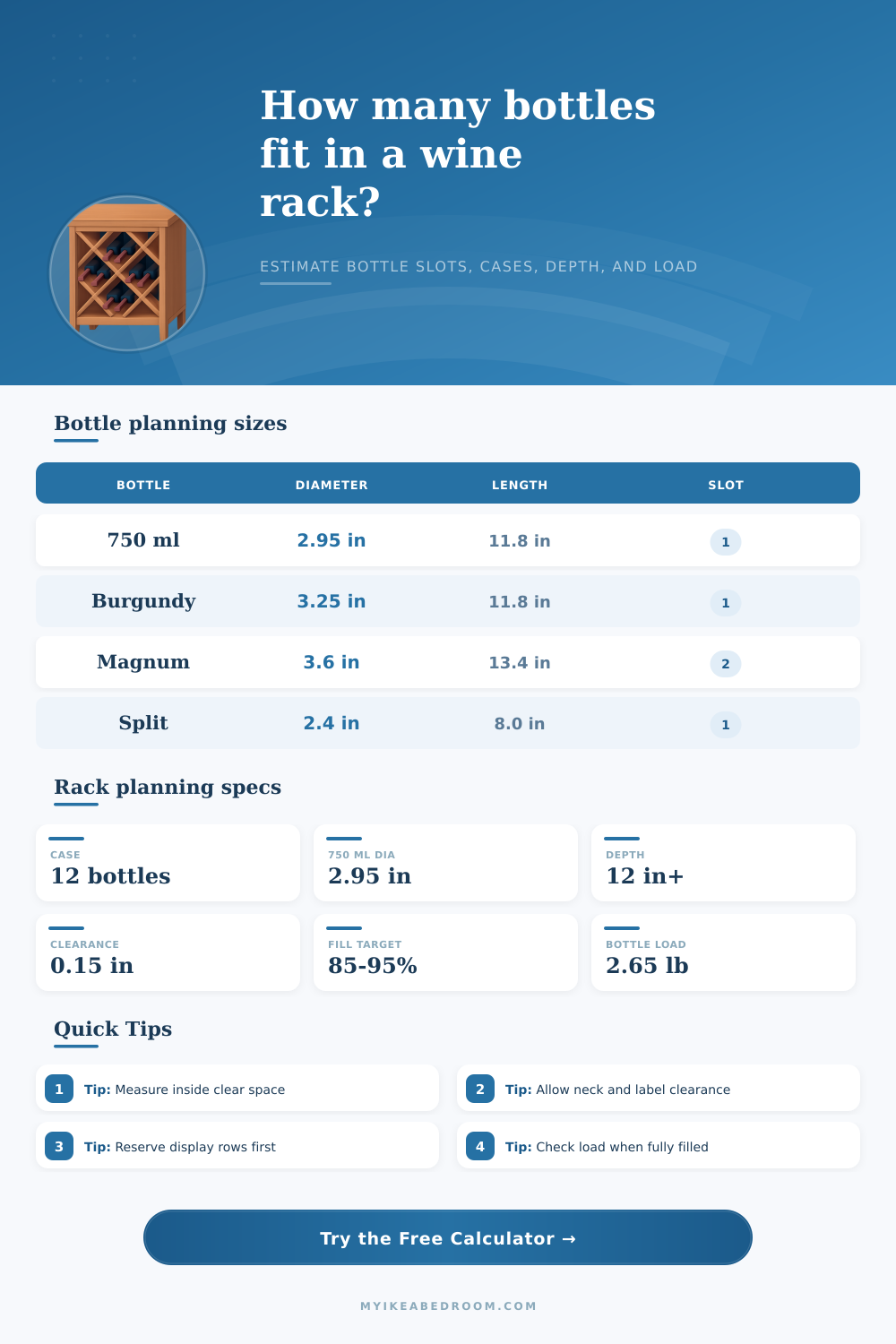
| Bottle type | Typical diameter | Typical length | Capacity impact |
|---|---|---|---|
| Standard Bordeaux 750 ml | 2.85 in to 3.0 in | 11.5 in to 12.0 in | Use one slot per bottle in most racks |
| Burgundy or Champagne 750 ml | 3.15 in to 3.35 in | 11.8 in to 12.4 in | Use wider spacing or reduce columns |
| Magnum 1.5 L | 3.45 in to 3.75 in | 13.0 in to 14.0 in | Often consumes about two standard slots |
| Split or half bottle | 2.25 in to 2.55 in | 7.5 in to 9.0 in | May fit extra depth lanes in shallow cubbies |
| Rack layout | Spacing rule | Depth behavior | Best use |
|---|---|---|---|
| Horizontal bottle rows | Diameter plus clearance per slot | One full bottle length per layer | Simple shelves, rails, and cabinet inserts |
| Individual square cubbies | Divider thickness between every bottle | One or two layers if fully supported | Neat single-bottle access and labels |
| Diamond lattice bin | Diagonal cells with shared dividers | Stacks bottles in a denser bin face | Bulk storage for similar bottle shapes |
| Tilted display shelves | Extra lift for bottle angle and lip | Usually one visible layer only | Feature bottles and daily selection |
| Vertical bottle slots | Bottle length becomes row height | Depth can hold side-by-side lanes | Short-term display or pantry storage |
| Opening | Typical clear size | Expected capacity | Planning note |
|---|---|---|---|
| Single cube shelf insert | 13 in x 13 in x 15 in | 9 to 12 bottles | Divider thickness decides if the third column fits |
| Base cabinet insert | 12 in x 30 in x 22 in | 18 to 24 bottles | Deep openings may hold two supported layers |
| Countertop cube rack | 24 in x 24 in x 12 in | 35 to 45 bottles | Best with uniform 750 ml bottles |
| Pantry tower rack | 24 in x 72 in x 12 in | 80 to 120 bottles | Use wall fastening and shelf support checks |
| Cellar wall lattice | 72 in x 84 in x 13 in | 300+ bottles | Load and anchoring matter more than slot math |
| Planning check | Rule of thumb | Why it matters | Calculator field |
|---|---|---|---|
| Standard depth | 12 in clear support | Supports most 750 ml bottles without exposed bases | Usable rack depth |
| Double depth | 24 in plus hand space | May double capacity when bottles are fully supported | Depth layers |
| Side clearance | 1/8 in to 1/4 in | Prevents label scuffing and tight bottle removal | Side clearance per bottle |
| Full bottle load | About 2.65 lb each | A 100-bottle rack can exceed 265 lb before rack weight | Average full bottle weight |
0 bottles
Simple grid using bottle diameter, row lift clearance, and one supported depth layer.
0 bottles
More divider thickness, cleaner single-bottle access, and slightly lower density.
0 bottles
Dense storage for uniform bottles, but harder to reserve individual display slots.
0 bottles
Visible labels and easier access with lower capacity than a storage-first rack.
Measure the clear opening: Capacity depends on interior space after side panels, lips, rails, and dividers. A nominal 24 in rack rarely gives a full 24 in of usable bottle width.
Plan for bottle variety: Burgundy, Champagne, and magnum bottles can remove an entire column or row. Use the large bottle share when your rack will hold mixed shapes.
Planning a wine rack involves understanding how many bottle will fit in a wine rack. Understanding how many bottles will fit in a wine rack requires considering a few physical constraint of the wine rack. While the wine rack might appear to have alot of space for wine bottles, the actual capacity of that wine rack may be less.
Wine rack calculators can help you to determine the total capacity that your wine rack will have. The calculator will use three main variable to determine the capacity of your wine rack: the opening dimensions of the wine rack, the dimensions of the wine bottles that you plan to store, and the layout style of the wine rack. The opening dimensions of the wine rack will determine the number of rows and the number of vertical slot of bottles that the wine rack can create.
How Many Wine Bottles Fit in a Wine Rack
The side clearance and the row lift of the wine rack will account for the small gaps between each bottle that goes into the wine rack; these gaps are necessary for the labels of each bottle to not scuff and the bottles to not become stuck when removing them from the wine rack. The depth of the wine rack is also one of the opening dimensions of the wine rack, as well as a factor in the calculations of the wine rack, the depth may change according to the type of wine bottles that will be stored (horizontal or vertical slots). Finally, using the display reserve percentage allow wine rack designs to leave some slots within the wine rack available for the display of specific wine bottles.
This allows for some wine rack to not be used solely for the storage of wine bottles. In many instances, people will find that there initial estimate of the number of bottles that will fit into a wine rack will be too high. For instance, individuals may calculate that their 24-inch cube can take a certain number of bottles, but the actual number will be less due to the thickness of the dividers within the wine rack.
Additionally, the total number of bottles that can be contained within a wine rack will change based off the type of layout that the wine rack will feature. Wine racks can have wine bottles arranged horizontal, vertical slots for bottles, or feature a diamond lattice of slots for wine bottles. Each type of layout for wine bottles will have a different impact on the total number of bottles that can live within the wine rack.
Therefore, individuals may wish to consider each layout option prior to purchase or construction of the wine rack. Additionally, another factor that should of been considered is the weight of each wine bottle. Each 750 ml bottle of wine will weigh approximately 2.5 lbs., and the total weight of the wine rack will increase with the addition of each wine bottle.
A load estimate may be used to calculate the total weight of the wine rack and whether or not it will be able to support the weight of the wine rack itself and the bottles of wine that will be stored within it. The variety of wine bottles that will be stored within the wine rack may also have an impact upon the calculation of the total capacity of that wine rack. For instance, bottles of wine like Burgundy and Champagne tend to be wider than Bordeaux wine bottles.
Additionally, magnums contain more wine than standard bottles and will take up more space within the wine rack. Therefore, any wine rack that is to contain many bottles of these types will need to reduce the number of bottles that will be contained within the wine rack. Additionally, splits and half bottles contain less wine than standard bottles, and will require an adjustment of the total number of bottles that will be contained within the wine rack.
An additional consideration for wine rack design is the fill target that will be used for the wine rack. Wine racks often will not be used to its 100% fill target. For example, individuals will need to rotate the bottles of wine and read the labels to ensure that the wine is not oxidizing or losing its flavor.
Therefore, a wine rack that is filled to 90% of its total capacity (by volume) may be sufficient for most wines, but increasing the fill rate to 95% or more may make it difficult for the individual to easily reach each bottle of wine. Finally, using the display reserve for each bottle will also make it so that the wine rack is not continuously used for the storage of wine bottles, but may be used for other display purposes as well. While the wine rack calculator will provide an estimation of the dimensions of the wine rack, as well as an estimation of the total capacity of the wine rack, it cannot determine the way that the wine rack will be used.
For instance, a wine rack that will be used each week for different wine bottles will have different requirements than a wine rack that will be used every few months to store a few bottles of wine. Additionally, wine racks that are to be placed on a countertop will have different requirements than wine racks that are to be placed within a cellar. These types of decisions must be made according to individual habits and the location of the wine rack.
Thus, the use of such a calculator will allow the individual to understand how each parameter impact the total capacity of the wine rack, and allow them to create a wine rack that is both sized appropriately for its wine bottles and according to the way that it will be used.