Window Tint Calculator
Estimate tint film area, roll length, VLT privacy category, cut layout, offcuts, and waste allowance for flat glass panes, patio doors, sidelights, and frosted privacy film projects.
Choose a common window film project, then adjust the pane size, roll size, VLT target, allowance, waste, orientation, heat or UV priority, and privacy pattern.
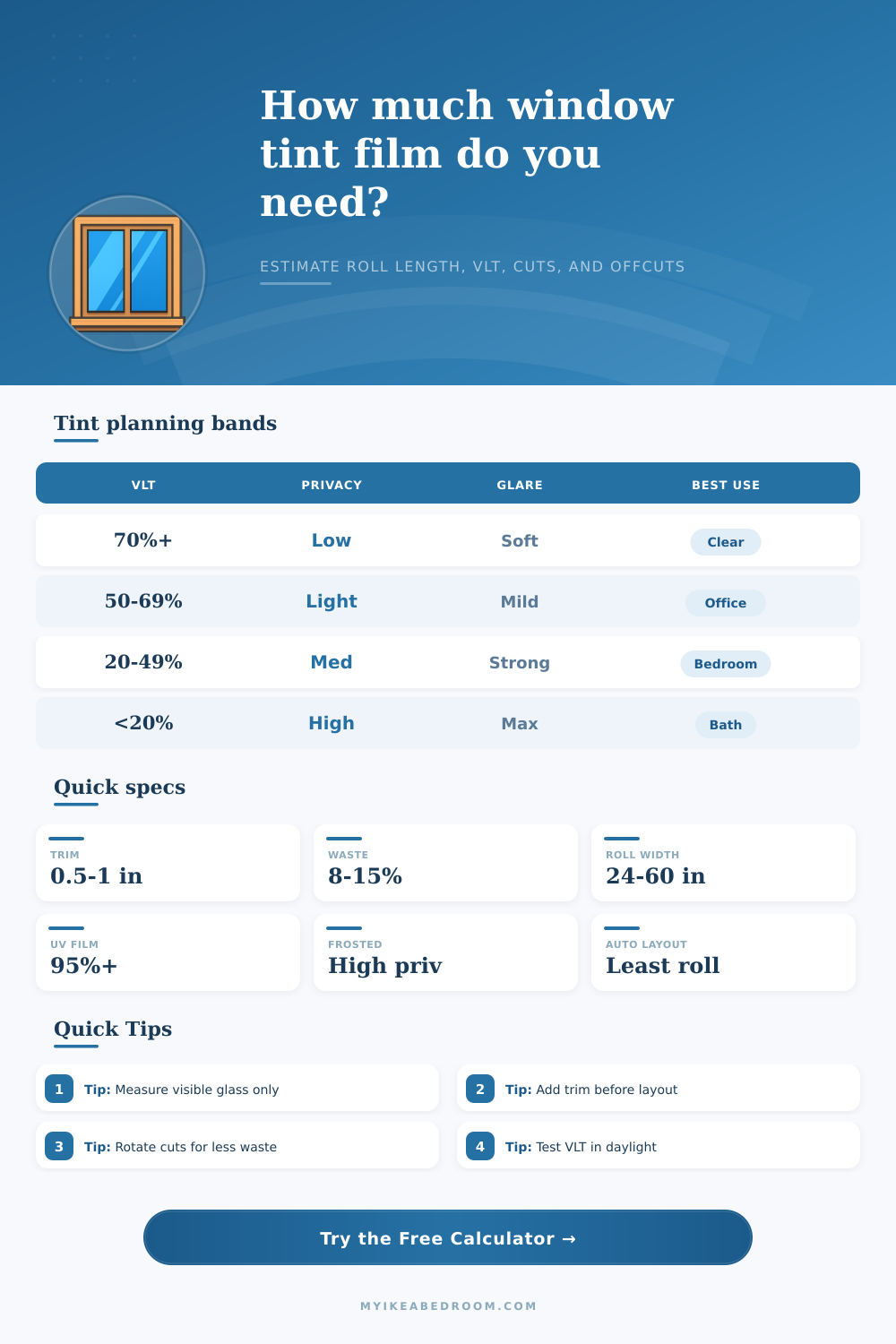
| Target VLT | Privacy category | Daylight effect | Typical use |
|---|---|---|---|
| 70% to 90% | Clear or very light | Room stays bright | UV protection, Low-E caution checks, display windows |
| 50% to 69% | Light privacy | Small glare reduction | Home offices, nursery UV control, shared living spaces |
| 35% to 49% | Moderate privacy | Visible dimming | Bedrooms, west-facing work areas, patio door glare |
| 20% to 34% | Strong privacy | Lower daylight | Street-facing panes, media rooms, bright afternoon glass |
| 1% to 19% | Dark or opaque effect | Very low view-through | Bathroom privacy, storage rooms, blackout panels |
| Roll width | Works well for | Layout watchpoint | Trim reserve |
|---|---|---|---|
| 24 in | Sidelights, small bath panes, narrow transoms | Large panes may need rotated cuts or a wider roll | 0.5 in per side minimum |
| 30 in | Small bedroom panes and cabinet-style glass | 30 in glass becomes 31 in with a 0.5 in allowance | Check before ordering roll width |
| 36 in | Common bedroom, office, and bay window panes | Good balance for 28 to 34 in glass widths | 0.5 to 1 in per side |
| 48 in | Patio door panels and tall wide panes | Can fit many doors without rotation | Use extra handling waste |
| 60 in | Large fixed glass and sunroom panels | Heavy pieces are harder to handle without creasing | Plan a larger waste percent |
| Film type | Privacy behavior | Heat or UV fit | Layout note |
|---|---|---|---|
| Clear solar control | Low privacy, high visibility | Often chosen for UV fade protection | Orientation usually does not affect appearance |
| Neutral smoke tint | Privacy rises as VLT drops | Balanced glare and comfort planning | Good for multi-pane matching |
| Reflective mirror film | Daytime privacy depends on brighter outside light | Often strong heat and glare control | Night privacy usually needs shades |
| Frosted privacy film | High privacy while diffusing light | UV varies by product type | Pattern direction may matter on doors |
| Decorative patterned film | Depends on pattern density | Usually selected for privacy and style | Align repeats across adjacent panes |
| Blackout or opaque film | Maximum privacy | Blocks view and daylight | Best for non-view panels |
| Project condition | Allowance per side | Waste percent | Reason |
|---|---|---|---|
| Small simple pane | 0.5 in | 8% to 10% | Short cuts and easy handling |
| Bedroom or office pane | 0.75 in | 10% to 12% | Enough trim margin for square edges |
| Patio door panel | 1 in | 12% to 15% | Tall film is harder to wet, position, and squeegee |
| Patterned or frosted film | 1 in | 15% to 20% | Pattern alignment and direction create extra offcuts |
| First-time installation | 1 in | 15% to 25% | Extra reserve helps cover practice and handling errors |
-
Chooses the valid orientation that uses the least roll length for the pane count.
-
Uses glass width across the roll and glass height down the roll.
-
Turns each piece ninety degrees when the roll width allows a better nesting pattern.
-
Shows how the selected VLT and film type affect the practical privacy category.
Measure the visible glass: Use the flat glass area inside gaskets or stops, and allow the calculator to add trim room. Measuring to the outer frame can overstate film needs.
Check film and glass compatibility: Some insulated, laminated, textured, wired, or Low-E glass needs product-specific guidance before tinting, especially with dark heat-control films.
When you decide to tint your windows or patio door, you must determine how much window film you need to purchase. If you order too little window film, you will not have enough to complete your project. If you order too much window film, you will have to spend more money than the tint you would like and you may have leftover window film that you wont use.
The amount of window film that you need to purchase will depend upon the size of the glass that you are tinting, the width of the window film roll that you purchase, and the amount of additional window film that is require for trimming the film to the edges of the glass. You must measure the area of the visible glass rather than the frame of the window. Window film only covers the glass.
How Much Window Film Do I Need
You must also add allowance for trimming the window film to the edges of the glass. The calculator will use your measurements of the glass, the number of pane of glass that you have to tint, and the width of the window film roll to calculate the amount of window film that you need. It will provide you with the total area of the window film that you need, the total length of the window film roll that you will use, and the orientation of the window film pieces that you will purchase.
In the cutting and installation of the window film, some of the window film will be lost. Some of the film will be lost due to cutting the film from the roll of film. Additionally, the film can become creased during the installation process.
Additionally, there may be dust on the film that you must remove before installing the film on the glass. Finally, someone installing window film for the first time will likely make mistake when applying the film to the glass. The calculator can set this percentage of waste so that the window film calculator accounts for both the installer’s experience with installing window film and the complexity of the design of the window film that is to be installed.
Visible Light Transmission or VLT is the measurement of the amount of light that passes through the window film. A film that allows 70% of the light to pass through will allow alot of light into the room, while a film that only allows 20% of the light to pass through will make the room appear more dark. The privacy that the window film provides also depends upon whether it is frosted, reflective, or a neutral smoke tint.
The calculator will use your desired VLT to suggest a category of window film for your selected application so that you can determine if the window film will provide the level of privacy that you require during the day. The orientation of the window film pieces that you purchase will also play an important role in the installation process. The width of the window film roll will affect the way in which you are to cut the film when installing it on your glass.
If the width of the film roll is less than both the width of the glass and the trim allowance, then you must rotate the film so that the long side of the film follows the length of the roll. Rotating the film pieces will change the number of pieces of film that can go across the width of the roll and the total length of the roll of film that will be used. The calculator tests both orientations of the film and chooses the one that will use the least amount of film for the given size of the window.
Heat rejection and UV protection are two different features for the film. Films that reject a great deal of heat will have a low VLT (visible light transmittance). Low VLT values can make the room dark.
For those that want to block the UV radiation but not darken the room, you can use a film with a high VLT. The calculator can adjust the type of film according to whether the heat or UV protection is the top priority for the film. For any film that features some type of pattern or that is frosted, more careful planning is required.
Each pane of glass will have to feature the same directional value for the pattern. This may leave scraps of film behind. As such, you must increase the trim allowance and the percentage of film that will be wasted in any project that features pattern or frosted film.
Many individuals make mistakes measuring the frame of the window instead of the glass. Additionally, many make mistakes with roll widths and glass sizes not being compatible. Finally, many do not account for the waste of film when cutting for any difficult projects.
You can avoid these mistakes all by adjusting the measurements, roll width, and waste percentage in the calculator. In addition to the suggestions from the calculator, it is also important to compare the different layout option. Some may waste less film but leave gaps in the film roll, while others may use up all of the film but make for larger pieces of film.
The decision between these options is up to the individual and their top priority for the installation process. Once you obtain the amount of film, you will have to clean the glass thoroughly to allow the film to perform correct. The planning stage ensures that there is enough film to cover the whole window without having to purchase additional film during installation.