Window Seat Storage Volume Calculator
Estimate the real storage inside a built-in window seat after cushion height, panel thickness, dividers, access style, and packing behavior reduce the clear box volume.
Start with a bench scenario close to your room, then adjust the actual finished dimensions and storage style.
Storage volume result
Hinged Blanket Bench
Best fit: bedding, pillows, and seasonal soft goods.
Material match: plywood or MDF cases with a lighter lid panel.
Highest access efficiency because the whole bay opens from above.
Front Drawer Seat
Best fit: books, shoes, crafts, and small sorted items.
Material match: birch plywood or melamine boxes with sturdy fronts.
Drawer slides and backs reduce depth before capacity is counted.
Open Cubby Bench
Best fit: toy bins, shoe baskets, and daily grab storage.
Material match: melamine or plywood with durable exposed edges.
Dividers improve sorting but reduce uninterrupted volume.
Tray Storage Nook
Best fit: craft supplies, wrapping paper, and shallow kits.
Material match: bamboo or birch plywood for removable trays.
Tray stack height is convenient, but it creates more dead space.
| Access style | Usable factor | Depth/height allowance | Best storage behavior |
|---|---|---|---|
| Single hinged lift lid | 90% of clear volume | 0.75 in hinge height and 0.75 in back swing depth | Best for large soft items because the full top opens. |
| Split hinged lift lids | 88% of clear volume | 0.75 in hinge height and 1 in center/back allowance | Good for long benches where one huge lid would be awkward. |
| Front drawers on slides | 78% of clear volume | 1.25 in height and 3 in drawer/slide depth loss | Best for small objects; drawer structure reduces raw capacity. |
| Open cubbies | 82% of clear volume | 0.5 in height and 1.5 in front lip/back loss | Easy daily access with baskets, shoes, or toy bins. |
| Lift-out trays | 72% of clear volume | 3 in stack height and 1 in tray clearance loss | Sorted storage with the largest convenience penalty. |
| Sliding front doors | 80% of clear volume | 0.75 in track height and 2 in track overlap depth | Works where cushions should stay in place during access. |
| Stored item profile | Packing factor | Typical item module | Why it differs from clear volume |
|---|---|---|---|
| Bulky bedding bags | 72% | 45 L per soft bag | Pillows and comforters trap air and leave rounded corners. |
| Folded linen stacks | 75% | 24 L per stack | Folded piles pack better but need pull-out finger space. |
| Toy bins and loose toys | 62% | 30 L per bin | Irregular shapes and bin rims reduce dense packing. |
| Shoe pairs and boot trays | 55% | 7 L per shoe pair | Heel height, toe shape, and tray spacing leave air gaps. |
| Books and paper stacks | 78% | 12 L per stack | Rectangular loads pack tightly but need reachable sections. |
| Seasonal lidded boxes | 68% | 56 L per box | Rigid boxes rarely match the exact compartment dimensions. |
| Finished bench size | Assumed case | Approx clear volume | Realistic usable example |
|---|---|---|---|
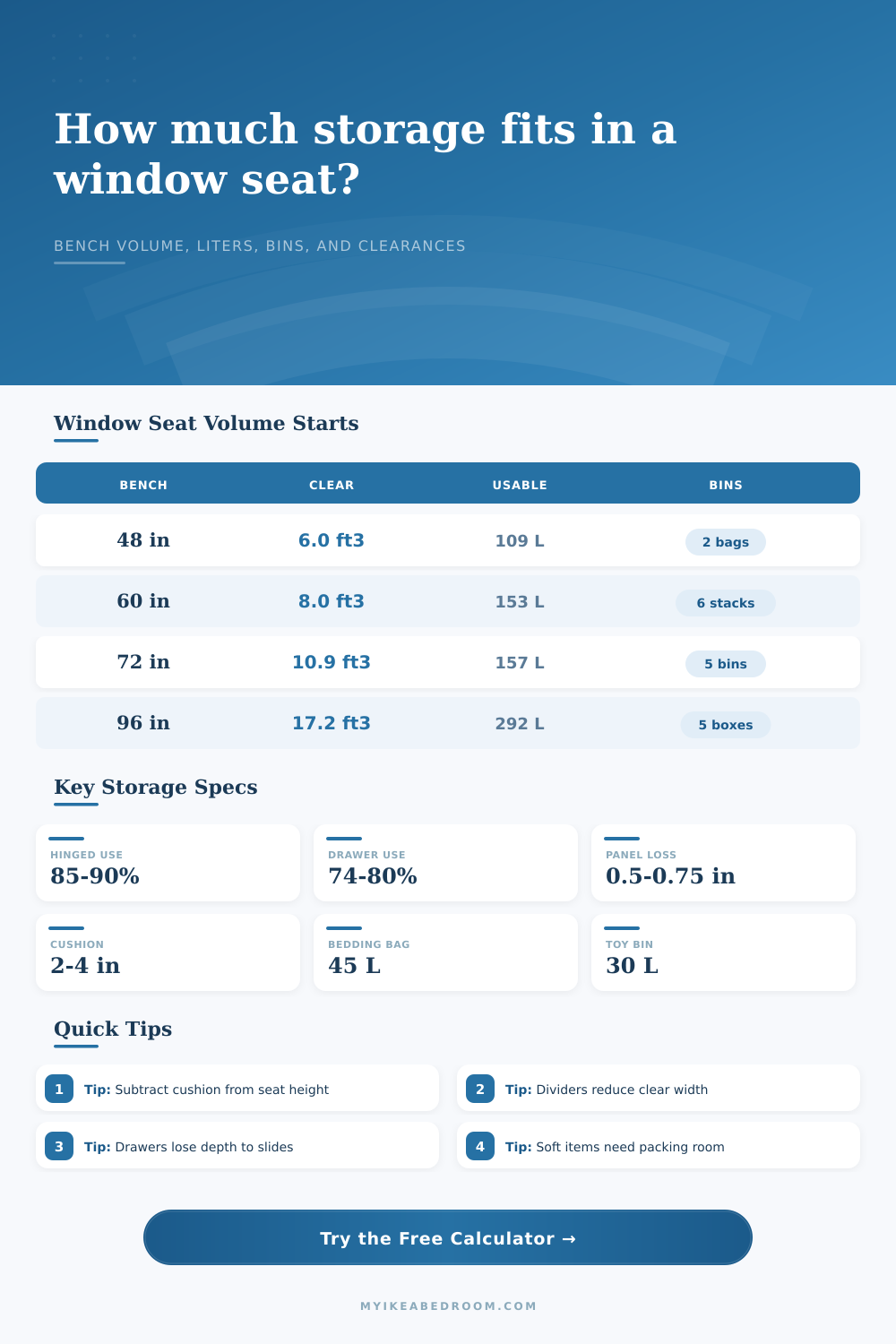
| 48 in wide by 18 in deep by 19 in high | 3/4 in panels, 2 in cushion, hinged lid | About 6.0 ft³ / 168 L | About 109 L for bulky bedding after access and packing. |
| 60 in wide by 18 in deep by 20 in high | 3/4 in panels, 2 in cushion, hinged lid | About 8.0 ft³ / 226 L | About 153 L for folded linens after access and packing. |
| 72 in wide by 20 in deep by 20 in high | 3/4 in panels, 2 in cushion, open cubbies | About 10.9 ft³ / 310 L | About 157 L for toy bins after access and packing. |
| 96 in wide by 24 in deep by 21 in high | 3/4 in panels, 3 in cushion, split hinged lids | About 17.2 ft³ / 488 L | About 292 L for seasonal boxes after access and packing. |
| Clear storage volume | Liters | US gallons | Metric cubic volume |
|---|---|---|---|
| 1 ft³ | 28.32 L | 7.48 gal | 0.0283 m³ |
| 4 ft³ | 113.27 L | 29.92 gal | 0.113 m³ |
| 8 ft³ | 226.53 L | 59.84 gal | 0.227 m³ |
| 12 ft³ | 339.80 L | 89.77 gal | 0.340 m³ |
| 16 ft³ | 453.07 L | 119.69 gal | 0.453 m³ |
Measure the seat as it will be used. If the total seat height includes a 3 in cushion, that 3 in is not storage height. Enter the cushion separately so the calculator only counts the built box below it.
Use clear volume and usable volume differently. Clear volume tells you the theoretical interior box. Usable volume is smaller because hinges, slides, dividers, baskets, and oddly shaped items all leave practical air space.
When I say window seat storage bench, what do you envision? Chances are, you envision a single large box. The kind of box where you can throw all your toys and blankets into and fill to bursting. The reality is this. There’s hardly anything in there but air. A lot of it is made up off structure and hinges. It’s a bunch of odd shaped things wedged together in a way that leaves lots of empty space.
Where most projects fail is in the difference between how much we think we have versus how much will fit in the frame. Sure the outside face may seem larger… But those inches are eaten up by the panel itself. Then take away the thickness of the cushion, add in the width of any dividers, factor in the space taken up by hardware … it gets ugly quick.
Why You Have Less Space Than You Think
Once you get the hang of the dimensions and style, you simply enter them into the calculator above, and let it do all the work. It converts the raw cubic feet into a more practical unit… Liters, which represent the actual storage. Most folks will stop there, completely overlooking the implications of weight. You could design a huge bench with solid oak panels on it and before it breaks your back, the lid may break from the hinges! This has structural effects that change your material choice.
Hardwood looks great but is heavy. It require strong support systems that further decrease interior depth. Lighter plywoods keep the lift easy.
The Cushion: The Silent Thief of Storage Space
Cushion is the silent thief of storage space. While it’s nice to have a cushy seat, that three or four inches of foam is lost forever in terms of storage height. At this point, you’re forced to make the decision: Is comfort worth the loss of capacity?
And then comes the question of the access method itself, a big factor when it comes to packing the leftover void efficiently. If you’ve got bulky bedding you need to be able to unfold, hinged lids provides nearly complete access to the vertical volume. For something like a drawer, you get neat organization at the expense of losing a large portion of its depth to the box construction and slide mechanism. With that, the tool automatically takes into account what you lose with a drawer so you don’t overestimate your ability to cram more shoe boxes before your couch.
Another place people get tripped up is on dividers. In renderings they’re clean and orderly-looking, but each vertical piece eat up width throughout the length of the storage bay. If you have three dividers, then goodbye: that’s three pieces’ worth of lost space. It is a small thing, but it is not an insignificant thing when you’re jamming in one more pile of linens.
Finally there’s the layer of what I call “optimism bias,” which the packing factor accounts for. Soft goods like comforters and pillows won’t go into corners tightly and will trap air. Books are hard and pack well, but require spaces to reach into them and find things. It assumes nothing packs a cubic void perfectly efficiently and adjusts the amount of clear volume to match something you can realy make use of.
Materials also affect interior size and weight. Thicker walls hold screws better and create stronger joints, but reduce your inner footprint. Plywood is half an inch thick (saves space) but feels wimpy to walk-on if it’s going to be a high-traffic bench. Melamine is wipe clean & resists shoe/shoe-toy wear; birch stays rigid over long spans so doesn’t sag. In all material choices, you’re exchanging interior volume for durability. On the page, the reference data spells this out visually so you get to see what each wood weighs before buying lumber.
Consider your relationship with the storage itself: Are you going to be lifting heavy holiday decor boxes just one time per year? You might retrieve toy bins several times each day after school. If so, shallow drawers and/or open cubbies are ideal (though they don’t necessarily contain as much total volume). Big hinged compartments that pack in lots of stuff are great for infrequently accessed storage.
You want to create a place where you use all of the space over time, not simply fill it up. For example, a fancy-looking bench that can only hold half of what’s theoretically possible due to bad design? It is a waste of money.
Always start from the outside in, your final exterior measurements… Then go backwards: take away cushions, then panels, then consider where to put the doors. Accept that there’s no such thing as perfect packability and everything else will fall into place. Remember it’s furniture you’re building first, storage second.
When you realize there are actual material thicknesses and hardware mechanics to respect, the math matches the real world. Mostly it is a matter of knowing which numbers reflect potential volume versus This is the actual volume. Actual volume. Measure twice, cut once (wisely), allow for some breathing space for the inevitable claims made by your pillows.