Window Seat Cushion Thickness Calculator
Estimate foam thickness, finished cushion height, sitter compression, and support comfort for a built-in window seat, bay bench, storage bench, or reading nook.
Start with a real seating scenario, then adjust the exact bench depth, foam style, sitter weight, and target finished height.
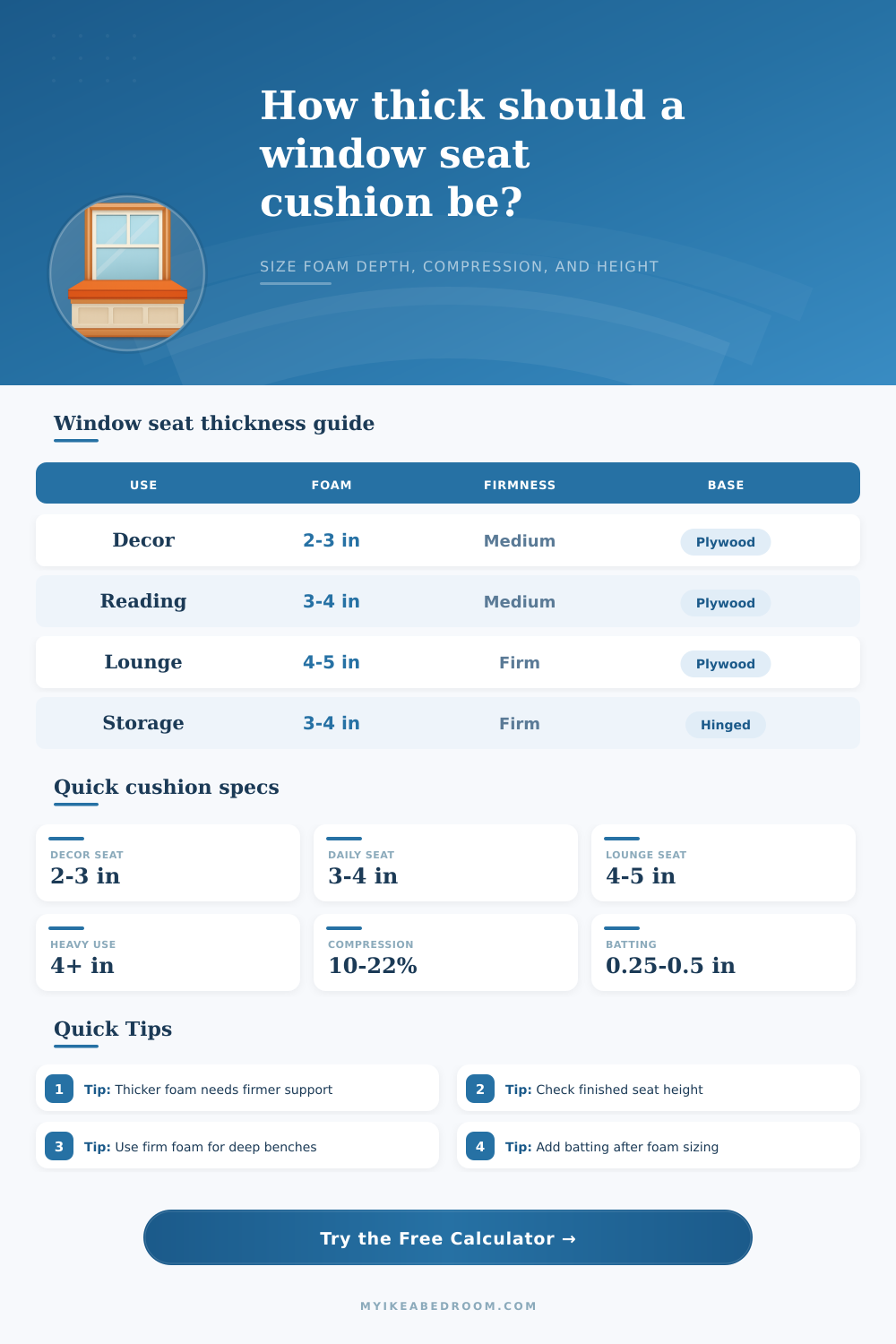
| Seat type | Typical foam | Suggested firmness | Why it works |
|---|---|---|---|
| Decorative bay window perch | 2 to 3 in | Medium | Keeps the sill low while adding enough padding for short sitting. |
| Everyday reading nook | 3 to 4 in | Medium to firm | Balances comfort, shape retention, and finished seat height. |
| Deep lounge bench | 4 to 5 in | Firm | Prevents bottoming out when legs tuck up or weight shifts backward. |
| Dining banquette by window | 2.5 to 3.5 in | Firm to extra firm | Maintains posture and keeps the seated height close to chair height. |
| Storage bench lid | 3 to 4 in | Firm | Gives comfort without making the lid feel bulky or hard to lift. |
| Kids room cushion | 2 to 3 in | Medium | Lower weight loads can use slimmer foam without harsh compression. |
| Foam firmness | Estimated compression | Best use | Thickness note |
|---|---|---|---|
| Soft upholstery foam | 18% to 25% | Back pillows or very light decorative seats | Usually needs extra thickness to avoid bottoming out. |
| Medium seat foam | 14% to 18% | Most casual window seats | Comfortable at 3 to 4 in on a solid base. |
| Firm seat foam | 10% to 14% | Daily seating, storage benches, deeper seats | Can feel supportive even when the profile is modest. |
| Extra firm banquette foam | 8% to 12% | Dining height benches and heavy use | Choose enough thickness so it does not feel board-like. |
| Purpose | Comfort height | Thickness tendency | Watch point |
|---|---|---|---|
| Dining banquette | 18 to 19 in compressed | Firm 2.5 to 3.5 in | Too tall can crowd knees under a table. |
| Reading nook | 18 to 21 in compressed | Medium 3 to 4 in | Back pillows may shorten usable seat depth. |
| Lounge bench | 16 to 19 in compressed | Firm 4 to 5 in | Deep seats need enough foam under hips. |
| Storage bench | 17 to 20 in compressed | Firm 3 to 4 in | Thick cushions can interfere with lid swing. |
| Low sill display seat | As low as practical | 2 to 2.5 in | Soft foam may flatten quickly in a thin profile. |
| Example | Foam build | Loaded height | Resulting feel |
|---|---|---|---|
| 48 x 16 in shallow perch, 140 lb sitter | 2.5 in medium foam plus thin batting | About 2.4 in above platform | Neat and low, best for short sitting. |
| 60 x 20 in reading nook, 180 lb sitter | 3.5 in medium or firm foam with 0.25 in batting | About 3.3 to 3.5 in above platform | Comfortable daily seat with manageable height. |
| 72 x 24 in lounge bench, 220 lb sitter | 4.5 in high-density firm foam | About 4.1 to 4.3 in above platform | Supportive for long reading and curled-up sitting. |
| 54 x 18 in banquette seat, 190 lb sitter | 3 in extra firm foam with tight boxed cover | About 2.9 in above platform | Upright and stable for table seating. |
Measure the hard platform first. The calculator uses platform height plus compressed cushion height, because a 4 inch foam blank rarely sits 4 inches tall once someone is seated on it.
Do not use softness alone to fix thickness. A thicker soft cushion can still bottom out, while a slightly thinner high-density firm foam may feel more supportive on a window bench.
Plan the cover after the foam. Batting, rounded covers, and bullnose fronts add visual height, so choose the foam thickness before adding seam and wrap details.
Check seat depth with pillows. A thick back pillow can steal usable depth; deep window seats often need firmer foam rather than only more cushion thickness.
When you are selecting an window seat cushion, you need to consider the appearance of the cushion and the thickness of that cushion. Many peoples select a thickness for the cushion based off only on the way that the cushion will look. However, selecting for only looks for the cushion thickness will fail because the foam will compress when the person sit on the cushion.
A piece of foam that is four inches thick will not remain four inches thick when the person sits on the foam for long period of time. Instead, the foam will compress and become thinner then when it started. As a result, the height of the finished seat will be lower than the original height of the foam cushion.
How to Choose the Right Cushion Thickness for Your Window Seat
To calculate the proper thickness of foam for the window seat cushion, you can use a calculator that is available on the page. To calculate the thickness of the cushion, you will need to enter three different measurements into the calculator: the measurements of the bench, the weight of the person who will sit on the cushion, and the amount of time that the person will spend sitting. Each of these impact the final thickness of the cushion.
For instance, if an individual will be sitting on the window seat for long periods of time, the foam will compress over time. Additionally, the more that an individual weighs, the more that the foam will compress when they sits on the cushion. Finally, the type of bench also will impact the thickness of the cushion; for instance, if the bench features a hinged storage lid, it will flex more than if the bench has a solid plywood platform.
It is also important to ensure that you distinguish the density of the foam from the firmness of the foam. These are two different features of the foam. For instance, the density of the foam can describe how well the foam will retain its shape over time, while the firmness of the foam can indicate how much that foam will compress when an individual sits on the foam.
High density foam will hold its shape better than low density foam. The calculator presents this information to allow an individual to understand the difference between these two features before they make there selection of the type of foam to use for the cushion. The final feature of the cushion to consider is the finished height of the seat.
The height of the finished seat is a measurement that will determine for what purpose the cushion will be used; for instance, if the seat is to be used as a dining-height bench, it will need to reach to a certain height to the dining table. However, the height of a lounge seat can be lower than a dining-height bench. The calculator will allow the user to enter the height that they would like to achieve with the window seat cushion.
Additionally, the calculator will alert the user of any problems with the height that is selected for the seat. This is important because youll not want to discover after creating the bench that the height of the seats is either too high or too low. An additional consideration for the height of the cushion is the style of the cover for the cushion and the batting that will be used for the cushion.
For instance, if the cushion will have a soft boxed cover or a bullnose front edge, those features will add to the thickness of the cushion; it will add height to the seat. The calculator considers these features to allow an individual to ensure that those features are considered in their selection of thickness for the foam cushion. An additional consideration that you should of made is the weight of the individual who will use the cushion.
The lighter the individual, the less the foam will compress; the heavier the individual, the more that the foam will compress. For this reason, an individual who weighs less than another individual may require a thinner cushion. Additionally, an individual who weighs more than another individual may require a higher density of foam to provide the necessary support for their weight.
The individual should adjust the weight in the calculator to allow the foam thickness recommendation to be adjusted according to the individuals weight. Common mistakes in creating a window seat cushion include choosing the thickness for the cushion based on style alone. For instance, if the individual chooses the thickness of the cushion according to their design skills, the result may lead to a window seat whose cushion has compressed to a height that is not appropriate for the height of the room.
To avoid these mistakes, use the calculator to determine the appropriate thickness of foam for the window seat. Additionally, the reference tables that are included in the article can assist in the individuals decision between the two available foam options. For instance, if an individual chooses the thickness based on the actual load that will be placed upon the bench and the height of the platform upon which the bench will be built, the resulting bench will be functional and the height of the seat will be correct.