Window Sash Weight Calculator
Estimate the working weight of a wood window sash from overall size, glass package, frame section, sash material, muntin layout, and hardware allowance, then size paired counterweights.
Presets use common sash dimensions and glass packages for repairs, bedroom windows, historic double-hung units, and heavier insulated replacements. Adjust every field after loading.
Pine drawer front
About 28 lb/ft3. Similar density to many painted sash frames, so a wide pine rail adds steady but manageable weight.
Oak bed rail
About 44 lb/ft3. Dense hardwood makes the frame and muntins noticeably heavier even when glass area stays the same.
Vinyl reinforced sash
Modeled at 24 lb/ft3. Hollow sections reduce volume, but reinforcement and tilt hardware add localized load.
Insulated glass unit
About 3.45 to 5.0 lb/ft2. Double-pane glass can outweigh the entire wood frame on larger bedroom windows.
| Glass package | Approx thickness | Weight used | Best fit |
|---|---|---|---|
| Single annealed glass | 1/8 in | 1.64 lb/sq ft | Older light bedroom and bath sashes |
| Restoration wavy glass | 1/8 in | 1.64 lb/sq ft | Historic sash with putty glazing |
| Single annealed glass | 3/16 in | 2.45 lb/sq ft | Medium replacement panes |
| Plate or tempered glass | 1/4 in | 3.27 lb/sq ft | Larger safety-glass sashes |
| Laminated safety glass | 1/4 in nominal | 3.40 lb/sq ft | Bedroom egress or impact-resisting replacements |
| Double-pane insulated glass | 3/8 in unit | 3.45 lb/sq ft | Light insulated replacement sash |
| Double-pane low-E insulated glass | 5/8 in unit | 5.00 lb/sq ft | Heavier modern bedroom sash |
| Frame material | Density used | Weight behavior | Use in estimate |
|---|---|---|---|
| Clear pine | 28 lb/ft3 | Light to moderate | Painted bedroom and cottage sashes |
| Douglas fir | 31 lb/ft3 | Moderate | Common old sash stock |
| Old-growth cypress | 32 lb/ft3 | Moderate | Rot-resistant historic exterior sash |
| Poplar | 35 lb/ft3 | Moderately heavy | Paint-grade repair sash |
| Mahogany | 40 lb/ft3 | Heavy | Exterior or custom hardwood sash |
| White oak | 44 lb/ft3 | Very heavy | Hardwood repair or specialty sash |
| Wood with aluminum cladding | 36 lb/ft3 plus allowance | Moderately heavy | Modern clad replacement sash |
| Reinforced vinyl | 24 lb/ft3 plus allowance | Variable | Tilt replacement sash with reinforcement |
| Total sash weight | Target per side | Acceptable side range | Balance note |
|---|---|---|---|
| 8 lb | 4.0 lb | 3.8 to 4.2 lb | Small light sash, cords should move freely |
| 12 lb | 6.0 lb | 5.7 to 6.3 lb | Common bath or small bedroom sash |
| 18 lb | 9.0 lb | 8.6 to 9.5 lb | Typical medium double-hung sash |
| 26 lb | 13.0 lb | 12.4 to 13.7 lb | Large glass area or hardwood frame |
| 36 lb | 18.0 lb | 17.1 to 18.9 lb | Heavy divided-light or tempered sash |
| 48 lb | 24.0 lb | 22.8 to 25.2 lb | Insulated glass may require pocket clearance check |
| Example sash | Glass area estimate | Likely glass | Approx weight range |
|---|---|---|---|
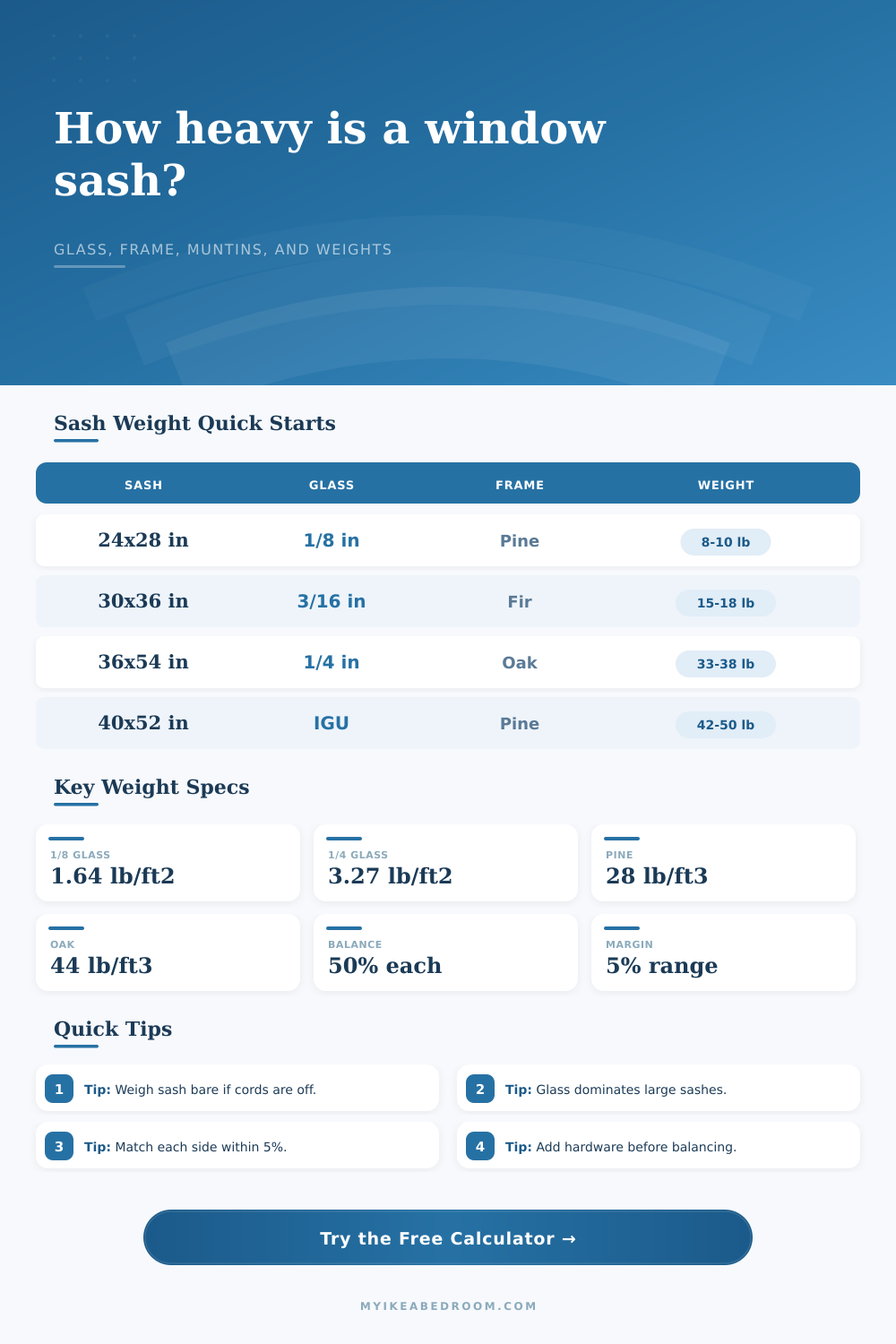
| 24 x 28 in cottage sash | 2.5 to 3.0 sq ft | 1/8 in single | 8 to 10 lb |
| 28 x 32 in bedroom lower sash | 3.5 to 4.2 sq ft | 3/16 in single | 13 to 17 lb |
| 32 x 44 in two-over-two sash | 6.4 to 7.5 sq ft | 1/8 or 3/16 in | 17 to 24 lb |
| 36 x 54 in six-over-six sash | 9.5 to 11.0 sq ft | 1/4 in safety | 33 to 41 lb |
| 40 x 52 in replacement sash | 10.5 to 12.0 sq ft | Insulated glass | 42 to 52 lb |
| 48 x 48 in picture sash | 13.0 to 14.5 sq ft | Laminated glass | 52 to 65 lb |
Measure the sash itself. Overall opening size can overstate weight if stops, tracks, or liners are included. Use the removable sash width and height, then allow the calculator to estimate the clear glass from average rail width.
Balance after hardware is present. Locks, lifts, tilt shoes, weatherstrip, putty, and paint do not weigh much alone, but together they can shift a small bedroom sash by enough to make it creep open or drift closed.
Pulling a sash out of one pocket, you find an old one that drops like a stone. You know right away something’s gone wrong with the counterweights and you’re looking at a higher price for the repair then simply replacing cord and pulleys. What’s in there? It’s the moment to figure out exactly what you’ve got to lift.
Window sashes frame nothing but air, but they is surprisingly weighted by glass thickness and hardwood density. Get the wrong number here, and in a month those new pulley will be crushed. The sashes start drifting open or sticking. Then it will be time to really get to work.
How to Calculate Your Window Weight
After plugging in your sizes, the calculator (above) do all the number crunching for you, no more guessing what each coefficient should of be or what the right conversions are. It breaks down the weight into two components, the volume of frame and the surface area of glass. Why? Because the glass weighs a lot for its size and the wood only weigh as much as the species of wood you use.
An oak sash might weigh twice as much than a pine one of the exact same dimensions. And if you give them both equal amounts of balancing weights, you’re going to be off by a few pounds. This can affect how smoothly the window operate for a decade.
Homeowners typicaly measure the rough opening instead of the actual removeable sash. That means you want the dimension from the outside edges of the wood not including lining blocks or stops. To deal with this, the tool will allow you to enter the depth and face width of frame stock. In older windows, the wood may be thicker than today’s substitutes, it could be a little swollen after decades of paint build-up (pine or fir). Today’s replacements may be clad wood or reinforced vinyl, which shift the weight distribution.
A heavy divided-light unit won’t require the same kind of counterweight as a lightweight cottage window so knowing what type of sash you have will guide your choice of counterweight material. Lead is softer but needs room to expand in a narrow pocket; cast iron is compact and dense. More important than many know are the impact of glass thickness.
Low-E insulated units that was installed as upgrades are much heavier than quarter inch tempered safety glass used for later retrofitting, and an eighth-inch pane in 1920 was far lighter than anything we would use today. In effect, if you upgraded your glazing but didn’t adjust the weights, the sash will now be permanently heavier. This isn’t something you can eyeball. Upgrading from single panes to double insulation can add ten pounds or more to a large livig room sash. The added weight is pulling harder on the cords and stressing the pulley blocks up at the top of the frame. The page’s reference table makes it clear how weight per square foot increase with thickness.
Now use your rough guess at the total weight and divide it in half for the weight on each side. Real windows are not perfectly balanced. You’ll rarely get exactly what the calculator shows because of things like friction in the track or a warped frame, so use the calculator as a target range. Ideally, the weights should fall between five percent on either side of your calculated ideal value. A window that’s too heavy will resist staying up when trying to clean while one that is too light will creep open each time someone walks past. Getting close usually takes some trial and error so having a good estimate here saves you from being frustrated.
Sometimes older houses hold a surprise in their wall cavity. You no longer have a way to tell how balanced they were because of the rotted weights and broken pulleys. If you have two identical sash, then you can measure the good weight left from the other sash to help. Often times they aren’t. Early builders would take whatever lumber was handy and even though the windows is in the same room, they could vary slightly in glass type or wood species. The only way to know for sure is to test them one at a time.
Adjusting a window balance requires more math than muscle; it’s a battle against gravity with very little room for error. Measure carefully. Double check that glass thickness (if you can). Select your frame material based off the list above. And then put down the pry bar and hammer, let the tool work for you before you apply any force. If the math adds up, the sash will float in position where you set it. A balanced sash gives you quiet confidence; it is the payoff for getting the number right the first time.