
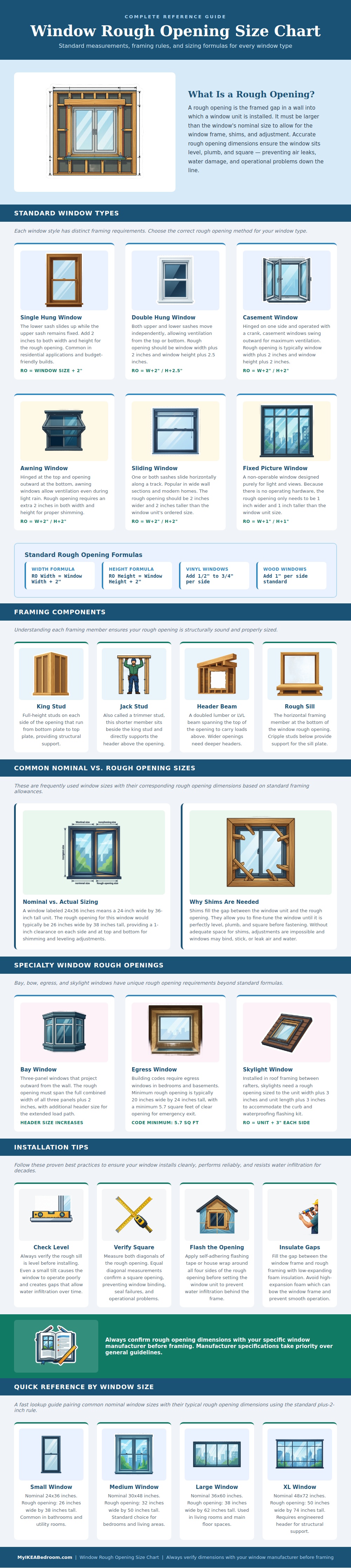
A rough opening are the framed area within the wall that is intended to recieve a window. The rough opening has to be larger than the window that is to be installed within it. It cannot be made the same size as the window because windows requires some extra space to allow for the window to be level and for any adjustments to be made to the window.
If the rough opening is too small for the window the window may become bound in its frame or may leak around the frame. If, however, the rough opening is too large the window may be difficult to ensure it remains square. Different types of windows has different dimensional requirements for the rough opening within which they are to be installed.
How to Make the Right Rough Opening for a Window
For instance, a single hung window requires a rough opening that is two inches wider then the window and two inches taller than the window. Similarly, double hung windows also require a rough opening that is two inches wider than the window, but the height allowance must be slightly larger than the single hung window because both sashes of the window must be allowed to move. Casement and awning windows also require a two-inch allowance in both the width and height of the rough opening since these types of windows also have hinges that allow the sash to swing open and close.
Sliding windows are also similar requiring the same two-inch allowances in both the width and height of the opening. However, fixed picture windows only require an inch allowance in both the width and height of the opening since they have no moving parts. It is important to ensure that the rough opening is built to match the type of window that is to be installed in it; using the incorrect size rough opening will require the framing to be changed once the window is ordered.
The studs within the frame perform specific tasks. The studs that run the full height of the wall are known as king studs and they help support the weight of the wall. The studs that are set beside the king studs are called jack studs and help to support the header.
The header spans the top of the rough opening and prevents the structure from sagging into the wall opening. The rough sill is the member that forms the base of the window opening and the cripple studs that are located beneath the rough sill supports it. If these studs are not correctly placed into the wall the rough opening will be inaccurately formed which will impact the installation of both the window and the wall.
Within the rough opening is an extra space within which shims will be placed. These shims will allow the window to be properly installed. The extra inch or two within the rough opening are not wasted; they allow for the window to be adjusted to become level.
If there is not enough extra space for the shims the window can become incorrectly installed and may lead to issues with the sash becoming stuck or water leaking out of the window. It is important to ensure the rough opening is square. The diagonals of the rough opening can be measured; if the measurements are not equal the rough opening isnt square.
Certain types of windows require special considerations to be made within the rough opening; the manufacturer of the window will dictate these requirements for the rough opening. For instance, bay windows have projections that extend outward from the wall thus requiring a stronger header. Egress windows are required to have specific minimum sizes for the openings as they can be used as emergency exits from the structure.
Lastly, any skylight openings will require additional clearance to be made on all sides of the window opening as the skylight will require a curb and flashing on the structure to prevent the roof from leaking when exposed to the weather. While the rules for rough openings are followed for these types of windows, the instructions of the manufacturer are to be prioritized as they may differ from structure to structure. It is important that each rough opening be prepared prior to the installation of the window.
The rough sill that forms the base for the window must be level and the sides that form the rough opening must be plumb. It is also important to ensure that house wrap or flashing tape is placed around the rough opening to prevent water from entering behind the window. Once the window is placed into the rough opening low expansion foam should be used to fill the gaps between the window and the opening; however, you should of used low expansion foam to prevent the window from becoming bowed.
In order to ensure that the installation of the window is successful it is important to measure the actual window that is to be ordered rather than using the picture of the window that appears in the catalog. Therefore the rough opening should be built according to the specifications of the window manufacterer. It is important to ensure that the rough opening is level, square, and plumb prior to permanently fastening the window to the structure.
Thus, following these steps will ensure an successful installation of the window; however, should any of these steps be skipped the installation of the window may become difficult.
