
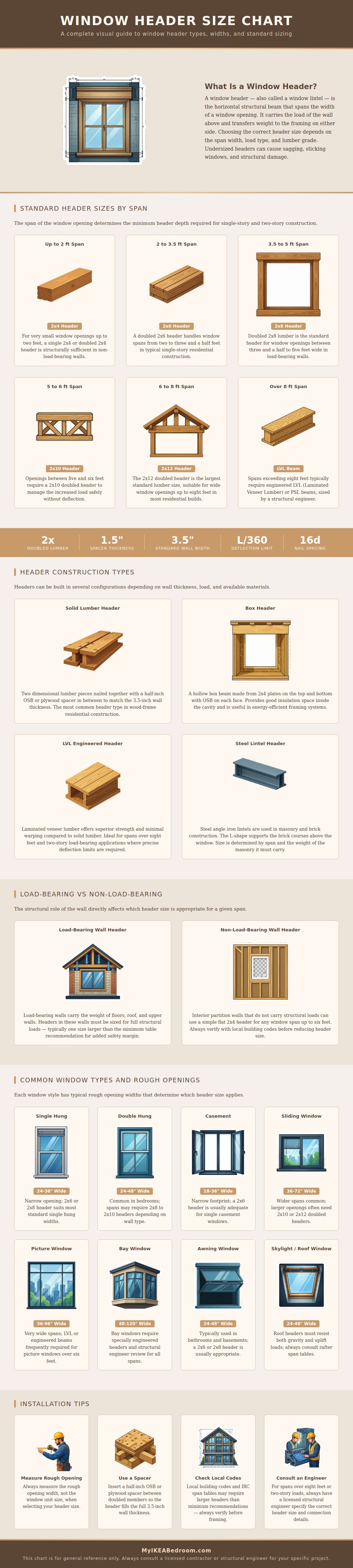
A header can be found above a window. The header is use to bear the weight that will normaly fall onto the window glass and it’s frame. If the header is the correct size for the window, the window will remain square in shape and the ceiling will remain flat above the window.
However, if the header is the wrong size for the window opening, the ceiling above the window may sag and the sash for the window may stick within there window frames. Additionally, if the header for the window opening is the wrong size, crack may form in the drywall above the window, and these crack may continue to reappear in the drywall despite attempts to patch those crack. A header should match the width of the window opening that it will fill.
How to Choose the Right Window Header
Additionally, the header must match the amount of weight that the header will have to bear. The wider the window opening, the more larger the header that will be needed to support the structural component of the wall. For example, a header that will support a small bedroom window will be smaller in size than the header that will support a large living room window.
The depth of the header will increase the ability of the header to resist bending within the wall. The type of wall will determine the amount of weight that the header will have to bear. The type of wall will determine the strength of the header that will be needed for that wall.
For example, exterior wall will have to bear more weight than interior wall. Those exterior walls will have to bear the weight of the roof and floor structure above them. Therefore, exterior walls will require stronger header than interior walls.
Interior walls will only have to bear the weight of the drywall. Thus, interior walls will have smaller headers than exterior wall. If a header of small size is installed in a load-bearing wall, the wall may fail structural and exhibit cracked plaster or door that dont close properly.
There are various type of headers that can be used. One type is the doubled lumber header, which consist of two pieces of wood with a spacer between the two pieces of wood. Another type is the box header, which has a cavity for the installation of insulation; however, you must nail the header carefuly to the wall to ensure that the box header remains rigid.
Another type of header is engineered lumber, such as LVL (lumber value). Engineered lumber is stronger than standard lumber and is better for situation in which the window opening is very wide or the weight above the window is heavy. Finally, a mason will use steel lintels in situations in which there is a masonry wall, as the steel lintels are better for supporting brick or block than wood header are.
The width of the window opening will determine the type of header that should be used in the wall. However, the most important measurement is the rough opening for the window. The rough opening is the opening in the wall for the window, not the window unit itself.
If you measure the width of the window unit rather than the rough opening, the header might be too small to bear the weight of the ceiling. If there is a wide sliding or bay window opening, the header will need to be larger than for a standard casement window. Additionally, local building code will determine the size of the header for windows.
These building codes will take into account local factor, such as wind or snow load. Before purchasing the lumber for the header, you should check these building codes to ensure that the size of the header will meet the local building codes. In instances in which the window opening is very wide, a structural engineer should of be consulted to determine the size of the beam that is required for that specific window opening.
To ensure that the window installation is completed properly, there are various step that should be taken. First, you should measure the rough opening of the window. Second, you should determine the wall as either a load-bearing wall or a partition wall.
Third, you should choose the type of header that will be used based off the construction of the house. Finally, the size of the header should be checked according to the local building codes or the specification of a structural engineer. Following these steps will ensure that the header will successfully bear the weight of the wall and that the window will operate smooth for a long time.
