Well Pressure Tank Size Calculator
Estimate minimum drawdown, total pressure tank volume, gallons, liters, precharge target, and recommended nominal tank size from pump flow and minimum run time.
Detailed Breakdown
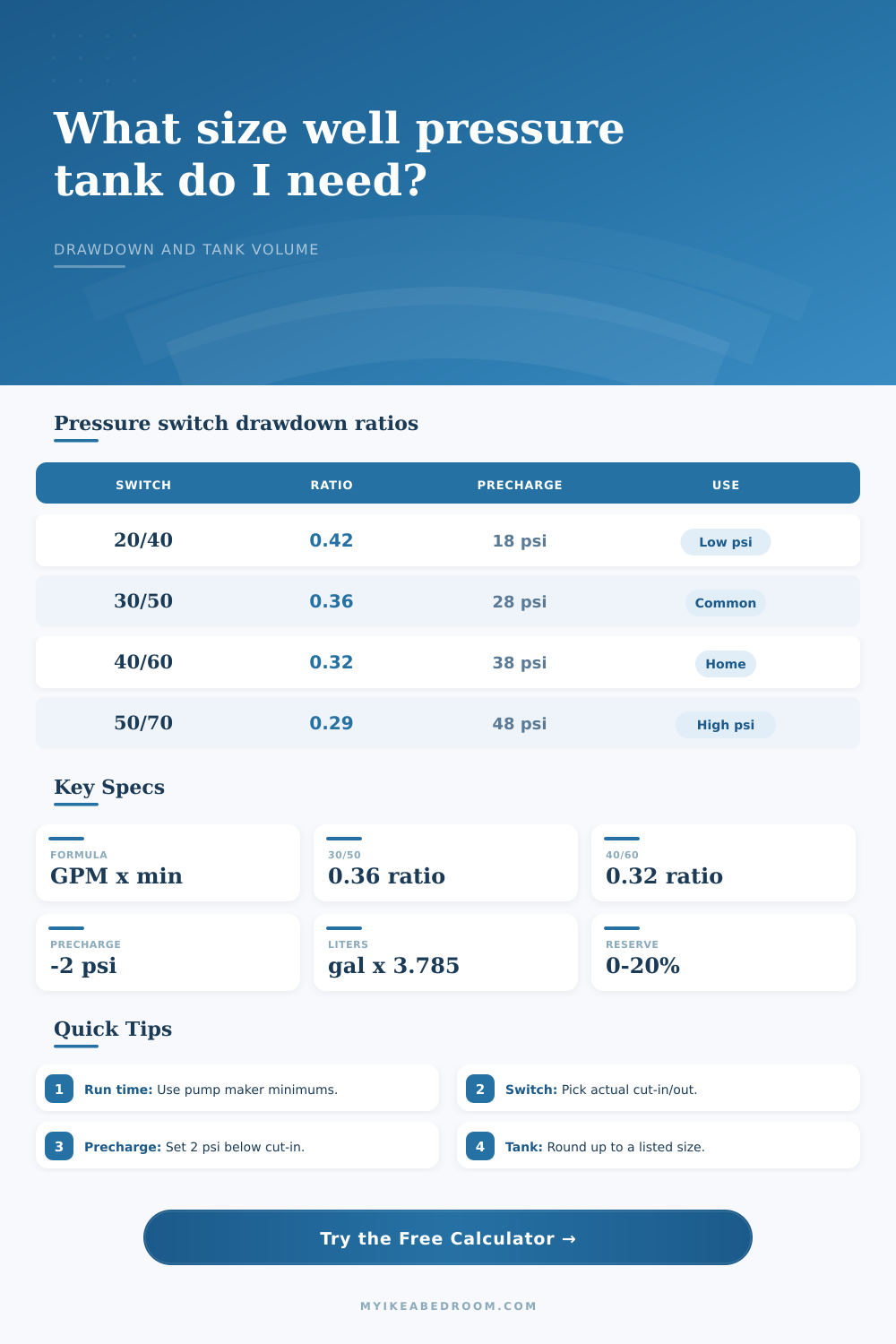
| Pressure switch | Approx drawdown ratio | Precharge target | How the calculator uses it |
|---|---|---|---|
| 20/40 psi | 0.42 of total tank volume | 18 psi / 124 kPa | Lowest common range, so a larger fraction of the tank volume is usable as drawdown. |
| 30/50 psi | 0.36 of total tank volume | 28 psi / 193 kPa | Often used on older or moderate-pressure well systems with standard fixtures. |
| 40/60 psi | 0.32 of total tank volume | 38 psi / 262 kPa | Common residential setting; higher pressure reduces usable drawdown fraction. |
| 50/70 psi | 0.29 of total tank volume | 48 psi / 331 kPa | Higher-pressure service where total tank volume rises for the same drawdown need. |
| 60/80 psi | 0.26 of total tank volume | 58 psi / 400 kPa | Booster-style range; confirm pump, tank, valve, and pipe pressure ratings. |
| Nominal tank volume | Liters | Drawdown at 30/50 | Drawdown at 40/60 |
|---|---|---|---|
| 20 gal tank | 75.7 L | About 7.2 gal / 27.3 L | About 6.4 gal / 24.2 L |
| 32 gal tank | 121.1 L | About 11.5 gal / 43.6 L | About 10.2 gal / 38.8 L |
| 44 gal tank | 166.6 L | About 15.8 gal / 60.0 L | About 14.1 gal / 53.3 L |
| 62 gal tank | 234.7 L | About 22.3 gal / 84.5 L | About 19.8 gal / 75.1 L |
| 86 gal tank | 325.6 L | About 31.0 gal / 117.2 L | About 27.5 gal / 104.2 L |
| 119 gal tank | 450.5 L | About 42.8 gal / 162.2 L | About 38.1 gal / 144.2 L |
| Pump flow | 1 minute drawdown | 2 minute drawdown | 40/60 tank volume before reserve |
|---|---|---|---|
| 5 GPM / 18.9 LPM | 5 gal / 18.9 L | 10 gal / 37.9 L | 15.6 gal for 1 minute, 31.3 gal for 2 minutes. |
| 8 GPM / 30.3 LPM | 8 gal / 30.3 L | 16 gal / 60.6 L | 25.0 gal for 1 minute, 50.0 gal for 2 minutes. |
| 10 GPM / 37.9 LPM | 10 gal / 37.9 L | 20 gal / 75.7 L | 31.3 gal for 1 minute, 62.5 gal for 2 minutes. |
| 12 GPM / 45.4 LPM | 12 gal / 45.4 L | 24 gal / 90.8 L | 37.5 gal for 1 minute, 75.0 gal for 2 minutes. |
| 15 GPM / 56.8 LPM | 15 gal / 56.8 L | 30 gal / 113.6 L | 46.9 gal for 1 minute, 93.8 gal for 2 minutes. |
| Input to verify | Normal value | Calculator effect | Practical check |
|---|---|---|---|
| Pump flow rate | Measured GPM or LPM | Directly sets drawdown: flow multiplied by run time. | Use a pump curve, well report, or timed bucket test at actual pressure. |
| Minimum run time | 1 to 2 minutes | Longer run time requires more drawdown and a larger tank. | Check pump motor documentation for minimum cycle recommendations. |
| Pressure switch | 30/50 or 40/60 | Higher pressure ranges have lower drawdown ratios. | Read the switch cover label or gauge behavior during a pump cycle. |
| Precharge pressure | 2 psi below cut-in | Correct precharge helps the tank deliver its expected drawdown. | Measure with water pressure drained to zero before checking air charge. |
| Tank condition | Captive-air tank | Aging or non-bladder tanks get a lower usable ratio in this calculator. | If the pump short-cycles, verify air charge, diaphragm condition, and switch settings. |
It’s annoying when your shower turns cold. Usually, this occurs because someone turned on another faucet and dropped the pressure (or shocked the pipes) by kicking on the well pump.
Although it’s tempting to lay the blame at the feet of the pump itself, the more likely cause are an undersized pressure tank. And correct sizing isn’t guesswork. To avoid burning out your pump, you need to strike a balance between its run time and amount of water it flows. It’s a tedious calculation … until you input the proper information into the calculator above at which point it does the math for you.
How to Choose the Right Size Pressure Tank
Drawdown Drawdown is the heart of this matter: how much water can you pull from the tank before the pressure drop low enough to turn the pump on again. For example, if you have very little usable water in your tank, each flush of the toilet cause the pump to cycle on and off. This not only consumes power but also wears out your motor. You want enough water in your tank to store some water so it doesn’t turn on so quickly. That’s why the inputs for minimum run time and flow rate is important. They establishes how much water the tank must store until the next time the pump goes off. A 10gpm pump with a min. Run time of one minute require ten gallons of drawdown. It’s simple math.
The useable portion of the tank depends on pressure settings. For example, higher pressure systems sound cool and all, but they don’t squeeze as much water from same amount of volume. With a typical forty to sixty psi switch, you’re looking at approximately 32% of the tank volume being usable for drawdown. Bump it up to say a fifty to seventy psi, and your usable fraction gets even smaller, down to maybe twenty-nine percent. That’s why many times a bigger nominal tank is necessary for higher pressure houses. At higher pressures, the bladder hold less water because there’s more air in it which is compressed into less space. Physics has constraints; you can’t cheat them.
The other setting that throws people off is called Precharge pressure. This represents amount of air pressure in the tank prior to adding water. Ideally you will have it two psi under your cut-in pressure. Too little precharge means water can compress the bladder against the tank walls. Too little precharge means the bladder will compress against the tank walls, while too much precharge mean the tank holds less water. A good habit is to drain out the water pressure and check this setting with a tire gauge. Over time many tanks lose their air and become short cycling even though initially they had the right sized tank. The tool considers your tank condition and switch range to adjust the total volume.
Here are a few notes. Bladder tanks are newer. Older galvanized tanks mix their water and air… So the air eventually dissolves in the water, so-called waterlogging. Newer systems use a rubber diaphragm to hold them apart. Because of this, the calculator accounts for the type of tank (older = higher total volume required). There’s also a reserve percentage feature. If you expect heavy demand or your pump size is big add ten to twenty percent. That way, when everybody showers at once, you’ve got a buffer.
To conclude. The bottom line is that you need your equipment to last, and it will be more comfortabley while doing its job. A good-sized tank is the shock absorber of your plumbing system. When you use water, the pressure in your system starts to drop. A well-sized tank lets the pump adjust gradually instead of having to react immediately when a faucet is opened or closed. The pumps has their output capability and your local pressure demand which may be different than what’s listed in the common examples laid out in the table on this page. Your requirements are unique to you.
You don’t want too little but you also don’t want much extra either. You’d like enough where you can go through your normal morning routine and know you won’t run dry before you’re ready for bed. More is more; larger size = fewer repairs = consistent flow pressure. You would of not had a cold shower moment. The system has breathing room.