Weed Barrier Fabric Quantity Calculator
Estimate landscape fabric from bed area, roll size, overlap, openings, waste allowance, and staple spacing in sq ft or m2.
■Landscape presets
▣Fabric inputs
Choose the unit system for dimensions. Results show both sq ft and m2.
Fabric estimate
▦Fabric planning grid
▤Roll coverage by size
| Roll size | Gross coverage | Metric coverage | Best use |
|---|---|---|---|
| 3 ft × 50 ft | 150 sq ft | 13.9 m2 | Side strips and tree rings |
| 4 ft × 50 ft | 200 sq ft | 18.6 m2 | Small and medium beds |
| 4 ft × 100 ft | 400 sq ft | 37.2 m2 | Foundation beds |
| 6 ft × 100 ft | 600 sq ft | 55.7 m2 | Large mulch areas |
▥Overlap and staple guide
| Condition | Overlap | Staple spacing | Planning note |
|---|---|---|---|
| Straight level bed | 6 in | 4 ft | Lowest added fabric allowance |
| Standard mulch bed | 8 in | 3 ft | Good default for most layouts |
| Curved planting bed | 10 in | 2.5 ft | Extra helps with cuts and seams |
| Slope or loose soil | 12 in | 2 ft | More pins and seam coverage |
▧Common landscape preset reference
| Preset | Bed area | Roll example | Notes |
|---|---|---|---|
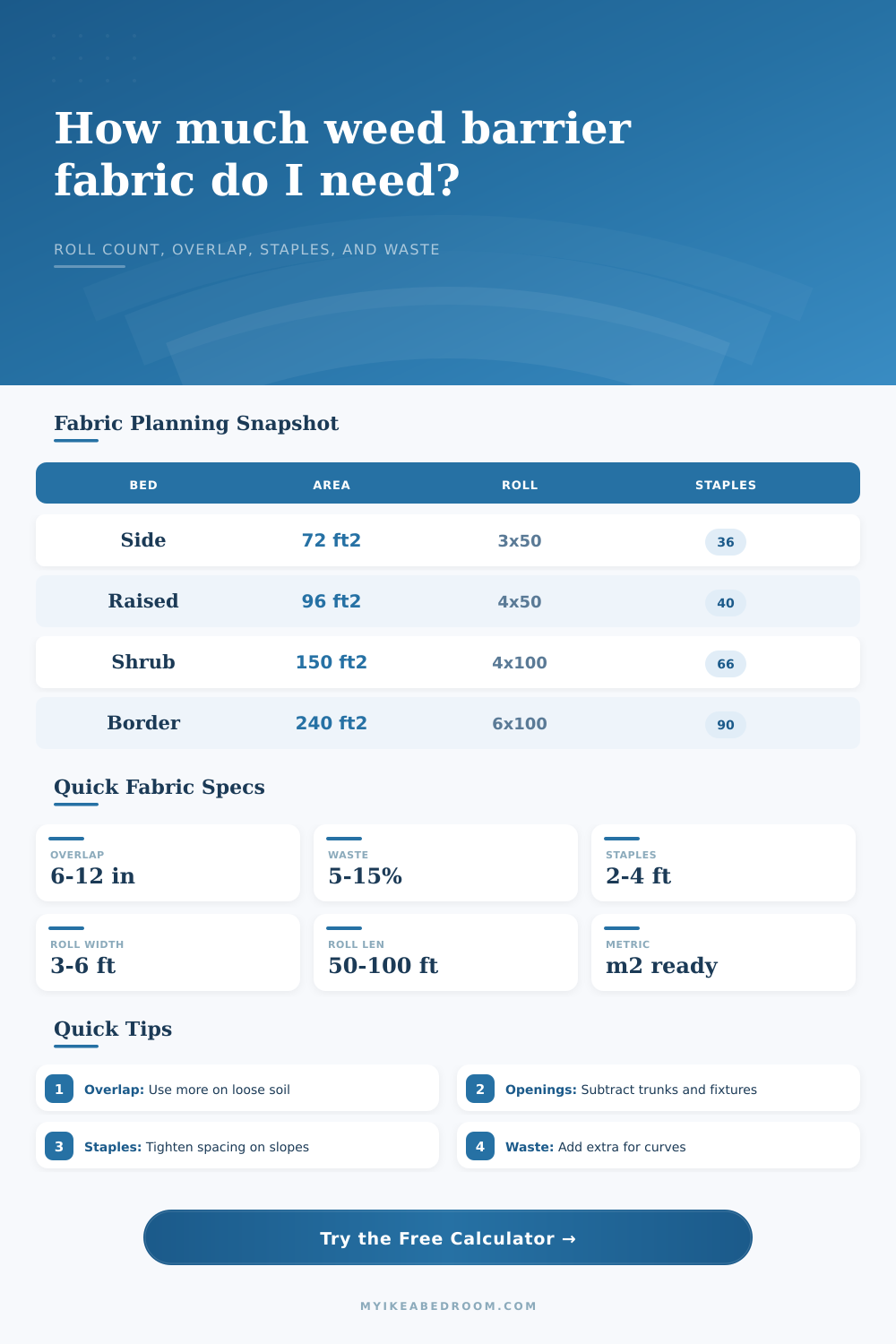
| Narrow side bed | 72 sq ft | 3 ft × 50 ft | Minimal openings and straight strips |
| Raised vegetable beds | 96 sq ft | 4 ft × 50 ft | Separate boxes increase cut waste |
| Tree ring trio | 85 sq ft | 3 ft × 50 ft | Subtract trunk openings before waste |
| Long fence border | 240 sq ft | 4 ft × 100 ft | Long seams make overlap important |
| Large mulch bed | 450 sq ft | 6 ft × 100 ft | Wider rolls reduce seam count |
▨Measurement tips
That means you measure the space in your garden bed, not its perimeter, then begin. Why? Because if you measure its perimeter and divide that by width of the roll, you are forgetting the entire space you have to cover. The goal is to figure out how much total square footage do I need? And the calculator does all the math for you. It will accept dimensions for triangles, circles, or rectangles (which match what your garden beds looks like far more closely than one square). So it lets you plan before you buy.
The fabric has seams that overlap each other. The recommended amount of overlap is six inches; go to 12 inches if the surface is steep or ground is soft. That extra six inches will affect how much fabric you’ll require, which matters in terms of cost. Unlike cut-offs, overlap isn’t wasted; it’s redundancy. Redundancy is good. (It keeps out weeds.)
How to Measure Your Garden Bed
The calculator assumes some overlap and includes waste based off that assumed overlap. For simple shapes with mostly straight edges, assume ten percent waste. For intricate forms with lots of curves, assume fifteen percent waste.
Also figure out what you’ll use to anchor the fabric down. Most people use staples, and you can choose how often to space them out. It depends how loose or tight you want the fabric but a few feet works well, with more staples needed closer together on a slope. A steeper slope need more anchors, while a less steep slope needs fewer anchors. Anchors should be pretty solid because wind will try to get underneath the fabric fast and raise it up from its edges.
Also see that table of references: That’s for figuring how many seams you have (and therefore how much potential space there might be for weed growth). Fewer seams = no weedy spots, but fewer seams = wider fabric roll required, which gets awkward when maneuvering into corners. So think about where you’re putting this thing.
Don’t calculate waste without accounting for the permanent obstacles in the garden. Large stones, tree trunks and utility boxes all occupy space and don’t require coverage by fabric. If you fail to account for this space, you’re paying for unused fabric. This is why the tool specifically requests these details so that you can visualize the bed with these obstacles in mind, instead of thinking about it as a blank canvas. It’s easier to spot potential tripping hazards in advance of beginning work.
If your supplier measures in square meters, there’s a metric conversion built into the calculator. You don’t need to calculate anything differently. It will switch to the right units automaticly. This lets you stay focused on the project instead of finding a conversion rate.
These estimates aren’t about conserving only fabric; they’re about conserving time. When you buy too much the first time around, you avoid wasting time making additional trips to the store. The estimates also account for seam allowances and cuts you’ll make. By accounting for the hard parts, you end up with something that is cheaper, more efficient, and cleaner.
You should of used this tool earlier to save money on extra furnitures. It would of been much easier than calculating it manually. This moddern method makes everything feel naturaly simple.