Water Softener Size Calculator
Estimate household grains per day, compensated hardness, reserve capacity, regeneration spacing, and the closest common softener size.
🏠Household presets
💧Softener sizing inputs
Estimated softener size
📊Capacity class reference
📐Reference tables
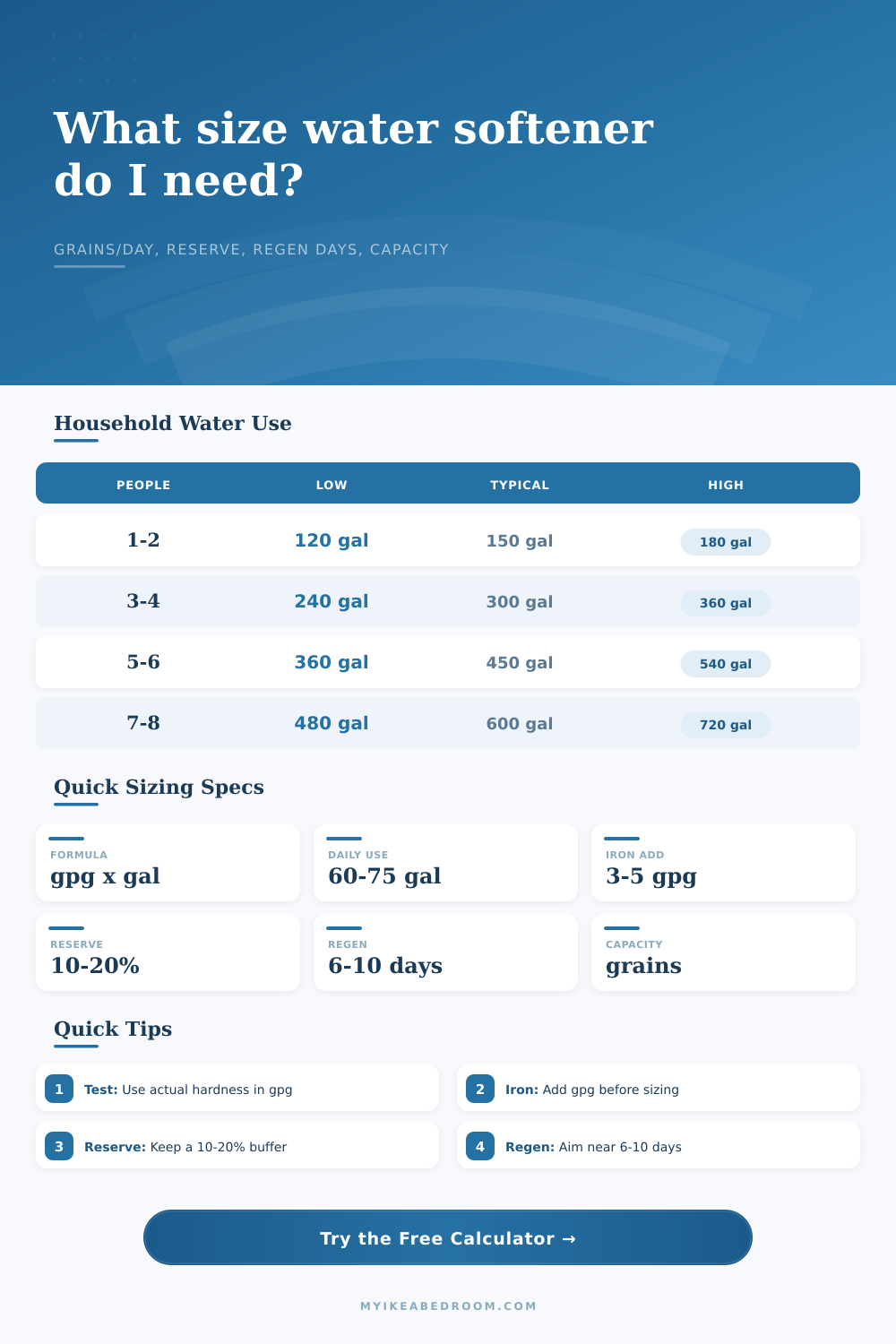
| Household | Low use 60 gal/person | Typical use 70 gal/person | High use 75 gal/person |
|---|---|---|---|
| 1 person | 60 gal/day | 70 gal/day | 75 gal/day |
| 2 people | 120 gal/day | 140 gal/day | 150 gal/day |
| 4 people | 240 gal/day | 280 gal/day | 300 gal/day |
| 6 people | 360 gal/day | 420 gal/day | 450 gal/day |
| Hardness level | GPG range | Daily grains at 300 gal | Sizing note |
|---|---|---|---|
| Moderately hard | 7-10 gpg | 2,100-3,000 | Small sizes may fit |
| Hard | 11-20 gpg | 3,300-6,000 | Check reserve closely |
| Very hard | 21-30 gpg | 6,300-9,000 | Often needs 48k+ |
| Extremely hard | 31+ gpg | 9,300+ | Shorter regen or larger size |
| Iron ppm | 3 gpg factor | 4 gpg factor | 5 gpg factor |
|---|---|---|---|
| 0.5 ppm | +1.5 gpg | +2.0 gpg | +2.5 gpg |
| 1.0 ppm | +3.0 gpg | +4.0 gpg | +5.0 gpg |
| 2.0 ppm | +6.0 gpg | +8.0 gpg | +10.0 gpg |
| 3.0 ppm | +9.0 gpg | +12.0 gpg | +15.0 gpg |
| Nominal capacity | Useful for | Approx service flow | Best regen range |
|---|---|---|---|
| 24,000 grains | 1-2 people | 6-8 gpm | 4-10 days |
| 32,000 grains | 2-4 people | 7-9 gpm | 5-10 days |
| 48,000 grains | 3-6 people | 9-12 gpm | 6-12 days |
| 64,000 grains | 5+ people | 11-14 gpm | 7-14 days |
💡Sizing tips
Mineral deposits are caused by hard water which destroys your water heaters and coats your showerhead with ugly minerals that prevents soap from lathering. Most homeowners make the wrong decision when selecting a water softener, whether they follows recommendations from local hardware stores or simply choose one based off their large family size. The right size for a water softener is determined by both how much water will flow through it and what the mineral concentration are in that water.
A too-small water softener results in excessive regenerations; an improperly sized one let hard water slip through between regeneration.
How to Choose the Right Water Softener Size
First, calculate the grain load each day. To do that, simply multiply your daily water use by the number of grains per gallon found in your water. If your home use three hundred gallons per day and your water is hard at eighteen grains per gallon, you have five thousand four hundred grains to deal with every single day. Enter those numbers into the calculator above; it will automatically multiply for you, taking the guessing out of the initial math.
But you’re not done yet. Don’t forget to account for iron. Dissolved iron (even at low levels) bind to the resin beads. It uses up their capacity. It also impairs how well they work without removing hardness from the water.
The tool on this page asks for your iron level and applies a compensation factor. On this page, you’ll enter your iron content, and the tool will use an additional compensation factor that increases the total hardness load. While this seems insignificant on paper it makes a huge difference in how much capacity is needed. If not accounted for, the softener could exhaust its capacity prematurely and have hard water right before regeneration.
Another key variable is how often this regeneration need to happen. How long can the system go between regens without being inefficient? It must also not go too long and allow the resin bed to get clogged with bacteria or other organics.
Most systems are configured for a six- to ten-day regeneration schedule. If you regenerate less frequently than that; for example, if your system determines you only need a three-day cycle… You will waste water and salt. On the other hand, if you do it more frequently such as with a two-week cycle, the resin bed could become clogged.
By tweaking the days the system will take to reach its full capacity (the “target days” on the calculator) you’ll find the right balance based on the real-world pattern of your consumption.
A safety margin is known as reserve capacity. There are always unknown factors like more water being used by family/guests, appliances running at the same time (i.e., washing clothes & dishes), etc. During these periods of increased usage, a softener without reserve capacity will break down exactly when you need it most. A 10-20% buffer gives you additional capacity for busy periods while reducing performance problems when the system is stressed.
Too many folks pick their tanks too big or too small. They might assume a 2,000-grain tank will be plenty for them and their spouse… until they realize just how fast that thing fills up in a hard water area. Or maybe they get a huge tank because they live alone in an apartment, yet that huge tank never regenerates enough leaving the resin sitting idle and degrading over time.
To help place such examples into context, I’ve provided reference tables on this page comparing the size of various capacity classes against normal household water flows. These numbers will allow you to gauge whether your water use is above average or below.
A water softener removes minerals by exchanging them, but there’s only so many places it can do that. When the system gets full of calcium and magnesium, it won’t be able to soften water anymore; until it recharges itself. How often do you want it to regenerate? You need to size a softener to work for your amount of water and how hard your water is.
Don’t guess what your water is like. Get your water tested. If you’re on a well, don’t trust the report from the city. Put those actual figures into the calculator and it will figure out all the math for you.
The right size will prevent mineral deposits, let your soaps lather better and keep the system running well. You should of used this tool to avoid inconvenince. It is most important than anything else. Realy make sure you check everything correctly so that problem dissapears.