Water Heater Size Calculator
Estimate the tank size and first-hour rating needed for the busiest hot-water hour in your household, with shower, bath, dishwasher, laundry, temperature rise, and recovery included.
🏠Household presets
📏Peak-hour hot water inputs
Water heater sizing result
⚙Formula cards
📊Water heater sizing reference tables
| Fixture or use | Low planning draw | Typical planning draw | High planning draw | How the calculator uses it |
|---|---|---|---|---|
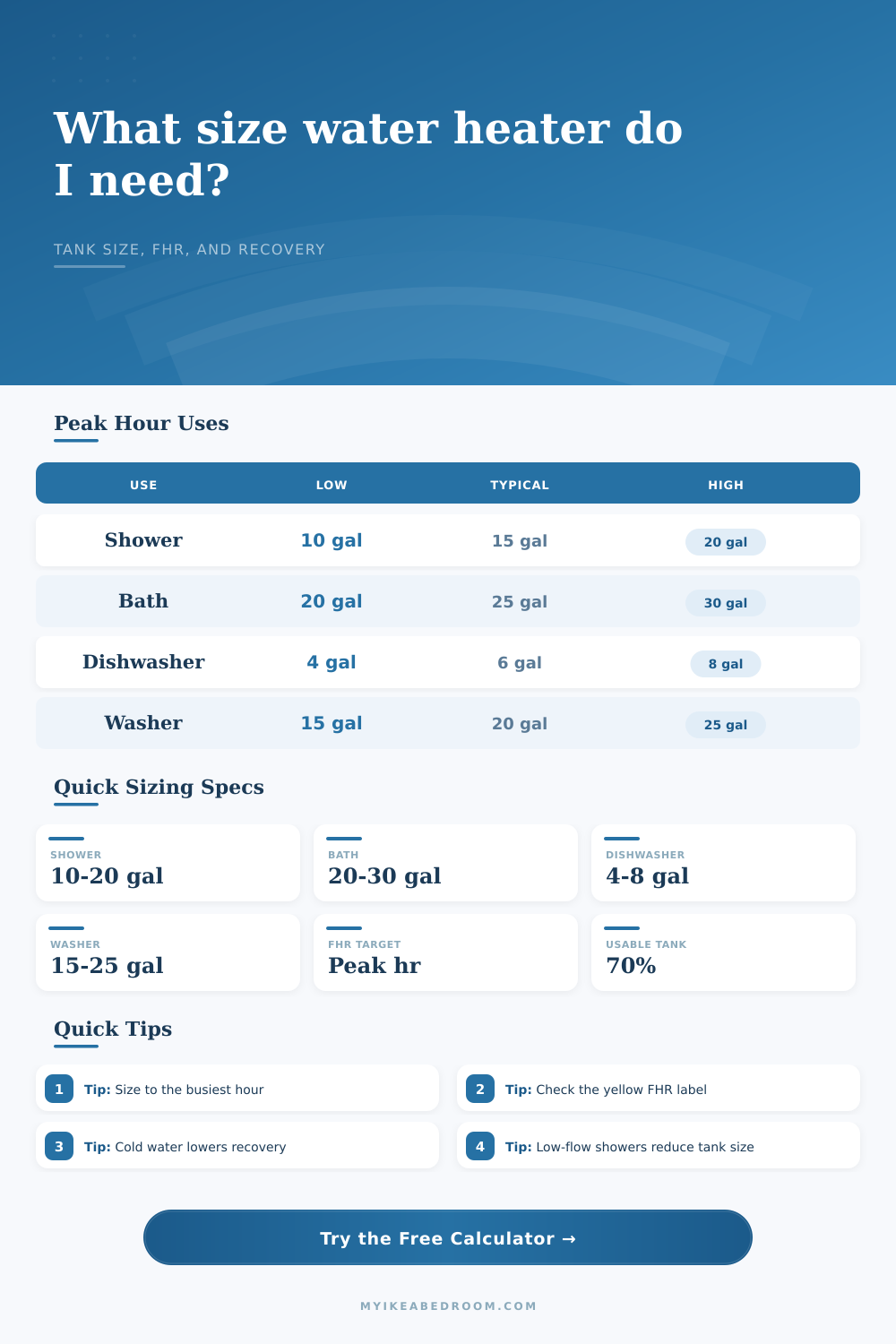
| Shower | 10 gal / 38 L | 15 gal / 57 L | 20 gal / 76 L | User-selected shower gallons multiplied by showers in the busiest hour. |
| Bath fill | 20 gal / 76 L | 25 gal / 95 L | 30 gal / 114 L | Bath selection combines number of baths and gallons per bath fill. |
| Dishwasher | 4 gal / 15 L | 6 gal / 23 L | 8 gal / 30 L | The calculator uses 6 gallons per cycle for a middle planning value. |
| Clothes washer | 15 gal / 57 L | 20 gal / 76 L | 25 gal / 95 L | The calculator uses 20 gallons per warm or hot load. |
| Lavatory or sink use | 1 gal / 4 L | 2 gal / 8 L | 4 gal / 15 L | Usually small compared with showers, baths, and laundry. |
| Peak-hour hot draw | FHR target with 10% buffer | Common tank direction | Household pattern |
|---|---|---|---|
| 20 to 35 gal | 22 to 39 gal FHR | 30 to 40 gal tank if recovery is modest | One to two people, short showers, little appliance overlap. |
| 36 to 55 gal | 40 to 61 gal FHR | 40 to 50 gal tank for many mixed-use homes | Two to three people with dishwasher or one laundry load. |
| 56 to 75 gal | 62 to 83 gal FHR | 50 to 75 gal tank depending on recovery | Three to four people or one bath plus other fixtures. |
| 76 to 100 gal | 84 to 110 gal FHR | 75 to 100 gal tank or high-recovery model | Large households with back-to-back showers and laundry. |
| Over 100 gal | Over 110 gal FHR | Large tank, paired tanks, or engineered sizing | Very busy homes, deep baths, or several simultaneous draws. |
| Inlet to set point | Temperature rise | Recovery effect from 90°F rating | Sizing note |
|---|---|---|---|
| 70°F to 120°F | 50°F / 28°C | About 1.80x listed 90°F recovery | Warm inlet water lets the heater replace hot water faster. |
| 60°F to 120°F | 60°F / 33°C | About 1.50x listed 90°F recovery | Mild inlet water often supports a smaller storage need. |
| 50°F to 120°F | 70°F / 39°C | About 1.29x listed 90°F recovery | A balanced planning case for many homes. |
| 40°F to 120°F | 80°F / 44°C | About 1.13x listed 90°F recovery | Cold inlet water makes recovery slower in real use. |
| 35°F to 125°F | 90°F / 50°C | 1.00x listed 90°F recovery | Matches many published recovery-rate labels. |
| Preset | Peak-hour pattern | Fixture demand | What drives the size |
|---|---|---|---|
| Studio single shower | 1 low-flow shower | 10 gal before buffer | Low fixture overlap and warm inlet water. |
| Couple morning rush | 2 typical showers | 30 gal before buffer | Back-to-back showers with no bath fill. |
| Family of three | 3 showers, dishwasher, laundry | 71 gal before buffer | Appliance overlap adds to shower demand. |
| Bath night household | 2 showers, 1 bath, dishwasher | 61 gal before buffer | The bath fill behaves like multiple shower draws. |
| Large busy household | 5 long showers, deep bath, appliances | 156 gal before buffer | Peak hour may exceed a single residential tank. |
💡Sizing tips
It’s cold outside … now you’re in the shower with water going from warm to cold. Why? Your water heater is too small; it’s not that something are wrong with it. People typicaly consider water heaters in terms of volume. The bigger the tank, the more hot water they assume will be available. That is partially true. However, it fails to account for measurement that determines comfort.
What are we measuring? When entering your peak hour of use into the calculator (above), it do all the math for you so you don’t have to guess any conversion/coefficients. What you do want to know is its First Hour Rating, or FHR. That’s how much hot water (in gallons) the unit will provide in an hour’s time from a full tank. It is based off both how much hot water it stores and how fast it can heats new water over the next hour.
How to Choose the Right Size Water Heater
The faster it can replenish while you’re in the shower, the more important the rate of recovery versus volume of the tank. For example: if your family take three back-to-back shower, then they care more about rate of recovery than the volume of the tank.
So what’s size? How do you get started on the question? That depends on how much effort you put into sizing your morning routine. Are you both in the shower at the same time, every day? Are you running dishwasher during a wash cycle? If so, those back-to-back loads puts a huge amount of strain on your water system. It’s not just extra gallons from doing all that stuff, it’s the fact that they’re happening at once. Plug them into tool and see for yourself. Enter in all of your appliance cycles, plus your showers and bath fills, and look for big spike. This is the moment when you’re most demanding of your system.
It may be one person taking a long shower, which uses fifteen gallons or more, but then you run dishwasher and throw in another load of laundry and suddenly you’ve got twice as much demand as before. And if you have a standard-size, forty-gallon water heater, chances are that won’t fit. This is where most people goes wrong when sizing their hot water heaters.
Temperature rise is a variable that trips up buyers, particularly ones in colder climates. If you have groundwater coming into your house that is close to forty degrees Fahrenheit in the middle of winter, then your heater need to increase the temperature by eighty degrees before it’s a comfortable one hundred twenty. But in the summer, that same inlet might be at seventy degrees, so it only needs to raise the temperature by fifty degrees.
That bigger jump requires more energy and thus will slows down the recovery rate. A heater sized just for warmer months may really struggle in January when it’s needed most. The reference table on the page shows that as the temperature rise increase, the effective gallons per hour of recovery decreases. This isn’t an adjustment; it is just a limit of physics. In a cold climate, you will have to run a bigger heater (faster recovery within that range of temps) or get a bigger tank to hold more pre-heated water. Thermodynamics = no free lunch.
The patterns are pretty obvious: Most families fits in one of several categories. Maybe you’re a couple who likes a short shower in the morning, in which case, a modest-sized forty-gallon tank will do. Throw in a teenage boy whose long showers can’t be stopped… Along with dishwasher whose heat setting is set to “blazing,” and an occasional load of laundry, and the arithmetic point toward a fifty- or even a seventy-five-gallon tank.
Don’t be tempted to downsize just to save on initial purchase price, as a smaller tank can increase energy costs and wear. Running out of hot water all the time requires a very small tank’s heating element to start and stop repeatedly. Not only does this waste energy, but it wears out the element. You should of had a bigger one. The idea is simply to get the equipment that matches how you behave.
Any potential unit has a yellow efficiency label. Look for FHR number. That’s what you’ll compare to your peak hour demand. If the FHR is higher than your highest-traffic hour, you’ve found a winner. If lower, then you’re going to be taking cold showers and paying for them. It is a simple equation, but it makes all the difference in the world if you get the inputs correct. You don’t want the heater to hold you back; you want it to keep up with you.