Washer Capacity by Load Calculator
Estimate whether a laundry load has enough drum room for tumbling by comparing washer cubic feet or liters, dry load weight, fabric bulk, fill level, bulky bedding, washer style, and soil or rinse buffer.
Start with a common washer and load scenario, then adjust the drum size, weight, fabric type, fill level, and rinse allowance for your actual load.
Toggle between cubic feet and pounds or liters and kilograms. The calculator converts all values internally so washer volume, load weight, and bedding loft stay consistent.
Washer load capacity result
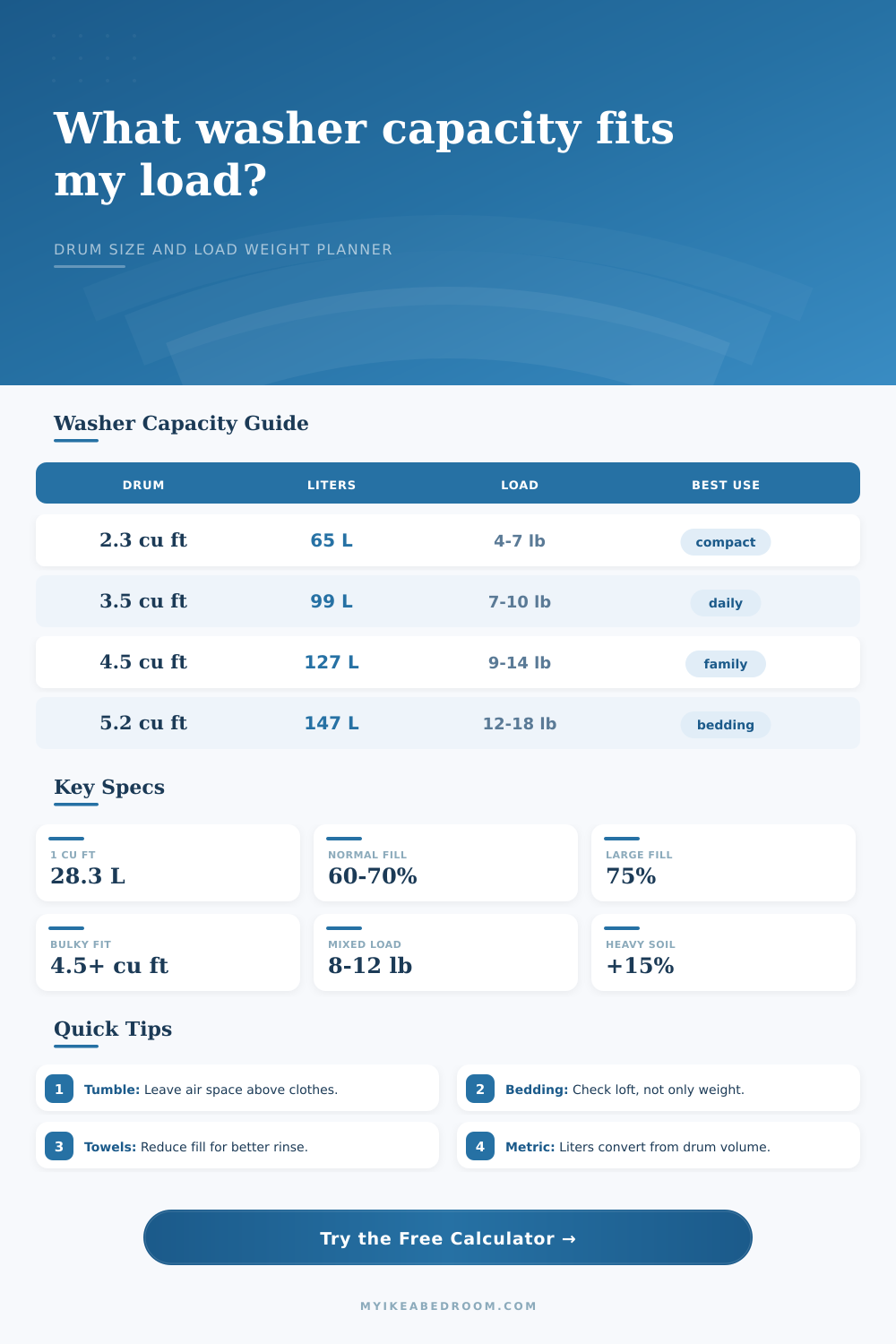
| Rated drum size | Metric volume | Typical normal load | Best fit |
|---|---|---|---|
| 2.0 to 2.4 cu ft | 57 to 68 L | 4 to 7 lb / 1.8 to 3.2 kg | Compact apartment loads, delicates, small baskets |
| 3.0 to 3.6 cu ft | 85 to 102 L | 7 to 10 lb / 3.2 to 4.5 kg | Daily clothing loads, small towel loads, sheet sets |
| 4.0 to 4.6 cu ft | 113 to 130 L | 9 to 14 lb / 4.1 to 6.4 kg | Family mixed loads, towels, queen bedding checks |
| 5.0 to 5.8 cu ft | 142 to 164 L | 12 to 18 lb / 5.4 to 8.2 kg | Large family loads and many bulky bedding items |
| Fabric category | Working bulk per dry lb | Working bulk per dry kg | Capacity note |
|---|---|---|---|
| Denim and dense workwear | 0.14 cu ft/lb | 8.7 L/kg | Heavy by weight, but relatively compact by volume |
| Mixed everyday clothes | 0.16 cu ft/lb | 10.0 L/kg | Good default for shirts, socks, underwear, and light pants |
| Towels and washcloths | 0.20 cu ft/lb | 12.5 L/kg | Needs extra rinse space because towels hold water and suds |
| Delicates and lingerie | 0.24 cu ft/lb | 15.0 L/kg | Lower fill protects movement and reduces tangling |
| Fleece and plush fabric | 0.28 cu ft/lb | 17.5 L/kg | Lightweight items can overflow the usable drum before weight looks high |
| Down or puffy bedding | 0.42 cu ft/lb | 26.2 L/kg | Loft is the limiting factor; split if compression is needed to close the door |
| Washer type | Usable tumble factor | Why it changes | Planning note |
|---|---|---|---|
| Front-load high efficiency | 88% of rated drum | Open cylinder and strong rollover pattern | Good for bedding when the drum is large enough |
| Top-load impeller | 80% of rated drum | Low-profile impeller still needs a clear turning zone | Use lower fill for towels and bulky fabric |
| Top-load center agitator | 68% of rated drum | Center post interrupts the usable ring of laundry | Split large bedding even when dry weight seems acceptable |
| Compact washer | 78% of rated drum | Smaller diameter limits rollover and item length | Best for frequent small loads rather than bulky pieces |
| Large item | Added loft allowance | Suggested minimum drum | Calculator behavior |
|---|---|---|---|
| Sheet set or duvet cover | 0.4 cu ft / 11 L | 3.0 cu ft / 85 L | Adds mild bulk but usually washes with normal clothing space |
| Twin comforter or small quilt | 1.5 cu ft / 42 L | 3.5 cu ft / 99 L | Checks for rollover space before approving a single load |
| Queen comforter | 2.4 cu ft / 68 L | 4.5 cu ft / 127 L | Raises the split recommendation if fill exceeds the chosen target |
| King comforter | 3.2 cu ft / 91 L | 5.0 cu ft / 142 L | Flags small drums even when weight alone appears to pass |
The drum lacks air (or rather, it isnt full of it). You throw in your king comforter and see the thing struggling to tumble. It’s not about weight. A washer can handles those pounds. It’s about volume. How much space do clothes take up as they churn and soak? That matters far more for laundry care than how heavy they are.
We all over-fill our washers. We trust the scale but forget about the space. This results in poor rinses, stiff towels, and to much vibration. But now, after plugging in what you’re washing and the size of drum, it’s all done for you with the calculator above. No more wondering if you’ll fit a basketful of jeans.
Why Space Matters More Than Weight
It doesn’t just look at dry weight. It accounts for how much bulk each fabric has. A pound of fleece is voluminous, even though it weighs the same than a pound of denim. Fleece is lightweight, but bulky. Jeans are dense and compact. You’ll crush your delicate synthetic fabrics in a tiny drum, or underuse a massive one if you don’t account for that. That’s why the tool adjusts, considering different types of fabric with bulk factors.
Athletic wear can expand, so it require some room for that. Towels need some breathing room for absorbing water, too. Capacity isn’t all that matters, washer type does too. A top-loader with a center agitator doesn’t provide the same amount of usable space in the drum as a high-efficiency front-loader. That agitator take up a fair amount of the interior volume of the drum. It breaks up the ring of laundry that must rise and fall to tumble clean.
Same rated cubic feet? No. The actual tumbling space are smaller. Table of references on the page shows where the drop off is for usable space due to mechanical design. If you’re looking for a good clean, you need to make allowances for this reduction. Ignore it, and you’ll load it too full for the machine to move your laundry propery.
Most people makes mistakes with their bedding plans. Not only is a queen comforter heavy. But it’s also got some loft. And when it becomes wet, that loft increase. So if you have too small of a drum, the comforter simply sits there. It tucks around on itself. The outer layer stays relatively clean while the inner part get mucked up.
To have an item like a comforter roll, you really should of need a minimum drum size to give that item room to unfold and roll. That is what the calculator tests against your bedding selection. It identifies if the loft is going to be greater than the air gap allowed. That way we don’t make the mistake of putting a large blanket in a medium drum because the weight looked OK. The door may close, but the clean won’t happen.
Another one of those little things are rinse buffers. More rinse water is needed if you have pets and dander, sensitive skin, or heavy soil. This means there is less capacity on the drum. The more full your machine is, the harder it will be to move water around. Your suds will get caught. Your rinse won’t rinse. And your rinse cycles becomes ineffective.
Putting in a soil buffer as part of your tool is going to increase the amount of open area you need to get clean. Because what good is clean water if it doesn’t go anywhere? Instead it just sits on top of the load. Small input change, big output impact. Cleanliness vs. Capacity.
The trade-offs are what practical laundry planning boils down to: knowing how much weight a machine can hold, how much volume it can take, its mechanical limitations. The fabric has to be considered. The basket has to be considered. You also need to consider the drum inside the machine. Consider leaving space for the tumbling. Consider leaving space for the water. Working with the drum size will get you softer, cleaner clothes that needs fewer wrinkles ironed out.
When the machine isn’t holding its breath, it’s doing its job better. Give it some air, and it’ll give you better laundry.