Wardrobe Hanging Rod Length Calculator
Size a wardrobe hanging rod from finished inside width, mounting cups, side clearances, rod material, clothing load, hanger spacing, and support span before cutting or drilling.
Start with a common wardrobe bay, then fine-tune the clear width, end cups, garment density, support style, and rod material for your actual cabinet.
Best for: short wardrobe bays and light to medium clothing.
Length driver: clear width, cup insertion depth, and lift-in gap.
Best for: 48 to 72 inch rods with mixed loads.
Length driver: split the span so each side stays under the safe span.
Best for: long walk-in walls or heavy coat runs.
Length driver: equal spacing prevents one overloaded bay.
Best for: wardrobes with vertical dividers or shelves.
Length driver: calculate each clear bay after divider thickness.
| Mounting style | Typical deduction | Metric deduction | Use this when |
|---|---|---|---|
| Open end cups | 1/8 in gap plus cup depth | 3 mm plus cup depth | The rod drops into sockets attached to side panels. |
| Closed sockets | 1/4 in to 3/8 in total | 6 to 10 mm total | The rod must be short enough to slide into one socket first. |
| Wall flanges | Visible gap only | 3 to 6 mm total | The rod sits between flanges or clamp collars. |
| Rail brackets | No socket deduction | No socket deduction | The rod rests on open supports and can be nearly full bay width. |
| Split cabinet bays | Per-bay clear width | Per-bay clear width | Vertical dividers create independent short rods. |
| Rod material | Light clothes | Mixed clothes | Heavy coats |
|---|---|---|---|
| 1 inch steel round tube | 48 in / 122 cm | 42 in / 107 cm | 34 in / 86 cm |
| Oval wardrobe tube | 54 in / 137 cm | 48 in / 122 cm | 38 in / 97 cm |
| 1.25 inch wood dowel | 42 in / 107 cm | 36 in / 91 cm | 30 in / 76 cm |
| Solid closet pole | 48 in / 122 cm | 40 in / 102 cm | 32 in / 81 cm |
| Thin decorative tube | 36 in / 91 cm | 30 in / 76 cm | 24 in / 61 cm |
| Usable rod length | Tight spacing | Everyday spacing | Roomy spacing |
|---|---|---|---|
| 24 in / 61 cm | 16 hangers | 9 hangers | 6 hangers |
| 36 in / 91 cm | 24 hangers | 14 hangers | 9 hangers |
| 48 in / 122 cm | 32 hangers | 19 hangers | 12 hangers |
| 60 in / 152 cm | 40 hangers | 24 hangers | 15 hangers |
| 72 in / 183 cm | 48 hangers | 28 hangers | 18 hangers |
| Wardrobe setup | Inside width | Suggested rod length | Support note |
|---|---|---|---|
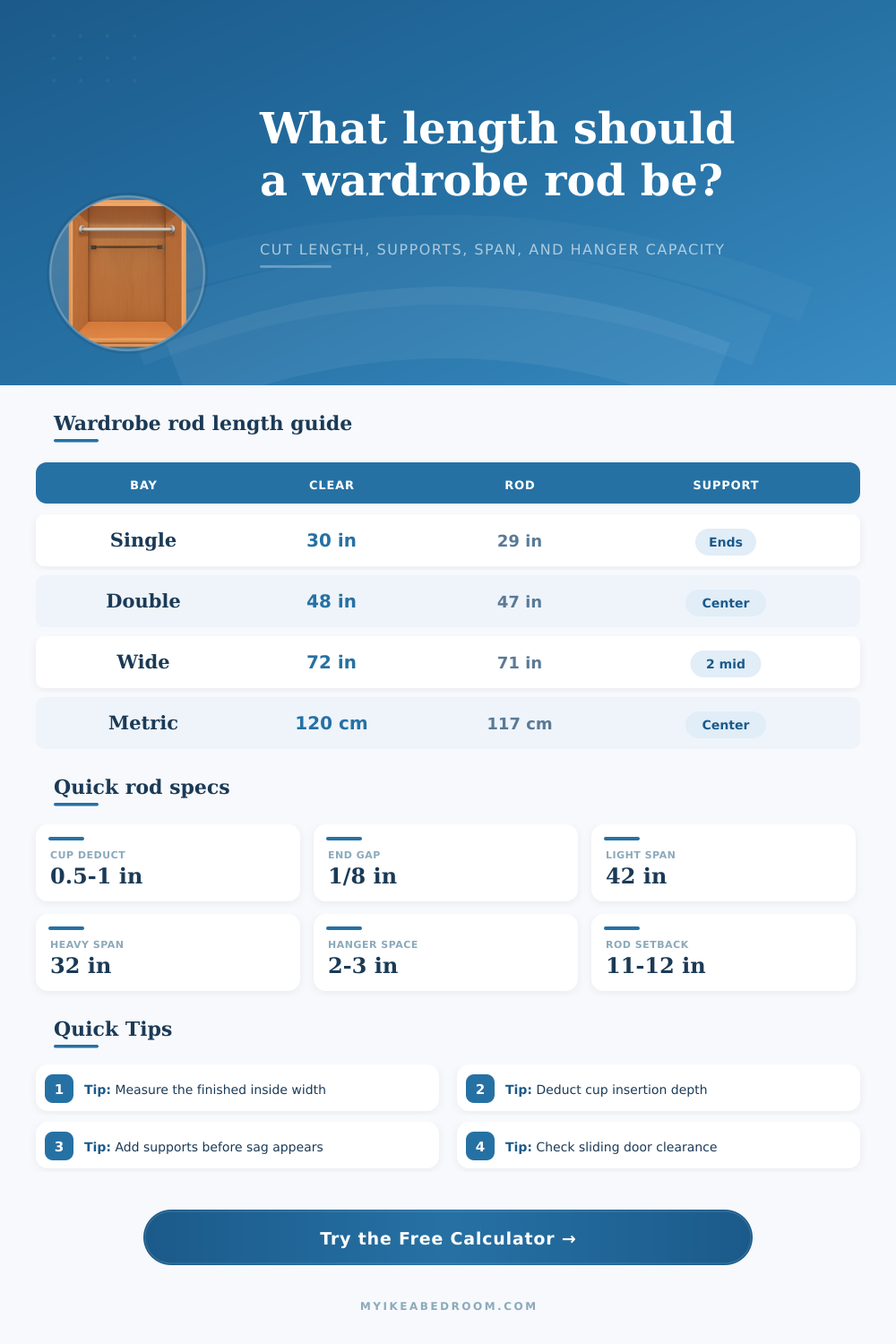
| Narrow single bay | 24 to 30 in | About 23 to 29 in | End cups usually enough for light clothing. |
| Standard wardrobe bay | 36 to 48 in | About 35 to 47 in | Use stronger rod or add center support near 48 inches. |
| Wide reach-in bay | 60 to 72 in | About 59 to 71 in | Plan at least one middle support for mixed loads. |
| Walk-in rod wall | 84 to 120 in | Split or support every 32 to 48 in | Multiple supports keep the rod straight under load. |
| Metric cabinet bay | 100 to 120 cm | 98 to 118 cm | Check socket depth and panel thickness before cutting. |
Measure the finished opening. Paint, liners, side panels, trim strips, and slightly bowed walls can change the clear width, so measure at the actual rod height.
Test the support spacing with the real load. A rod can fit perfectly but still sag if heavy coats are packed tightly across a long unsupported span.
To determine the correct length for a wardrobe hanging rod, you must take several specific measurement of the wardrobe. Despite the apparent ability of the wardrobe doors to accommodate a wardrobe hanging rod based on visual inspection alone, a wardrobe hanging rod require precise measurements to ensure that the rod can support the wardrobe door’s supports, the movement of the clothing hangers, and the weight of the clothing within the wardrobe. Should the wardrobe hanging rod be of a wrong length or fail to account for the weight of the closet’s contents, the wardrobe hanging rod may sag or may crowd the wardrobe door.
The first of the specific measurements you must take is the finished inside width of the wardrobe space. This measurement take place between the side panels or walls of the wardrobe at the height of the hanging rod. This specific height must be measured because the wardrobe space may be of different width at various heights due to bowed wardrobe walls or the placement of lining within the wardrobe.
How to Measure a Wardrobe Hanging Rod
Furthermore, you must take into account the supports that will hold the wardrobe hanging rod within the wardrobe doors. The placement of these support can alter the length of the wardrobe hanging rod that is purchased for the wardrobe. Additionally, vertical divider within the wardrobe may also reduce the length of the wardrobe hanging rod that can be purchased.
The spacing between the supports can dictate whether the wardrobe hanging rod will remain level or sag under the weight of the clothing. A wardrobe hanging rod may remain level when it does not contain any clothing; however, when clothes is hanging on the wardrobe rod, the rod may dip. The ability of the wardrobe hanging rod to hold weight depends on the material used to construct the hanging rod and the type of clothing that is to be stored within the wardrobe.
For example, if the wardrobe is to contain only light shirts, then the distance between the supports of the wardrobe hanging rod can be more longer. However, if the wardrobe is to contain heavy items such as denim coats, the supports may need to be brought closer together to prevent the wardrobe hanging rod from sagging. Another consideration is the depth of the wardrobe.
If the wardrobe hanging rod is too close to the back wall of the wardrobe, the hangers will not be able to swing into the wardrobe. Additionally, if the wardrobe rod is too close to the front of the wardrobe doors, the clothing will touch the wardrobe doors. These measurements will not impact the length of the wardrobe hanging rod; however, they will impact the ability of the wardrobe doors to allow the hangers to move within the wardrobe.
Many individual make specific mistakes when measuring for the wardrobe hanging rod. For instance, many individuals may measure the rough opening of the wardrobe doors instead of the finished opening. Additionally, individuals may not account for the depth of the end cups of the wardrobe hanging rod.
The material of the wardrobe hanging rod is often purchased with insufficient consideration of its stiffness. If the wardrobe hanging rod is too flexible, it will bow when clothes are hung on the rod. Once the individual installs the wardrobe hanging rod into the wardrobe doors, it is often difficult to add supports for the hanging rod.
Thus, when purchasing the wardrobe hanging rod, individuals should of plan for the supports. Reference tables can be used to calculate the deductions for various mounting styles for wardrobe hanging rods. These reference tables has information regarding the amount of clothing that can be hung from various lengths of wardrobe hanging rods.
A wardrobe hanging rod that can hold a specific number of clothing hangers may become overcrowded if the individual owns a large amount of clothing within the wardrobe. Thus, the length of the wardrobe hanging rod should allow for each clothes hanger to move freely within the wardrobe doors without interference. Finally, the order in which the wardrobe hanging rod is to be installed into the wardrobe should be decided before beginning the installation process.
For example, the installation of a support in the middle of the wardrobe doors may be easier than installing the hanging rod and the shelves. Additionally, before making the final cut for the length of the hanging rod, you may test the placement of the hanging rod using weighted hangers. The goal is to have a wardrobe hanging rod that remains straight, clears the wardrobe doors, and allow the hangers to move within the wardrobe.