Wardrobe Box Quantity Calculator
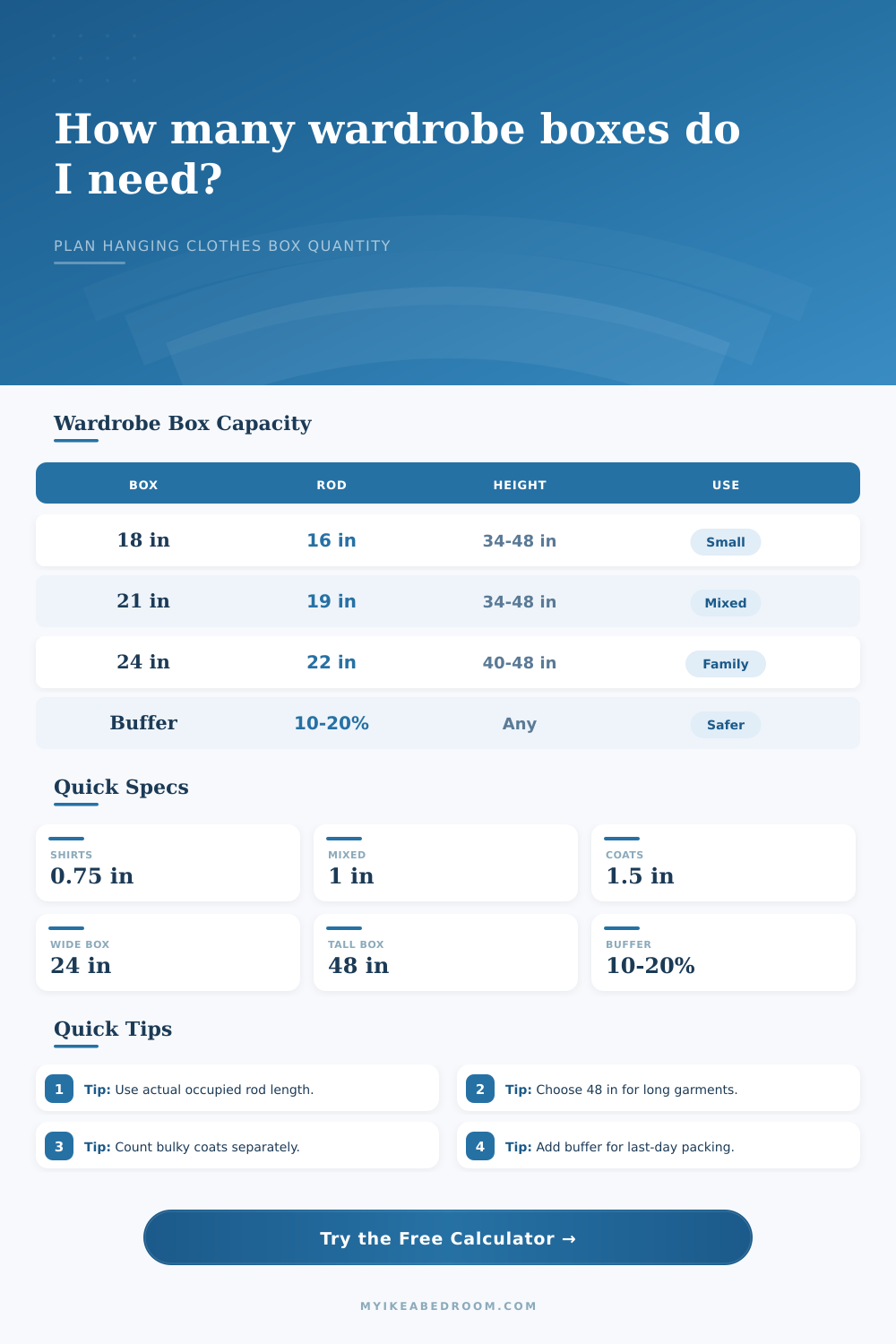
Estimate wardrobe boxes from occupied garment rod length, garment spacing, box width, box height, folded overflow, and last-pack buffer.
| Nominal box width | Usable garment rod | Typical hanging capacity | Best use |
|---|---|---|---|
| 18 in wide | 16 in usable rod | 16 mixed hangers or 10 coat hangers | Small closets, short runs, divided clothing groups |
| 21 in wide | 19 in usable rod | 19 mixed hangers or 12 coat hangers | Apartment closets, balanced moving loads |
| 24 in wide | 22 in usable rod | 22 mixed hangers or 14 coat hangers | Large wardrobe runs and family closets |
| Clearance rule | Box width minus 2 in | Prevents sidewall compression | Use for hanger hooks, fabric bulk, and loading space |
| Garment group | Allowance per hanger | Capacity on 21 in box | Planning note |
|---|---|---|---|
| Light shirts | 0.75 in, 1.9 cm | About 25 hangers | Thin hangers, shirts, light blouses, slim trousers |
| Mixed closet | 1.00 in, 2.5 cm | About 19 hangers | Everyday shirts, pants, dresses, and light jackets |
| Suits and blazers | 1.25 in, 3.2 cm | About 15 hangers | Structured shoulders need extra side clearance |
| Coats and knits | 1.50 in, 3.8 cm | About 12 hangers | Good default for sweaters, coats, and thick knits |
| Bulky outerwear | 2.00 in, 5.1 cm | About 9 hangers | Use for parkas, long coats, padded jackets, and robes |
| Box height | Hanging fit | Folded capacity range | Use this height when |
|---|---|---|---|
| 34 in short | Shirts, kids clothes, folded pants | 14 to 18 folded pieces by width | Garments are short or can be folded over hangers |
| 40 in standard | Most shirts, blazers, short dresses | 17 to 22 folded pieces by width | Closet is mixed and long pieces are limited |
| 48 in tall | Suits, coats, dresses, longer garments | 20 to 28 folded pieces by width | You want fewer folded-over hanging garments |
| Height warning | Box shorter than garment group | Adds folded overflow pieces | The calculator converts the height mismatch into overflow |
| Preset | Occupied rod | Garments and type | Box setup |
|---|---|---|---|
| Studio closet | 48 in, 122 cm | 50 mixed hangers plus 8 folded pieces | 18 in wide, 40 in high, 10% buffer |
| One-bedroom mixed | 72 in, 183 cm | 72 mixed hangers plus 12 folded pieces | 21 in wide, 40 in high, 10% buffer |
| Winter coat closet | 54 in, 137 cm | 34 coat hangers plus 6 folded pieces | 24 in wide, 48 in high, 15% buffer |
| Formal wear | 60 in, 152 cm | 45 suit and dress hangers plus 10 folded pieces | 24 in wide, 48 in high, 15% buffer |
How do you get an accurate idea of how many clothes will fit inside a cardboard box? Try standing in front of your open closet and then freak out. Most folks throws some hangers into a box and pray it works out.
If you follow that plan, you’ll probably end up with a bunch of empty boxes littered throughout the garage and then run out of boxes on move-in day…while you’re still trying to pack.
Why Use a Wardrobe Box Calculator?
By entering your garment types and hanging rod length into the wardrobe box quantity calculator above, it do all the math for you. You do not need to guess conversions and coefficients.
This gets to the heart of the issue: Not all hangers is created equal, for example, a thin wire hanger holding a button-down shirt take up significantly less room than a sturdy wooden coat hanger supporting a heavy wool blazer. Because each box has its own unique capacity based on size of the fabric you’re hanging and width of the hanger’s hook itself, the tool want you to tell the difference between your different garments. Otherwise, you’ll find yourself with some overflowing boxes and other ones completely vacant.
When realy, they should of been treated differently, like a closet packed with warm winter coats versus a closet filled with light cotton summer blouses.
The most important step that most movers skip entirely is measuring your closet rod. When you’re doing it yourself, you’re not measuring from wall-to-wall; you’re measuring from one hanging point to the next. There is a difference between a full rack and a sparse one with bulky items. This used length tells the calculator how many linear inches of your clothing require a home. Then it divide that number by the amount of usable rod space inside a standard box. This space is usually shorter than the outside width because there needs to be some room on the sides.
Another one that throws people off is height. Sure, you think a small box is great if you’re storing only clothes like shirts. But if you have suit jackets and dresses that is longer, they’ll either bunch up inside the box, or get folded, undoing the whole point of storing it wrinkle free.
To counteract this, the tool flags any height mismatches. If your clothes exceeds the height of the box, you can treat them as being folded over. These are overflow items that need to go somewhere else, such as into separate packing or a taller box. This impact how many boxes you end up with overall.
This is where logic meets intuition, the buffer setting. I don’t think anyone adds a 10-20% buffer because they’re pessimistic, I think everyone adds it because it’s reality. You decided to hang up one jacket rather than fold it. You totally forgot about that one sweater.
How much of a difference does it make? The chart found on the page breaks it down and shows how adding even a small percentage can save you from the nightmare of purchasing those last-minute emergency boxes. Better to have an extra box than scramble for trash bags in front of the moving truck.
Overflow is also part of the equation. Everything doesn’t fit on a hanger. You choose to pack away off-season clothes instead of hanging them. Jeans that takes up more space different than you expected. Stretch sweaters. Items like sweaters that stretch, jeans, or off-season items goes in the folded category. But since they use a different kind of space, the calculator take these off of the hanging items and separates them out. If you mix the two categories together in your mental model then you gets an inaccurate estimate. How many are going to be folded? How many is going to be hung?
So ultimately, it’s all about space and volume, and how do you solve the packing puzzle? You break down your closet into something measurable and you take away any anxiety around it. No longer are you guessing and winging it.
The calculator tells you a number, but the beauty of it is that you learn what that number means for yourself in relation to your personal clothing habits. It takes something that feels chaotic and messy (a pile of clothes) and converts it into something that can be managed (a series of boxes). At the end of it all, there’s no vague sense of dread; only clarity on what comes next.
The rod length itself isn’t important as much than the planning.