Wallpaper Paste Quantity Calculator
Estimate ready-to-use paste, dry powder packs or ready-mix tubs, adjusted wall area, and reserve paste for wallpaper, lining paper, vinyl, murals, and grasscloth.
Full paste breakdown
| Adhesive type | Best wallpaper match | Typical ready mix coverage | Common pack size |
|---|---|---|---|
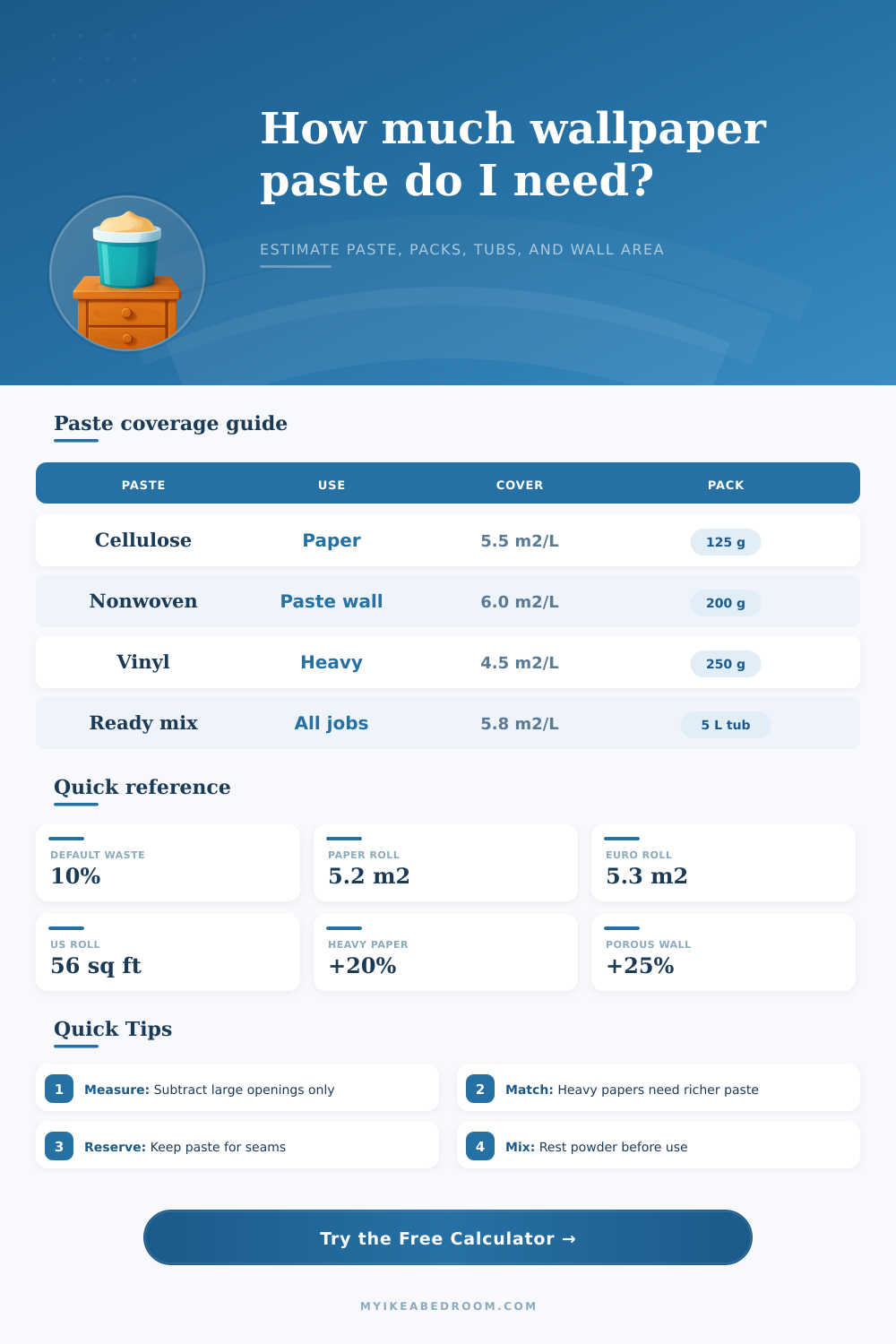
| Standard cellulose powder | Light and standard paper | 5.5 m²/L or 59 sq ft/L | 125 g makes about 4.5 L |
| All-purpose powder paste | General paper and lining paper | 5.2 m²/L or 56 sq ft/L | 200 g makes about 5 L |
| Non-woven paste-the-wall | Paste-the-wall non-woven rolls | 6.0 m²/L or 65 sq ft/L | 200 g makes about 5 L |
| Vinyl-over-vinyl adhesive | Vinyl facing or overlap work | 4.5 m²/L or 48 sq ft/L | 1 L or 2.5 L container |
| Heavy-duty clear adhesive | Embossed, anaglypta, heavy vinyl | 4.2 m²/L or 45 sq ft/L | 250 g makes about 4.5 L |
| Ready-mixed tub paste | Convenient multi-purpose hanging | 5.8 m²/L or 62 sq ft/L | 2.5 L or 5 L tub |
| Clay-based adhesive | Grasscloth and textile coverings | 3.8 m²/L or 41 sq ft/L | 1 gallon or 5 L pail |
| Seam and border adhesive | Seams, borders, patches | 3.2 m²/L or 34 sq ft/L | 250 ml tube or tub |
| Wallpaper type | Paste demand factor | Why it changes | Planning note |
|---|---|---|---|
| Non-woven paste-the-wall | 0.90x | Even wall application | Often uses less than pasted paper |
| Standard paper | 1.00x | Baseline absorbency | Book panels after pasting |
| Pre-pasted paper | 0.55x | Activator or light extra paste only | Use water tray data if supplied |
| Washable vinyl | 1.15x | Less absorbent face, heavier sheet | Use vinyl-rated adhesive |
| Embossed or anaglypta | 1.22x | Thicker paper profile | Keep paste consistent at edges |
| Grasscloth or textile | 1.35x | Heavy natural backing | Avoid staining the face |
| Panel mural | 0.80x | Smaller controlled panels | Do not over-wet printed panels |
| Lining paper | 1.05x | Absorbent prep layer | Size porous walls first |
| Ceiling wallpaper | 1.25x | More handling and edge brushing | Mix a little richer for sag control |
| Roll format | Roll size | Area before trimming | Paste planning use |
|---|---|---|---|
| European single roll | 0.53 m x 10.05 m | 5.33 m² or 57.4 sq ft | Use 90% to 95% for repeats |
| US single roll equivalent | 20.5 in x 16.5 ft | 28.2 sq ft or 2.62 m² | Often sold as double rolls |
| US double roll | 20.5 in x 33 ft | 56.4 sq ft or 5.24 m² | Default roll entry values |
| Wide wallpaper | 27 in x 27 ft | 60.8 sq ft or 5.65 m² | Check pattern repeat waste |
| Mural panel | 24 in x 96 in | 16 sq ft or 1.49 m² | Paste by panel count |
| Commercial wide goods | 54 in wide | 4.5 sq ft per linear ft | Use direct area for accuracy |
| Common project | Approx area | Likely paste | Typical material count |
|---|---|---|---|
| Single accent wall | 9 to 14 m² | 1.8 to 2.8 L | 1 powder sachet or small tub |
| Small bedroom, four walls | 28 to 36 m² | 5.5 to 8 L | 2 powder packs or 2 x 5 L tubs |
| Living room, four walls | 42 to 55 m² | 8 to 12 L | 2 to 3 powder packs |
| Hallway or stair run | 20 to 35 m² | 5 to 9 L | 2 packs, allow seam reserve |
| Grasscloth feature wall | 10 to 18 m² | 4 to 7 L | 1 pail or 2 heavy-duty packs |
| Ceiling wallpaper | 12 to 25 m² | 4 to 8 L | 1 to 2 heavy-duty packs |
Powder paste
Best when you want flexible mix strength. The calculator converts required ready-to-use paste into full dry packs using each pack yield.
Ready-mixed tub
Best for steady texture and quick setup. Results round to 2.5 L or 5 L tubs depending on the adhesive preset.
Heavy wallcovering
Vinyl, anaglypta, grasscloth, textile, and ceiling work need lower coverage rates and higher reserve than standard paper.
Roll-based planning
Use roll mode when the room is not measured yet. It estimates pasted surface from roll width, roll length, and pattern allowance.
With high hopes you begin hanging wallpaper, yet that first panel sags. Why? You had to conserve adhesive by diluting paste. But the wall required more paste than you anticipated; the paper is heavy, or plaster is porous.
Why does getting quantity correct matter? Because the paste is not only a bonding agent but also a buffer and timing mechanism. Running out of paste mid-wall lead to seam problems. Color mismatch from batch to batch also are possible. Inconsistent drying time create potential for bubbles down the line.
Why Calculating Wallpaper Paste Matters
Typically, most folks just guess at how much paste they’ll need… Which isn’t a good way to do it. Two room of the same size might need more or less glue because of how much is wasted on things like wall patterns and texture. Also, do you want to apply the glue to the paper or the wall? The calculator takes care of all that math when you input your room size.
It even accounts for heavier grasscloth absorbing more glue then lightweight non-woven paper. It also explains what they’re talking about: How does it compare? Ready mixed or powder? Powder lets you control how thick it goes on; but you have to mix it yourself. Ready mix is easy; but you’re hauling more. If you’re wallpapering a big room (and you have high ceilings) those extra tub add up. You’ll see in the table at right that standard paper goes 5.5 square meters/liter, while heavy textiles goes down to 3.8. When you’re buying for an entire house, that’s a major difference.
Prepping the wall: I know, we always forget about this until it’s too late. A freshly skim coated or plain plaster wall is a sponge. That means you want to seal it with sizing coat. Otherwise, the paste just dissapears into your drywall rather than sticking to the paper to hold up your wall. To account for this, the calculator will let you make a buffer for porous walls. It’s nothing major on the input side. But it saves you from running out of glue half way down your hallway after the first couple of rooms drank it all up.
Heavier wallcoverings such as vinyl or anaglypha will require a paste that has more body (is richer). Because they are less absorptive on their faces, you want more adhesive body to help hold weight against gravity. Regular paper is forgiving in that it absorbs fast and sets fast. Vinyl slides longer and therefore will help you align better but can be dangerous without strong paste. Always match your adhesive type to the thickness of your wallcovering. Using light cellulose on a heavy mural causes peeling edges. The tools helps you choose an adhesive with the right strength and coverage rate.
Another key item is paste reserves. After the first time up they dry out, or the edges pull away at the seam. Having some reserved paste (mixed) that can be kept sealed will allow you to reseal the seams. No sense mixing up a whole new batch. Sometimes there are differences in consistency with new batches. The reserve has the same viscosity and texture as what is already on the wall. It’s what makes all the difference between a professional finished look and a patchwork mess.
The logic behind wallpapering is also part art and part math. Preparing your materials before you start eliminates impromptu visits to the store. It guarantees consistent and equal adhesion for each panel. Treating your paste quantity as a calculated variable rather than an afterthought preserves your time and the wallcovering itself. Your reward is a seamless, bubble-free finish. No rushing seams or sagging panels. From the initial roll to the final trim cut, it’s a finished room.