Wallpaper Border Calculator
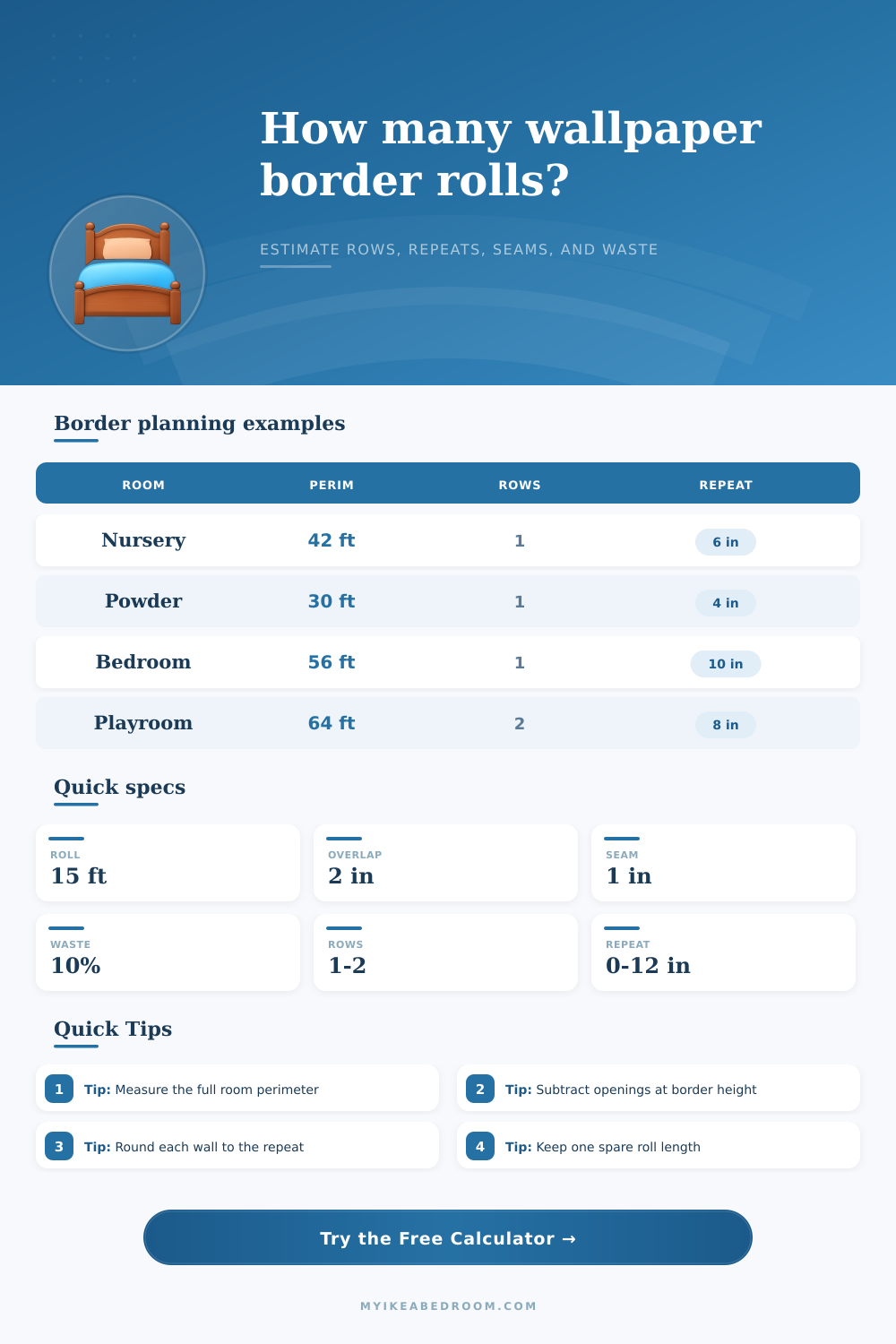
Estimate wallpaper border roll count from room perimeter, wall count, doors, windows, border height, roll length, pattern repeat, corner overlap, seam allowance, rows, and waste.
Choose a room type to load a realistic starting point, then replace the values with your measured perimeter and openings.
0 rolls
Uses the current opening, repeat, row, and waste settings.
0 rolls
Compares a continuous border around all trim.
0 rolls
Shows the roll count if repeat is set to zero.
0 rolls
Useful for double bands or a ceiling plus chair rail layout.
| Location | Typical border height | Rows | Planning note |
|---|---|---|---|
| Chair rail nursery border | 6 to 9 in | 1 | Subtract doors and windows when the band stops at trim. |
| Ceiling border | 4 to 7 in | 1 | Openings usually do not interrupt the run near the ceiling. |
| Playroom wall band | 7 to 10 in | 1 or 2 | Use extra waste for bold motifs and multiple rows. |
| Closet trim border | 3 to 5 in | 1 | Short walls can create more repeat waste per wall. |
| Tile-top bathroom border | 4 to 8 in | 1 | Door openings are usually deducted; mirrors may or may not be deducted. |
| Allowance | Typical input | Added by calculator | Use when |
|---|---|---|---|
| Corner overlap | 1 to 3 in | Wall count x rows | Inside and outside corners need wrapped overlap. |
| Seam allowance | 0.5 to 2 in | Estimated roll joins | Ends are overlapped or trimmed at seams. |
| Pattern repeat | 0 to 12 in | Each wall cut rounded up | Border has a motif that must align at starts. |
| Waste percent | 5% to 20% | After repeats and seams | Allows for trimming, mistakes, and roll defects. |
| Opening type | Count when | Measure | Calculator handling |
|---|---|---|---|
| Door | Border crosses the doorway height | Clear trim-to-trim width | Door count x average door width |
| Window | Border intersects casing or frame | Outside casing width at band height | Window count x average window width |
| Mirror or cabinet | Border stops at the object | Visible gap where border is omitted | Enter as window width if needed |
| Continuous ceiling border | Border runs above openings | Full room perimeter | Choose run through all openings |
| Roll length | Plain match | 6 in repeat | 12 in repeat |
|---|---|---|---|
| 5 yards / 15 ft | Best for small rooms | Plan moderate waste | Use for short walls carefully |
| 10 yards / 30 ft | Fewer seams | Good for bedrooms | Better roll efficiency |
| 4.5 m / 14.8 ft | Common metric roll | Similar to 15 ft | Check repeat in cm |
| 9 m / 29.5 ft | Useful for large rooms | Fewer joins | Good for two rows |
Measure openings at the border line. A chair-rail border may be interrupted by windows, while a ceiling border often passes above doors and windows without a deduction.
Pattern repeat is applied wall by wall. This keeps motifs aligned at new wall starts and gives a more realistic roll count than rounding only the full perimeter once.
To install a decorative border around a room, an individual must perform a few calculations prior to beginning the installation of the border materials. One calculation that an individual is to perform is the calculation of the total amount of border material that is required for the room. The total amount of border material that is required for the room can be influenced by various factors besides the perimeter measurement of the room, such as the number of doors, windows, corner, and the pattern in which the individual is to arrange the border material.
To determine the length of border material that is required for each wall of a room, an individual may measure each of the walls of the room. Additionally, the individual may subtract the width of each door and window from the length of each wall. For example, if installing a chair rail border, the border will likely stop at the trim of each door or window.
How to Work Out How Much Border You Need
However, if installing a ceiling border, the border may continue beyond the trim of the doors and windows. Each of these different installation methods will influence the length of border material that is purchased for the room. The individual can measure the length of each wall of the room, the individual can subtract the widths of any openings in those walls, and the individual can then round the length of each wall up to the nearest inch to allow for the border pattern to line up with the border pattern of the adjacent walls.
Additionally, more inches can be purchased for the corners of the room, as well as for waste in case any trimming error occur when installing the border. The calculator that is provided on this page allows an individual to input the measurements of their room and the widths of their openings, and it will calculate for them the length of border material that they will need based off these factors. These measurements will allow an individual to determine if their roll of border material is the most efficient roll size for their specific type of room.
For instance, a 15-foot roll of border material may be sufficient to install around a small powder room. However, a 15-foot roll of border material may be inefficient if installing two rows of border material, as well as if the border material feature a 12-inch repeat in its pattern. Because border material that features a 12-inch repeat will require rounding each length to the nearest 12-inch measurement, a 15-foot roll may be insufficient for the length of each wall of the room that is to be bordered.
Not all rooms are the same in size, layout, or the type of border that an individual is to install on those rooms. For instance, the border that may be installed in a nursery may cross many doors and windows, while the border that is installed in a playroom may include two row of border material. Additionally, because there will be more waste with the playroom border due to the additional rows of border, the percentage of waste in that calculation will be higher.
Finally, a border that is installed in a closet may require more waste per foot of border material than waste per foot for a hallway. This page provides a reference table that includes the dimensions for various types of rooms and the type of border that is to be installed in those rooms. Although an eight-inch playroom band requires more border material than a three-and-a-half-inch office picture rail, both types of bands require you to account for the material that will be required to make the corners of the band.
The reference table will provide indications of when you should subtract the width of openings from the perimeter measurements and when you should not subtract the width of the openings. People often under-estimate the amount of border material that will be required for the small allowances for the corners of a room. For example, two inches of border material will be required for each corner of the room.
Thus, eight inches of border material will need to be accounted for before any additional material is purchased for the seam in the border. Additionally, if a room has an eleven-foot wall with a border pattern that repeats every six inches, the border material will need to be cut at a length of twelve feet of border material for that one wall. Any room with a pattern will require an additional foot of border material to be purchased for each wall with that pattern.
Calculators that are used to compute the amount of border material required for a job will often indicate high numbers of rolls of border material needed because of these allowances. A waste percentage will be necessary for any calculation that computes the amount of border material needed for a job. This percentage is used to account for the fact that many border designs include a seam that does not match the adjacent border material.
Additionally, any roll of border material may have defects in it that are only discovered after unrolling the border material. A ten percent waste is typically used for most border jobs. However, if the border has a bold motif design with distinct images in it, or if there are multiple rows of border material to be installed, a higher waste percentage will be required.
A lower waste percentage can be used for plain borders or borders whose patterns are randomized along the border material. Plain border material can often be cut into smaller pieces that can be used on another wall. A toggle button can be used to change the units from feet and inches to metric units.
Metric units will be useful if the manufacturer manufactured the border material overseas. The measurements in metric units may be used if the tape measure to be used to measure the dimensions of the room uses centimeters as its unit of measurement. The calculations will be the same, but the answers will be reported in the type of measurement units that the border material will be measured in.
The dimensions of the rooms that will be adorned with the border may have features that are more complex than rectangles. For example, alcoves, built-in cabinetry, and doors may interrupt the perimeter of the room. These features will need to be accounted for when measuring the perimeter of the room for border material.
The border calculator will assume that the room has straight walls and that the height of the border will be consistent throughout the entire room. In this case, the individual should measure the room at the height at which the border will be installed to avoid introducing errors into the border material purchase calculations. When determining the number of rolls of border material are necessary for the job, it is often a good idea to also purchase an extra roll of border material.
Border patterns are often discontinued at manufacturers, so purchasing an extra roll of border material is a small price to pay to avoid having to purchase a new border pattern. The calculator will provide the measurements in rolls of border material that will be required for the job. However, it is up to the individual to decide if an extra roll should be purchased.
The calculations are not made to determine the amount of border material that would create zero waste with border cuts; rather, it is to ensure the supplier purchases enough border material to complete the project.