🏗 Wall Framing Calculator
Estimate studs, plates, headers & lumber for walls with windows and doors
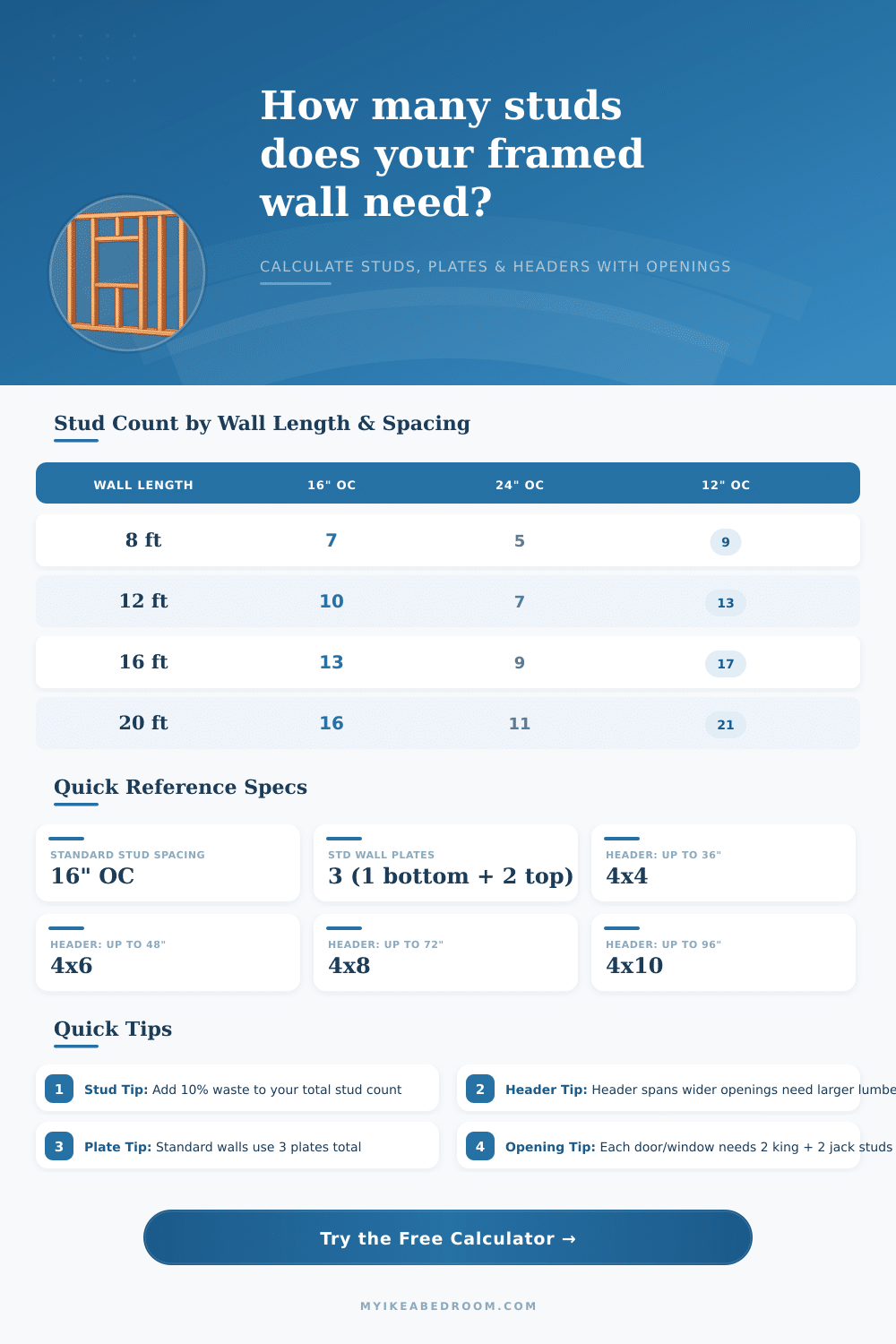
| Wall Length | 12" OC Studs | 16" OC Studs | 24" OC Studs | Notes |
|---|---|---|---|---|
| 4 ft | 6 | 4 | 3 | Short partition wall |
| 8 ft | 10 | 7 | 5 | Standard bedroom wall |
| 10 ft | 12 | 9 | 6 | Common exterior |
| 12 ft | 14 | 10 | 7 | Standard room width |
| 16 ft | 18 | 13 | 9 | Living room wall |
| 20 ft | 22 | 16 | 11 | Garage / open plan |
| 24 ft | 26 | 19 | 13 | Long exterior wall |
| Opening Width | Header Size | Typical Use | Notes |
|---|---|---|---|
| Up to 36 in (3 ft) | 4x4 | Narrow doors/windows | Interior walls OK |
| 37 - 48 in (4 ft) | 4x6 | Standard doors & windows | Common residential |
| 49 - 72 in (6 ft) | 4x8 | Wide windows, double doors | Verify with engineer |
| 73 - 96 in (8 ft) | 4x10 | Garage doors, large openings | Structural review needed |
| Over 96 in (8 ft) | Engineered beam | Large garage / sliding doors | Engineer required |
| Wall Size | Studs (ea) | Plate Length (ft) | Total Lumber (lin ft) |
|---|---|---|---|
| 8 ft x 8 ft | 7 | 24 | 80 |
| 12 ft x 8 ft | 10 | 36 | 116 |
| 16 ft x 8 ft | 13 | 48 | 152 |
| 20 ft x 9 ft | 16 | 60 | 204 |
| 24 ft x 9 ft | 19 | 72 | 243 |
| 24 ft x 10 ft | 19 | 72 | 262 |
Wall framing is structure that you can assemble on the floor for more easy nailing and later raise it vertically. So that the drywall easily fits and the wall is stable, you must measure exactly and cover the spacing. This method on the floor is very popular although some prefer to build everything in place, cutting the studs because the floor or ceiling could be wonky
You must consider two main kinds of walls. A load-bearing wall carries the weight of the roof and the ceiling. A non-load-bearing wall does not bear any weight of the upper framing.
How to Build a Wall Frame
You must know the differnece before you start any work.
Imagine a window or door as a big hole in the wall. Because of such a hole, the wall studs are removed, which weakens the structure. Usually above a window is a header, that is a solid bit of wood.
To the sides of every opening you lay wood to brace it. For plans with openings and cripples above the header, you first cut and nail the king studs and the trimmers. Lay them in position and nail them to the plates.
Later set the header on the trimmers and nail through the king studs to keep it flat. Use real trimmers and cripples at rough openings give a better result, although many builders ignore that now.
Framed walls require vertical studs each 16 or 24 inches. When you lay internal walls, the studs must be arranged so that drywall fits the corners. Also line the studs with the existing joists.
Ensure that the framing will not take the whole width of the wall, because maybe you will need to move the wall when you raise it.
In a house, the hallway and the longest walls of the main rooms are usually through walls, while closets and short partitions are usually butt walls. You first build and raise the through walls, and later nail the butt walls to their corners.
For batch cuts, you save time if you line the studs and mark all at the same size on the edge, and later cut them with a round saw. Corners always require support. Instead of wood, you can use metal studs to build the framing.
In the Pacific Northwest, you use treated wood only for the bottom plate, and regular kiln-dried wood for the studs and the upper plate. Leave a small space of one inch between the wall and the concrete to stop humidity from moving from the foundation to the framing. Some bits of noggins also are needed, depending on the size of the wall coverings.