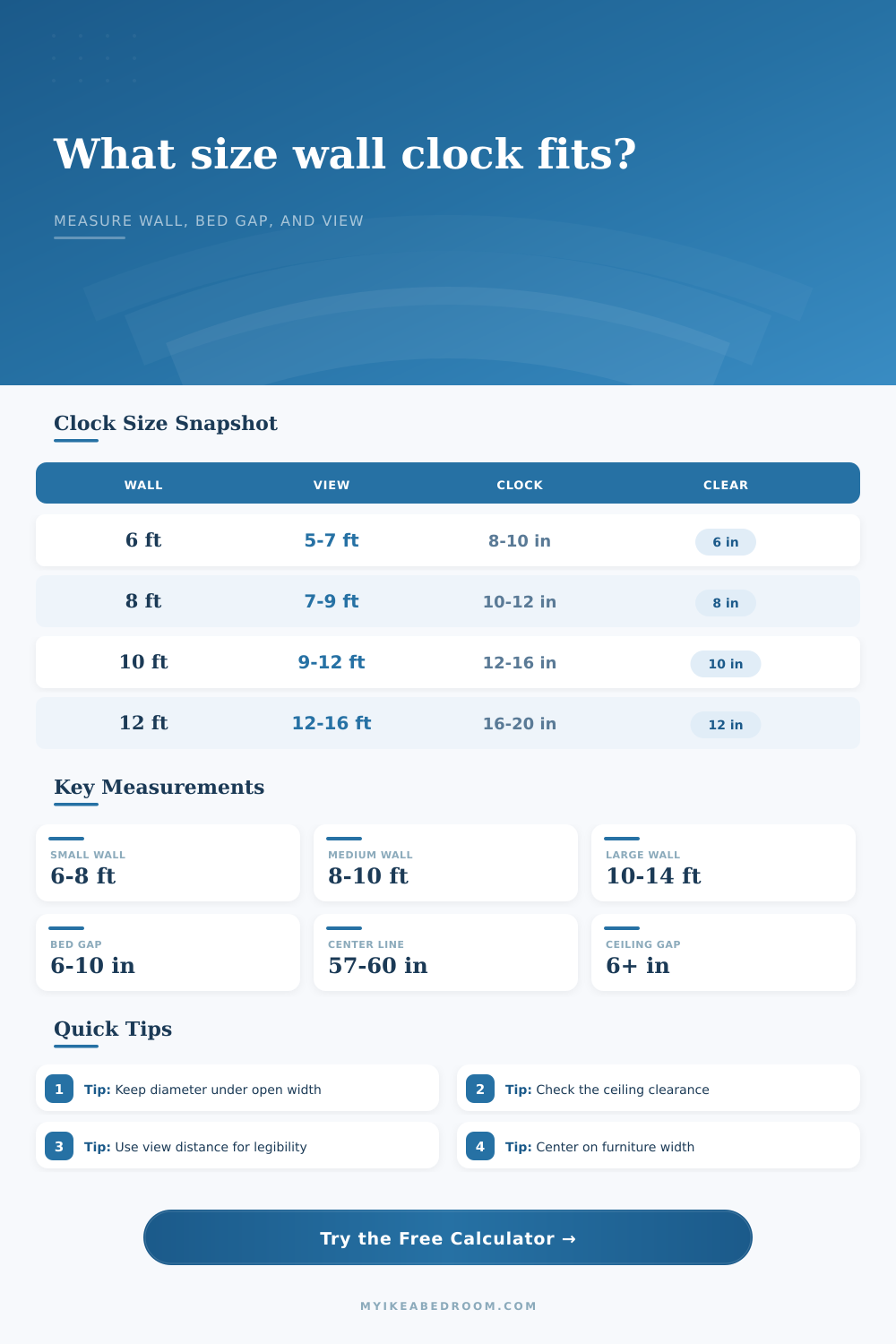
Wall Clock Size for Wall Calculator
Calculate a wall clock diameter from usable wall width, wall height, viewing distance, furniture width, clearance, and mounting center height.
Choose a measured wall situation, then adjust the exact dimensions for your room.
| Usable wall width | Measured width in inches | 12% clock width | 15% clock width | 18% clock width |
|---|---|---|---|---|
| 4 ft narrow wall strip | 48 in | 5.8 in | 7.2 in | 8.6 in |
| 6 ft closet-side wall | 72 in | 8.6 in | 10.8 in | 13.0 in |
| 8 ft bedroom wall | 96 in | 11.5 in | 14.4 in | 17.3 in |
| 10 ft queen-bed wall | 120 in | 14.4 in | 18.0 in | 21.6 in |
| 12 ft king-bed wall | 144 in | 17.3 in | 21.6 in | 25.9 in |
| 14 ft large bedroom wall | 168 in | 20.2 in | 25.2 in | 30.2 in |
| Viewing distance | Minimum diameter | Comfort diameter | Large diameter | Metric comfort diameter |
|---|---|---|---|---|
| 4 to 6 ft | 6 in | 8 in | 10 in | 20 cm |
| 6 to 8 ft | 8 in | 10 in | 12 in | 25 cm |
| 8 to 10 ft | 10 in | 12 in | 14 in | 30 cm |
| 10 to 12 ft | 12 in | 14 in | 16 in | 36 cm |
| 12 to 16 ft | 14 in | 18 in | 22 in | 46 cm |
| 16 to 20 ft | 18 in | 24 in | 30 in | 61 cm |
| Clock diameter | Minimum clear width | Minimum clear height | Center to edge | Metric diameter |
|---|---|---|---|---|
| 8 in | 16 in | 16 in | 4 in | 20 cm |
| 10 in | 20 in | 20 in | 5 in | 25 cm |
| 12 in | 24 in | 24 in | 6 in | 30 cm |
| 16 in | 32 in | 32 in | 8 in | 41 cm |
| 20 in | 40 in | 40 in | 10 in | 51 cm |
| 24 in | 48 in | 48 in | 12 in | 61 cm |
| Measured condition | Typical dimension | Clock bottom clearance | Ceiling clearance | Width alignment check |
|---|---|---|---|---|
| Above headboard | 48 to 60 in top height | 6 to 10 in | 6 in or more | Under 1/3 bed width |
| Above dresser | 32 to 42 in top height | 6 to 12 in | 6 in or more | Under 1/2 dresser width |
| Above desk | 28 to 30 in top height | 10 to 18 in | 6 in or more | Under 2/3 desk width |
| Open wall center | 57 to 60 in center | Not applicable | 6 in or more | 12 to 18% wall width |
| Door-side wall | 24 to 36 in strip width | Not applicable | 6 in or more | Leave 4 in side gap |
For a single clock on a clear bedroom wall, 12% to 18% of usable wall width keeps the diameter tied to the measured surface.
Use the normal viewing position to confirm readability; long sight lines usually need a larger diameter than wall proportion alone.
When a bed, desk, or dresser sits below the clock, the bottom edge should clear the furniture top by the entered gap.
Check the top edge after the diameter is calculated so the clock does not crowd the ceiling, trim, or upper shelf line.
Consider the empty wall, then grab a measuring tape and stand in center of the room. What happens? A clock too large becomes a target; a clock too small become lost. This is a scale problem; one that most people guess at. More often than not they end up with a clock that’s too dominant or too small for the space.
Once you enter your wall dimensions and viewing distance into the calculator above, it do the math for you. That means no more guessing on proportion, and better yet it allows you to verify clearances before making an un-aligned install.
How to Choose the Right Clock Size
First off, let’s get one thing straight: walls is limited. That doesn’t mean they can holds any big object just because they have enough space. Interior designers often follow a rule that art pieces shouldn’t take up more than roughly sixty to seventy percent of the furnitures beneath them. However, a clock hanging on an empty wall follows a different set of rules. It require breathing room.
Say your wall measures ten feet across. What if you place a two-foot diameter clock? Technically, it’ll fit. But visually, it’ll dominate the scene. To ensure the clock matches the architectural elements instead of struggling against them, the tool take a percentage-based approach to keeping its diameter in check. Remember, you’re often only thinking about the clock itself; what’s missing is negative space that makes it meaningful.
The other variable here is the viewing distance. From six feet away I can read a small clock, but not when it’s on the other side of a big room with the bed pushed up against the far wall. In that case, I won’t be able to make out the numbers. To deal with this, the calculator wants to know where you normally sit to view your clock. This help ensure that you’ll be able to read the time without having to strain.
Want this for your home office? You’re going to want something legible at close range. Want this for a big living area? You’re going to want something that stand out at a distance. The calculator figures out how to balance both needs. And it protects you from purchasing something so small you won’t be able to read it, or so big you won’t even notice its there.
The math meets the physical world through mounting height. This means think about what exists already. Window sill? Dresser? Headboard? The existing furniture alter how much vertical space is available to work with. If you have a dresser that’s 42-inches tall, then the clock won’t go up to eye-level. It must be mounted a few inches away (six-to-eight) so it doesn’t appear as though it would of topple over on piece underneath. The desired center point, plus height of the furniture, goes into the equation to provide an exact limit on diameter. It’s not a large constraint, but it avoids the most frequent mistake people make when installing.
The same goes for ceiling clearance. When we look at our furnitures, we have a tendency to look downward. What about upward toward the ceiling line? If your clock are hung too high, it will seem disconnected from what’s happening in the room. Fifty-seven to sixty inches above the floor is the general eye-level range, where our eyes rest when standing or sitting comfortabley. That means it’s only natural to take a quick peek upward to see the time. There’s a reason this rule of thumb applies. This is where our eyes naturaly go when we’re seated (or standing) comfortably. Hanging your clock outside of that range just feels wrong.
This means that when you’re looking at clocks in online shops and trying to picture what it will look like in your space, having some sort of reference table of common sizes against their dimensions can be realy helpful. This is where these tables come in: They’re a way of quickly checking your sanity when you’re wondering whether an eight inch clock is going to look right on a narrow wall, or what a sixteen inch clock is going to do on a broader wall. You have the data to help back up your intuition.
Ultimately, a wall clock is not just an item to check time with, but also a feature of the room’s design. Size it correctly and it anchors the room. Size it incorrectly and it detracts from all the other elements. Above is the tool that makes the geometry simple so that you can concentrate on the style. Enjoy the symmetry; measure twice, calculate once.