🪡 Voile Curtain Yardage Calculator
Estimate sheer voile fabric by window width, fullness, panel count, bolt width, hems, repeats, shrinkage, and cutting buffer.
📌 Room and window presets
⚙ Yardage settings
📏 Voile spec grid
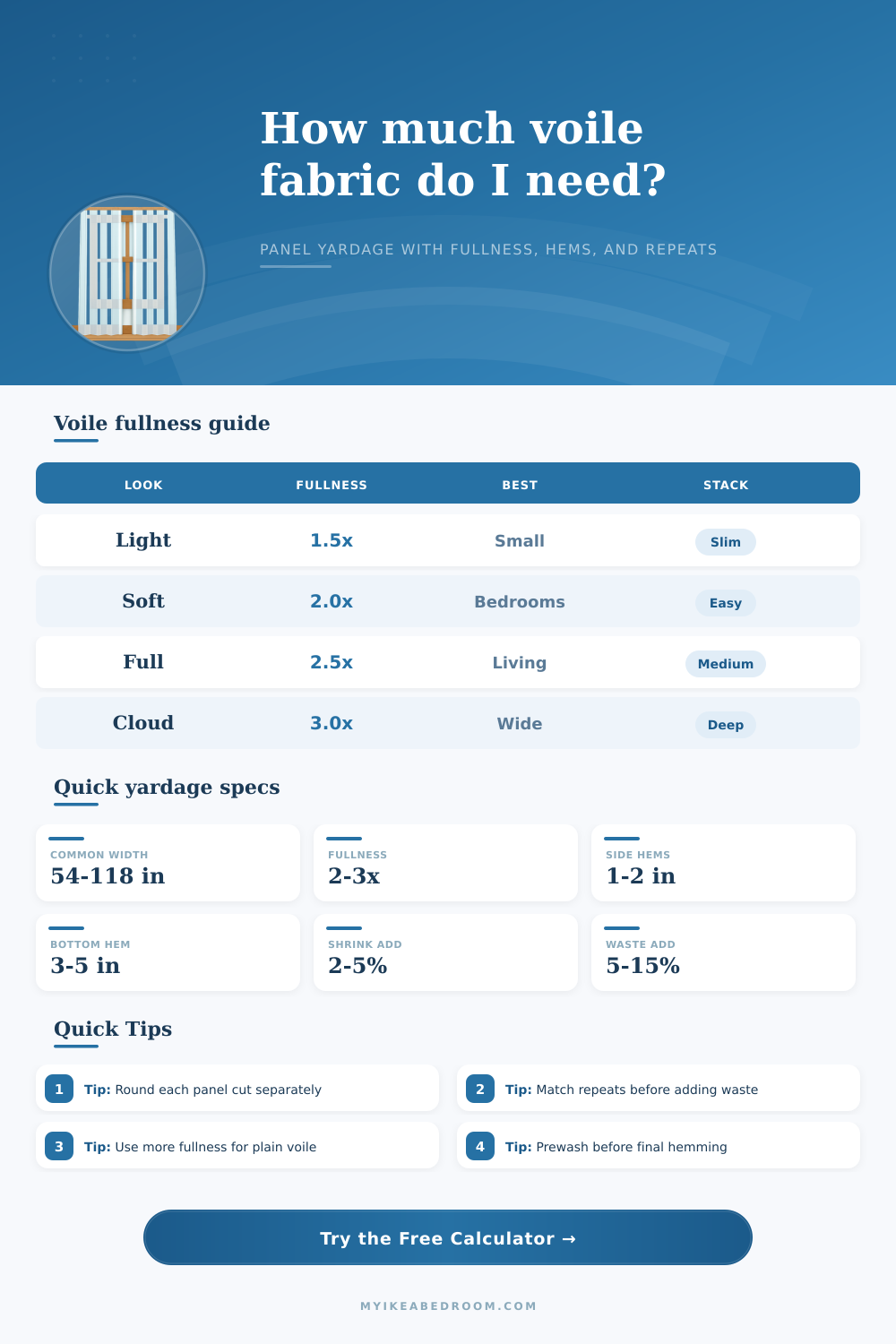
🗂 Fullness reference table
| Voile look | Fullness ratio | 72 in coverage uses | Best use |
|---|---|---|---|
| Light gather | 1.5x | 108 in fabric face | Short cafe panels and small rooms |
| Soft standard | 2.0x | 144 in fabric face | Most bedroom voile pairs |
| Full sheer | 2.5x | 180 in fabric face | Living rooms and tall windows |
| Cloud sheer | 3.0x | 216 in fabric face | Wide glass with a layered look |
| Very dense | 3.5x | 252 in fabric face | Plain voile where privacy matters |
🧵 Fabric width and seam table
| Bolt width | Approx usable face | Seam behavior | Typical voile use |
|---|---|---|---|
| 45 in | 41-43 in | More joined widths | Narrow embroidered panels |
| 54 in | 50-52 in | Common joined widths | Standard decorator voile |
| 60 in | 56-58 in | Moderate seams | Casual cotton voile |
| 90 in | 86-88 in | Fewer seams | Tall or wide sheer panels |
| 108 in | 104-106 in | Often one width per panel | Full-length bedroom curtains |
| 118 in | 114-116 in | Best for seamless sheers | Extra wide living room voile |
📋 Header and hem allowance table
| Construction | Top add | Bottom add | Notes |
|---|---|---|---|
| Clip rings | 1 in | 3-4 in | Shortest cut allowance, airy hang |
| Rod pocket | 4 in | 3-5 in | Classic gathered sheer heading |
| Back tab | 3 in | 4 in | Cleaner top, less visible hardware |
| Wave tape | 3 in | 4-5 in | Even folds with controlled fullness |
| Pleater tape | 4 in | 4-5 in | Structured heading for formal sheers |
| Grommet-style | 5 in | 4 in | Needs extra top depth for rings |
📐 Repeat and rounding table
| Repeat type | Round cut length to | Extra per width | When it matters |
|---|---|---|---|
| Plain voile | Actual cut length | 0 in | No visible vertical motif |
| Tiny texture | Actual or 2 in | 0-2 in | Subtle slubs or dots |
| Small embroidery | Repeat length | Up to one repeat | Motifs align at hem line |
| Stripe or vine | Repeat length | Up to one repeat | Panels meet evenly at seams |
| Border voile | Border layout | Project-specific | Bottom border must stay level |
🔁 Yardage comparison grid
💡 Practical tip boxes
Voile is notoriously difficult to budget because it moves so much on the cut. A slight snip with shears can throw off the balance in a panel. When you’ve hung one panel and are admiring how it looks, you have that moment of “oh no, what about the second panel? You do not have quite enough fabric. That’s why accurate measurement before cutting is important and trimming the excess at the top will affect appearance.
You can understand how it all works, and avoid any costly mistakes. Sheer curtain-making rely on one key variable: fullness ratio. Voile will be see-through if pulled taut across the window. Using 1.5 times the window’s width would look OK, but a heavy velvet would not. To achieve light diffusion and soft privacy, count on twice or even triple final width. For a full, layered look, go with a greater ratio.
Why Voile Needs Extra Fabric
The tool multiples that number by the ratio you chose, so you only buy as many yards as necessary. Then there’s bolt width. That’s the place your gut won’t serve you well. Fifty-four inch widths is standard for decorator fabric. That seems like plenty until you consider adding seam allowance and side hem. So if you want a panel finished at forty inches wide, you’ll need more than one width of fabric joined together.
The calculator figure out how many widths are necessary across all the panels, and it also looks at style of header. Adding a simple rod pocket only increases amount by so much, while a grommet top add a little extra height for the rings. If you’re making six or eight panels for a big bay window, these little extras adds up fast.
Another source of waste is pattern repeats. For example, if you choose a voile with a vertical motif like embroidery or a delicate vine, every cut must be spaced correctly. This ensures the pattern look consistent. In other words, you need to round all of your cuts up to the next complete repeat, which will create some scrap fabric that can’t be used. Colorful or plain white voiles without any motifs don’t present this issue and are thus sometimes cheaper options for starters.
Check out reference table on the page to see the impact of different seam strategies and header types on your overall amount of yardage. Finally, remember that all finished curtains will shrink. Linen or cotton voile (and other natural fibers) does shrink with washing. Purchase just enough fabric to fit your curtain (dry), and then your hem could rise an extra couple of inches in the wash exposing raw edge. For a proper professional finish you should of add a little extra for shrinkage.
With the calculator, you can enter the shrinkage allowance and it will adjust final cut length to allow for it settling over time. Voile takes some planning and patience, a sharp blade will help, but you’ll expend less energy improvising than if you plan ahead of time. On a big work surface lay out fabric flat and cut each panel, all at once, for consistency. Mark the hems with chalk or pins then cut all pieces at once to maintain consistency.
Voile is so flimsy it’s tempting to hurry up and get it over with when it comes to the hem. The visual layer is what makes this a light-filled room. Take your time on the bottom fold and top header, they set the tone for the curtain’s weight and how it hangs. The secret is that a well-executed window treatment understands the way a fabric behave and accommodates it instead of trying to fight it.
Voile likes to gather, like to float… and needs room to do it. Plan in advance for shrinkage, hems, fullness, and voila! The finished product is not only beautiful but also has that airiness that comes from planning ahead for just the right amount of fabric. You will have no more frantic “I’m-out-of-fabric” moments and you will have the happiness of a perfectly proportioned drape.