Visual Weight Calculator
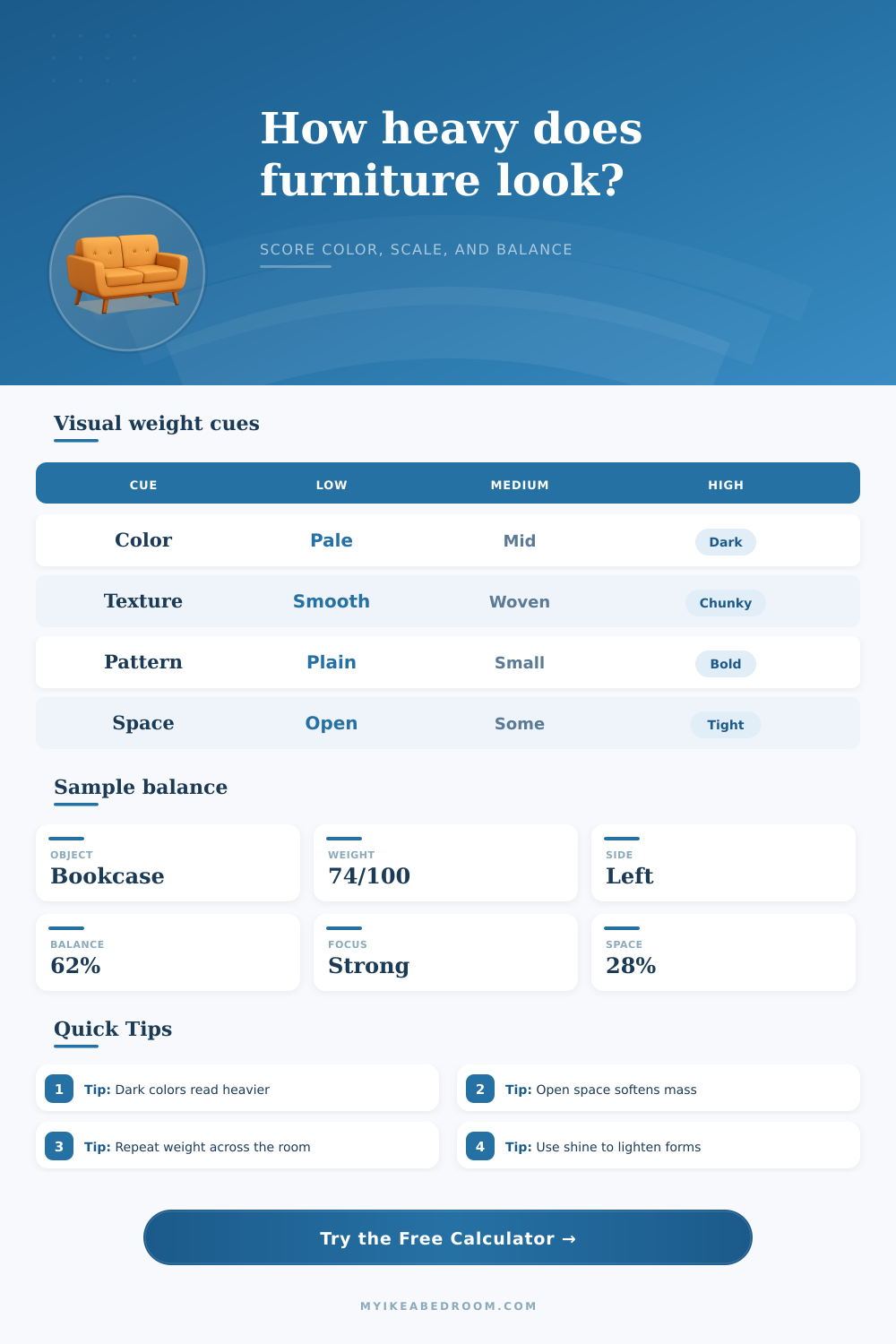
Estimate how strongly a sofa, bookcase, rug, gallery wall, bed, dresser, or accent group pulls attention by combining size, color depth, texture, pattern, placement, quantity, reflectance, and surrounding open space.
Start with a familiar furnishing, then tune the measurements and visual cues to match what you see in the room.
Balance and cue breakdown
| Visual score | Perceived role | Room effect | Typical adjustment |
|---|---|---|---|
| 0 to 24 | Very light | Fades into background | Add contrast, height, or repetition if it disappears. |
| 25 to 44 | Light support | Balances small accents | Pair with medium pieces for a calm arrangement. |
| 45 to 64 | Room anchor | Noticeable but flexible | Use near center or counter with similar mass. |
| 65 to 82 | Strong feature | Pulls the eye quickly | Balance with color, art, lighting, or open space. |
| 83 to 100 | Dominant focal point | Controls the composition | Keep intentional or reduce darkness and clutter. |
| Cue | Light reading | Medium reading | Heavy reading |
|---|---|---|---|
| Color darkness | White, cream, pale oak | Tan, gray, medium wood | Black, navy, walnut, charcoal |
| Texture level | Smooth lacquer, glass | Flat weave, fine grain | Boucle, caning, ribbing, rough wood |
| Pattern scale | Plain or low contrast | Small repeat or tonal plaid | Large checks, murals, high contrast motifs |
| Negative space | Open sides and clear floor | Some breathing room | Tight grouping, crowded wall, blocked floor |
| Placement condition | Balance effect | Use it when | Watch for |
|---|---|---|---|
| Centered | Low left/right pull | Beds, media consoles, dining tables | Can feel static if every object is centered. |
| One third off center | Moderate pull | Accent chairs, dressers, plants | Needs a smaller echo on the other side. |
| Near room edge | High leverage | Tall shelves, wardrobes, gallery clusters | Can make the room tilt visually. |
| Split pair | Self-balancing | Nightstands, lamps, twin chairs | Mismatch in color or height can still pull. |
| Object type | Usual score band | Why it reads that way | Balancing move |
|---|---|---|---|
| Dark bookcase | 68 to 86 | Tall, dark, detailed, and edge placed | Use art, lamp height, or a pale rug opposite. |
| Light sofa | 38 to 58 | Wide but low, often soft in color | Add pillows or art if it needs more presence. |
| Patterned rug | 46 to 72 | Large flat field with strong pattern | Keep nearby furniture visually calmer. |
| Gallery wall | 55 to 80 | Multiple frames create grouped density | Align edges and leave margin around the set. |
Dark and tall
Highest pull: bookcases, wardrobes, and black dressers.
Height plus darkness makes the eye register the object before most lower pieces.
Wide and pale
Quiet anchor: sofas, low beds, benches, and pale cabinets.
Width matters, but lighter color and soft texture keep the score moderate.
Flat and graphic
Pattern field: rugs, wallpaper panels, and large textiles.
Low depth can still dominate if the pattern contrast is large enough.
Repeated smalls
Grouped weight: frames, shelves, plants, and accessories.
Quantity builds mass, especially when pieces sit close together.
Visual weight are the perceived heaviness of an object, based off the amount of mental energies that it takes for a person to process that object. Visual weight isnt to be confuse with physical weight, which can be measured in pound or ounces. Instead, the brain makes a calculation of the visual weight of an object when entering a room.
Based upon visual weight calculations, a person can understands if a given room is balanced or if that room is unbalance. An unbalanced room can cause a person to feel tension or instability in that room, even if the objects within the room are of high quality. Visual weight can be determined by several different factor.
How Visual Weight Affects a Room
Some of these factors includes the scale of the object, the color of the object, the contrast of the object, the texture of the object, and the pattern of the object. Scale refer to the size of the object. However, not all objects of large scale have high visual weight; an object of small scale can have high visual weight.
Color and contrast is one factor that determine visual weight of an object; darker colors create more visual weight than light color. For example, a massive white linen sofa has a large visual scale. However, because the color of the sofa is pale, it have low visual weight.
In contrast, a small black lacquer pedestal table may have a small visual scale. However, because the color of the table is black (a dark color) and because the contrast of the black color against the surrounding area of the room is high, that small black lacquer pedestal table has high visual weight. Thus, an object of small scale and small size can have more visual weight than an object of large visual scale and large size.
Visual weight is also affected by texture and pattern. An object that has visual friction has high visual weight. Visual friction is created when the texture or visual elements of an object make it difficult for the eye to process that object.
An object that has a smooth and glossy texture have low visual friction and, thus, low visual weight. An object with visual elements that create visual friction, such as a chunky weave or high contrast geometric pattern, has high visual weight. Adding a patterned rug to that area can increase visual weight for a room.
The placement of an object within a room also affect the visual weight of the room. If a visually heavy object is placed in the center of a room, the room will remain balanced. However, if you move that heavy object toward a wall in the room, that heavy object gain more leverage within the room.
For instance, a tall and dark bookcase placed in a corner of a room will have more visual leverage than if it were placed in the center of the room. In this way, the bookcase will make the room lean as if it were balance on one side. Negative space is another factor that can affect the visual weight of the objects within a room.
Negative space is the empty space around an object. If objects are place close together within a room, the visual weight of each of those objects will combine to create a single heavy mass within the space. If you increase negative space around those objects, the visual weight of the objects within the space will be diluted.
Thus, objects placed in close proximity to one another will have more visual weight than objects that have negative space between them. Another goal in the consideration of visual weight within a room is to achieve dynamic balance within the room. Dynamic balance can be achieved when an object has high visual weight relative to the other objects in the room; however, dynamic balance do not necessarily require that the visual weight of the objects be evenly distributed throughout the space.
For instance, you can balance an object of massive visual weight with several objects of lower visual weight. For example, if a room contains a massive dark dresser, it does not necessarily have to contain another dresser of similar visual weight to create a feeling of balance in the room. Instead, an object like a tall plant and a slim lamp can provide a different type of visual weight that help to balance the massive visual weight of the dressers.
Finally, a person can control the visual weight of the furnitures in a room to change the mood of that room. For instance, if a heavy wardrobe is present in a room, it may be stealing the focus from another area of the room. To fix this issue, adding reflectance to the wardrobe can reduce the visual weight of the wardrobe.
Reflectance is the phenomenon in which light reflect off of the object; by introducing reflectance to an object, you can lessen the visual weight of that object. Thus, by treating each object in a room and each piece of furniture as having visual weight, a person could of change the mood of the entire room by adjusting the visual weight of each object in that room.