Vinyl Record Shelf Capacity Calculator
Estimate LP count, linear shelf space, record weight, load margin, span risk, and cube utilization for KALLAX-style bays, IVAR shelves, media units, crates, and custom record storage.
Choose a familiar storage layout, then adjust bay dimensions, record thickness, dividers, material, span, load rating, and safety factor.
How the calculator reads the shelf
LP count is based on clear width after dividers, divided by average jacket thickness, then limited by height, depth, and load margin.
Load margin compares estimated record weight with the shelf rating after the selected safety factor.
Span warning uses material stiffness, unsupported span, and LP load density to flag sag-prone shelves.
Cube utilization compares occupied record volume with usable bay volume, while width utilization shows how tightly the row fills the bay.
| Record mix | Typical thickness | Weight per LP | Use when |
|---|---|---|---|
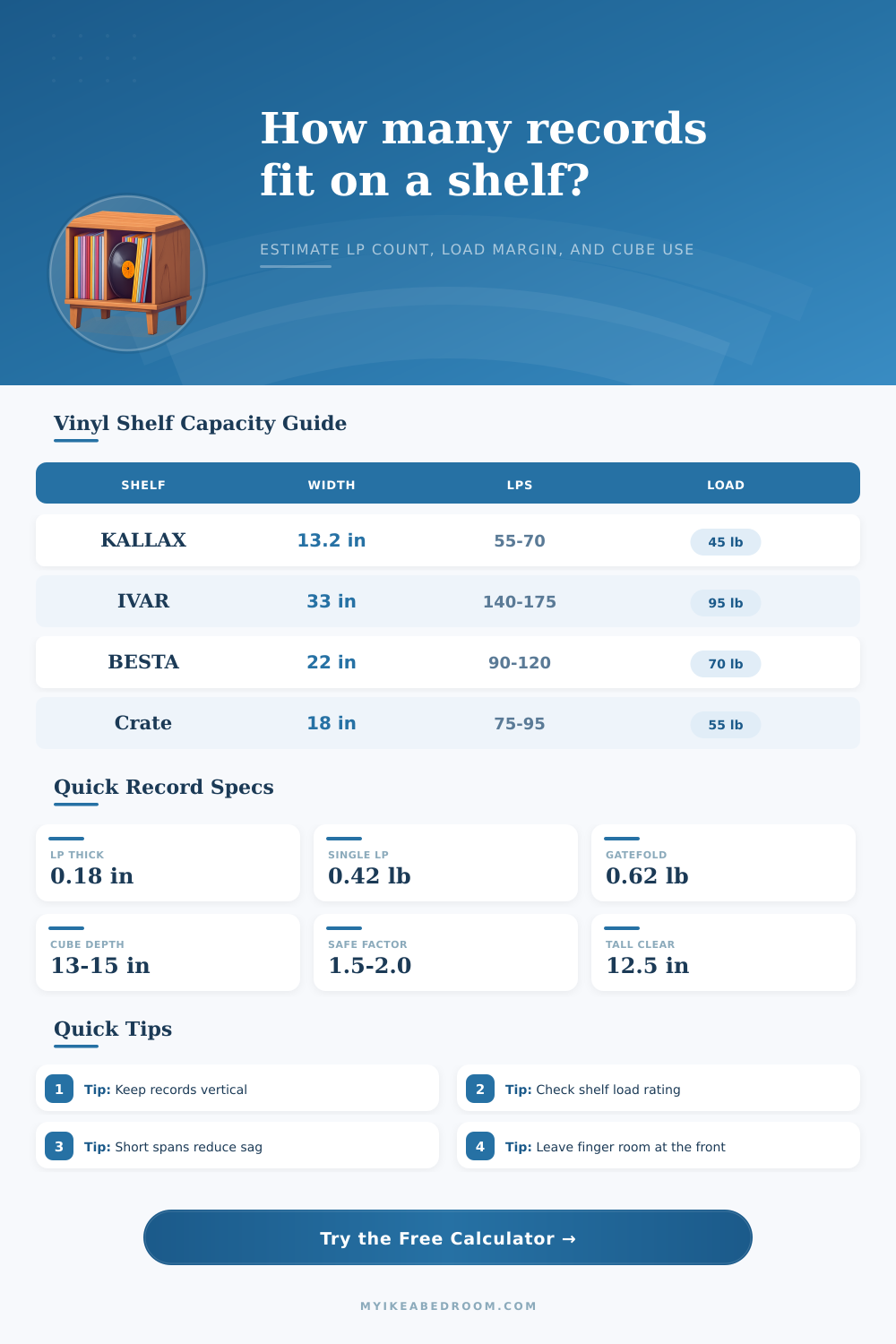
| Thin single LPs | 0.12 to 0.15 in | 0.34 lb | Older thin jackets or unsleeved light records. |
| Standard LP mix | 0.16 to 0.20 in | 0.42 lb | Most mixed collections with normal sleeves. |
| Outer sleeves and inserts | 0.18 to 0.23 in | 0.48 lb | Protective sleeves, booklets, and heavier jackets. |
| Gatefold and 180g mix | 0.24 to 0.32 in | 0.62 lb | Many gatefolds, double LPs, and thicker reissues. |
| Box-set heavy average | 0.40 in and up | 0.85 lb | Box sets blended into the same row estimate. |
| Material | Stiffness score | Span behavior | Record storage note |
|---|---|---|---|
| Particleboard cube shelf | 30 | Short spans preferred | Common in cube units; rely on manufacturer load limits. |
| MDF or melamine shelf | 34 | Moderate stiffness but heavy | Smooth face, but sag can show with dense LP rows. |
| Solid pine or softwood | 42 | Moderate span | Useful for open shelves if knots and warping are controlled. |
| Cabinet plywood shelf | 54 | Good span stability | Good custom option for long media shelves. |
| Birch plywood shelf | 62 | Strong and predictable | Better for wide bays or visible record walls. |
| Steel or wire record rack | 70 | Rating-driven | Often strong, but check wire deflection and side bracing. |
| Preset | Clear bay size | Typical LP count | Main caution |
|---|---|---|---|
| KALLAX cube | 13.2 x 15.4 x 13.2 in | 55 to 75 LPs | Weight adds quickly when every cube is filled. |
| IVAR shelf bay | 33 x 11.8 x 13.5 in | 135 to 180 LPs | Depth can be tight unless records sit proud. |
| BESTA media shelf | 22 x 15 x 12.8 in | 90 to 120 LPs | Height clearance should be checked with sleeves. |
| Wood crate | 18 x 13 x 13 in | 75 to 95 LPs | Good pull access, but crate bottom carries the load. |
| BILLY adjusted shelf | 29.5 x 11 x 13 in | 0 to 150 LPs | Depth is usually the limiting issue. |
| Condition | Safety factor | Good margin | Recommended action |
|---|---|---|---|
| Known rated cube | 1.5 | 25% or more | Use the manufacturer bay rating and avoid overfilling adjacent weak bays. |
| Older shelf or unknown anchors | 2.0 | 40% or more | Reduce count, add supports, or store heavy box sets lower. |
| Long horizontal shelf | 2.0 to 2.5 | 50% or more | Add dividers or brackets so each span behaves like a shorter bay. |
| Wall-mounted ledge | 2.5 | High margin | Verify fasteners, studs, and bracket rating before loading records. |
Cube side panels
Best for: KALLAX-style short spans.
Watch: total unit load when several cubes are filled with records.
Adjustable shelf pins
Best for: media cabinets and bookcases.
Watch: pin rating, side panel quality, and shelf depth for LP jackets.
Vertical dividers
Best for: long shelves that need shorter record bays.
Watch: dividers reduce LP count but improve upright support.
Wall brackets
Best for: custom plywood shelves and ledges.
Watch: fastener pullout and front-heavy record access.
Leave handling room: A perfectly packed row is hard to browse. Use the calculated count as a structural limit, then leave a few records worth of slack for fingers and dividers.
Respect the weakest part: The shelf board, side panels, pins, wall anchors, and floor contact all matter. Treat the lowest verified rating as the actual limit.
It’s Tuesday night. You’re at record store, and you’ve got three brand-new records in your hands. The excitement of owning something physical fills you up as you drag those records home. But then you stand in front of your record collection and look around. There’s nowhere to put ’em.
This isn’t just a problem for obsessed archivalists or casual music lovers; it’s a problem for anyone who’s devoted to their collection. It’s never actualy because they dislike the album too much to find space for it. It’s because, when stacked, vinyl records is a lot more dense than you’d think, and most furnitures wasn’t built to bear weight of an analogue archive. When you hold a regular 12″ LP in your hand, it doesn’t seem like much. But stack fifty of them onto particleboard shelf, and suddenly you’ve got a structural engineering problem on your hands.
How to Store Your Vinyl Records Safely
If you want to calculate how many of what size shelves you need (and have room for), simply type in the sizes of your collection bays and the type(s) of record you collect on the calculator above. It’ll do the numbers for ya, so you won’t have to wonder if that cheap cube unit will hold all your discs or start sagging in six months.
The biggest one is shelf material. Most inexpensive storage units is made from particleboard, which soaks up water like a sponge and softens rapidly when carrying a prolonged load. Solid wood or plywood does not act this way because there grain keeps them from bending. Choosing your material in the calculator isn’t just about looks, it’s determining how much weight that board can handle without permanently deforming. And that deformation doesn’t just screw up the furniture… it screws up your records too.
Weight distribution is the hidden enemy of any vinyl collection. Because it looks complete and tidy, folks tend to fill shelves from top to bottom. This places most weight onto the longest unsupported span, which just happens to be right at the top of the shelving unit. Gravity doesn’t negotiate. If you’ve got a high bookcase loaded up with dense 180-gram pressings, those top shelves will work double duty compared to those at the bottom. This is because they are supported by a shorter distance below. The table below show the effect on various types of material under certain spans… So a short span may be ok in particle board. But that same material spanning over three feet with heavy gatefolds? Trouble ahead.
Box sets and gatefolds is especially problematic. They increase both weight and thickness but don’t contribute anything structurally to the stability of the shelf. They just make the shelf hold more and become less stable than before. In terms of physics (and organization)… Dividers make all the difference. A simple vertical spacer split a long unsupported span into two shorter spans. That reduces the force on the shelf edge and dramatically decreases the chance of sag. Not only that, but it allows for easier browsing since records remain upright rather than being stacked and leaned up against one another. Of course, every divider you add will reduce amount of linear space you have available. But gaining stability is worth the small loss in count. Most collectors find themselves regretting empty space far more then they do having a little fewer records on a given row. That’s why the tool calculates your own unique utilization based off your divider configuration so you can see that trade-off for yourself.
No calculator will be able to account for temperature and humidity either. Ambient conditions cause vinyl to expand and contract, and shelves warps in response to moisture fluctuations. For long term storage, records should always be stored vertically, but this only works if there is something rigid holding it up. Any give, even a quarter of an inch, transfers the pressure off of the jacket’s spine and onto its corners. Those corners are what go all wonky and mess with playback later down the line. What you want is more than just enough capacity; you would of wanted some sort of safe margin.
First know how much room you actualy have to work with. Measure inside frame. Subtract any walls that block your storage area or divider walls. Next look up what type of shelf material the manufacturer rates their product as. If they don’t list a rating, assume it’s on the low side. The weak point of your system becomes the limit of the entire system. For example, a really solid wall mount will be useless if the shelf board bend under weight. Wherever possible fill from the bottom up. When making custom shelves, use heavier material towards the bottom. Give yourself some breathing room up top otherwise pulling a jacket out will cause it to rub against the bottom of the shelf above.
I know it’s tempting to look at this as a numbers game, how many more albums can I stuff into this space? It is a vanity metric. The point isn’t cramming more into less; it’s protecting your collection. Respect the physical nature of the medium. Your records don’t need their spines bent out of shape every time you reach for one. They don’t need to reside on a sagging shelf where weight of others has bent their spines. Let them have some level, stable ground to sit on, and they’ll sound just as good decades from now as they do today.