Vertical Blind Track Length Calculator
Calculate vertical blind headrail length from opening width, mount type, side returns, stack pocket, carrier pitch, hardware clearance, stock rail length, and support spacing.
🪟Common vertical blind track presets
📏Opening, stack, and hardware inputs
Track Length Results
🧰Hardware summary from current inputs
Counts are rounded upward because track, carriers, and mounting clips are easier to trim or omit than to stretch after drilling.
📊Vertical blind track length reference
| Mount type | How to measure | Typical side allowance | Planning note |
|---|---|---|---|
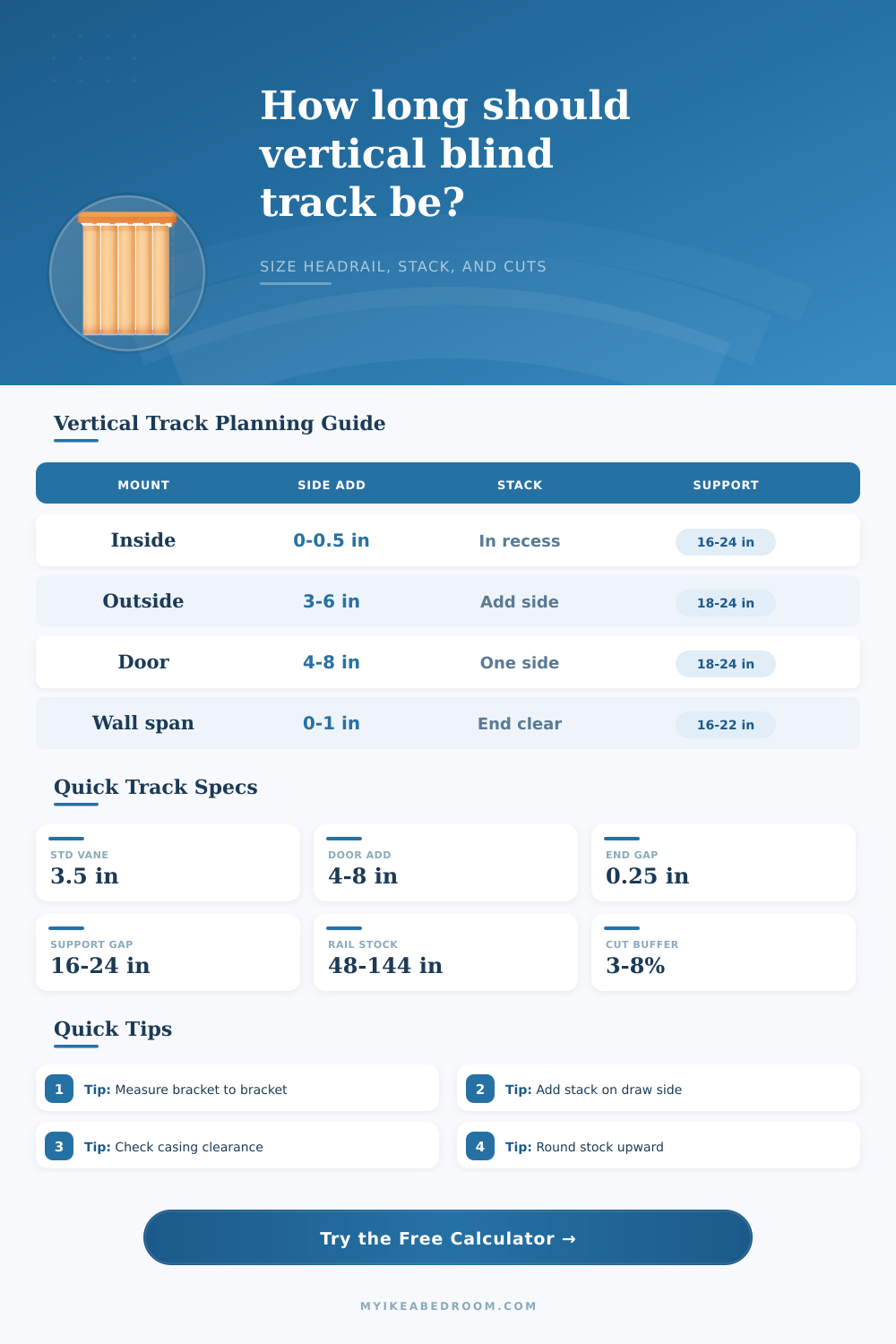
| Inside recess | Inside width at the top | Subtract 0.25-0.5 in total | Leaves a small fitting gap so the rail does not bind. |
| Outside window | Opening width plus returns | Add 3-6 in per side | Improves edge coverage and hides side light gaps. |
| Sliding door | Door frame plus stack side | Add 4-8 in each side | One-way draw usually needs a deeper stack pocket. |
| Wall-to-wall | Wall span minus end gaps | Subtract 0.25-1 in per end | End gaps leave room for caps and out-of-square walls. |
| Room divider | Finished travel path | Add parking pocket if needed | Check furniture, door swing, and walk path clearance. |
📐Vane width, carrier pitch, and stack guide
| Nominal vane | Typical carrier pitch | Approx stack per carrier | Common use |
|---|---|---|---|
| 2.5 in / 63 mm mini vane | 2.25 in / 57 mm | 0.33 in / 8 mm | Narrow sidelight or compact recess. |
| 3.5 in / 89 mm standard vane | 3.25 in / 83 mm | 0.46 in / 12 mm | Most bedroom windows and patio doors. |
| 3.94 in / 100 mm metric vane | 3.63 in / 92 mm | 0.51 in / 13 mm | Metric replacement tracks and imported systems. |
| 5 in / 127 mm wide vane | 4.63 in / 118 mm | 0.62 in / 16 mm | Large doors and broad view-through spacing. |
🔧Support and connector spacing guide
| Track situation | Support spacing | Join support | Best practice |
|---|---|---|---|
| Light vinyl vanes | 20-24 in | One near each join | Good for short bedroom windows. |
| Fabric or blackout vanes | 16-20 in | Support both sides | Closer clips reduce headrail twist. |
| Wide patio door | 18-22 in | Keep join off center | Avoid placing a connector at the busiest carrier path. |
| Ceiling mount | 16-20 in | Support near ends | Verify anchors or joists before cutting rail. |
| Under valance | 14-18 in | Leave tool access | Check clip height and wand clearance first. |
✂Stock rail cut planning table
| Stock length | Best fit | Typical connector count | Cut note |
|---|---|---|---|
| 48 in / 4 ft | Narrow windows | 1 per extra piece | Easy to transport, more joins on doors. |
| 72 in / 6 ft | Bedroom windows | 1 per extra piece | Often enough for inside-mount tracks. |
| 96 in / 8 ft | Patio doors | 1 per extra piece | Good balance of length and handling. |
| 118 in / 300 cm | Metric doors | 1 per extra piece | Useful for balcony doors and wide openings. |
| 144 in / 12 ft | Wall spans | 1 per extra piece | Fewer joins but harder to transport straight. |
🏠Common opening examples
| Opening | Mount plan | Estimated track | Carrier estimate |
|---|---|---|---|
| 48 in office window | Inside recess | 47.5 in | 15 carriers |
| 58 in bedroom window | Outside, 4 in each side | 66 in | 21 carriers |
| 72 in patio door | Outside with stack pocket | 91-96 in | 28-30 carriers |
| 96 in sliding door | Split stack | 112-118 in | 35-37 carriers |
| 144 in wall span | Wall-to-wall | 143 in | 44 carriers |
The glass measurement from yesterday? Wrong. For verticals, the head rail go within the frame rather than on pane. You also want to allow enough space for those vanes to stack like an accordion against casing. Vertical blinds act like an accordion of bellows when folded; you has to account for more hardware and clearance to get the track length correct.
Once you plug in your side returns and opening type, the above calculator do all the math for you, removing the guess work about adding or subtracting width depending on your mount type. If you’re mounting inside, you’ll need to subtract just enough width to allow rail to fit into the recess while still not binding on any trim or drywall. When you mount outside, you must add a few inches on each side to cover edges and prevent light from bleeding through. The tool quickly recognizes which scenario applies. It factors that into base length where the blind is going and how the vane will fold.
How to Measure for Vertical Blinds
The next thing people forget about until install day is stacking. When vertical blinds close, they don’t just dissapears. It depends on how you’ve set them to draw (either to one side or split to both sides). They will either fold up into a pocket at one end of the track, or stack vertically in both directions. So if you have a sticking-out handle on the patio door, you want to make sure all of the fabric clears that handle completly when it stacks up.
You can tell calculator what size the stack pocket will be. Or, it will calculate it for you based off the width of the vanes and the spacing of carriers. Usually, standard vanes measures 3.5 inches across, but they fold up even more compactly into a nested position. This allows you to buy a track long enough for true volume of fabric, and not some random number.
The rest of the equation hinges on vane width. Sleeker and wider vanes provide better coverage, but also make for a thicker stack. A 2.5 inch mini vane closes up to much less horizontal space then a 5 inch vane. How does that affect side returns? Thick vanes combined with mounting outside the frame will likely mean extending the track farther out so that the stacked pile doesn’t interfere with window jamb. Aesthetics versus spatial reality, it’s a tradeoff. To illustrate, the page’s reference table matches the nominal widths with most common carrier pitch and details precisely how much linear footage each vane size use when bunched up.
There’s also a hidden variable called support spacing. If you leave a long horizontal rail hanging unsupported in the middle, it will sag over time just from its own weight. Wide vanes and heavy blackout fabrics makes it even worse; they’ll droop so much that carriers can’t get up to their proper position and instead start to lean (or jam). Based on how much weight you’re planning for those vanes, and what your overall rail length is, the calculator account for necessary support intervals. Ceiling mounts usually need closer spacing than wall brackets because there is no side frame to hold things in place with friction. Anything ignoring that rule will be a loose fit that looks cheap and works poorly within weeks.
Rail comes in standard sizes (typically 4 feet, 8 feet, or 12 feet long). And, since your estimate is never going to line up exactly with a standard size, you’ll either have to cut an extra-long piece down to size, or connect two pieces to make up the total length required. The tool tells you what size stock rail you should of order, and then it also estimates how much will remain after cutting to fit. That’s key for the budget. For example, if the tool says you need 82 inches, you can’t just buy an 84-inch rail unless your supplier cuts custom orders. Chances are that you’ll end up joining two shorter pieces instead. Knowing those limitations ahead of time means you can plan for additional hardware and connectors. Without wasting money by having to drill hole after hole into the ceiling.
Never compromise when you measure top of the opening. Ceilings slant, walls bow out, and trim can be anywhere from 1/4 to 3/8 thick. Glass cavity width may not match frame width either. Measuring from the middle of the glass centerline adds another variable. Always take your measurement at top where you’ll mount the brackets. Subtract your clearances, account for the stack pocket on the draw side, then add it all up and use the numbers to make the final cut. A closer headrail makes it less likely that your carriers will jam and helps your vanes run straighter. This makes for a neat, professional-looking install instead of a headache.