Wood finish planning
Varnish Coverage Calculator
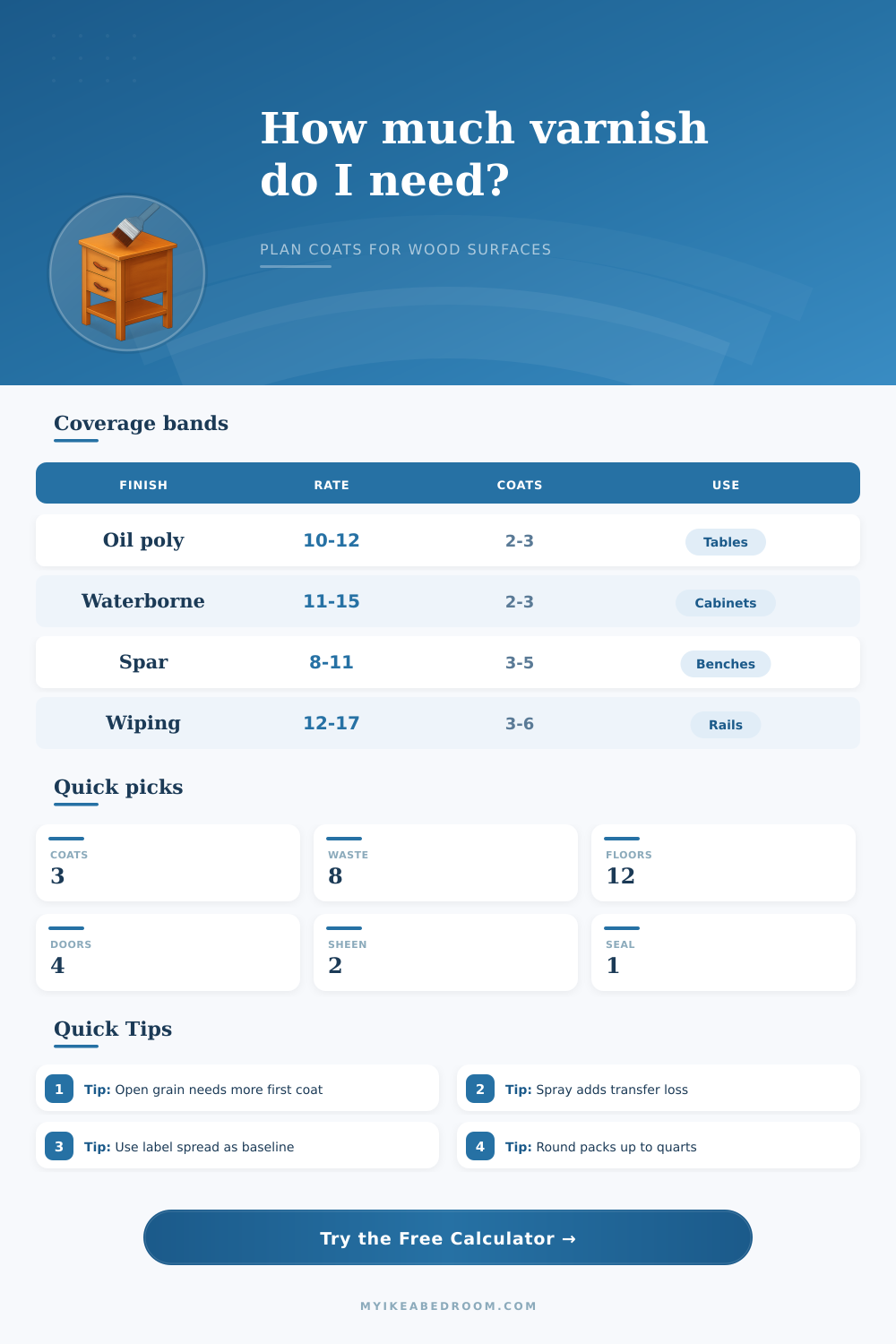
Estimate how much varnish you need for tabletops, floors, doors, trim, cabinetry, and exterior woodwork by combining coat count, product spread rate, wood porosity, and application loss.
Measure both faces, edges, rails, and exposed shelves.
Use the can label value for one coat on smooth wood.
Full breakdown
Project setup
Coverage math
Measure both faces of doors, shelves, and leaves before multiplying by coats. Coverage shortfalls usually come from missed edges and open grain, not from the flat panel field.
If you spray louvers, chair backs, or slatted screens, the transfer loss can exceed the wood soak-in. Run the calculator with a higher waste band and compare the pack suggestion before opening cans.
When you prepare to apply varnish to a wood surface, you must calculate the total amount of varnish that will be required to complete the project. Calculating the amount of varnish that will be required is necessary to ensure that there is enough varnish to complete the project; if there is too little varnish, the varnish will run out before the project is completed, and if there is too many varnish, the varnish will be wasted. Many person make the mistake of only using the coverage rates indicated on the label of the varnish container.
The coverage rate for varnishes indicated on the label of the container, however, dont always indicate the actual amount of varnish that the wood will absorb. The amount of varnish that the wood will absorb depends upon the type of wood being used and how the wood is prepare. Different type of wood are more porous than others.
How to Figure Out How Much Varnish You Need
For example, oak will absorb more varnish than birch due to the porosity of the two types of woods. Additionally, the sand grit used on the wood will impact the porosity of the wood. If the wood is sands with a coarse grit, the porosity of the wood will cause it to absorb more varnish than if it was sands with a fine grit.
Thus, the type of wood that is to be varnished and the sanding grit that the user will use will impact the amount of varnish that should of be calculate for the project. The method for applying the varnish will also impact the amount of varnish that will be required for the project. If natural bristle brushes are use to apply the varnish, very little of the varnish will be lost; however, if an HVLP sprayer is used, some of the varnish will be lost due to the transfer of the varnish droplet with the air currents that the sprayer creates.
Thus, some extra varnish will have to be added to make up for the loss of varnish that occurs with using an HVLP sprayer. The application method of the varnish must therefore be considered in calculating the amount of varnish that will be required for the project. The total surface area of the wood that is to be varnished must be calculated.
The length and the width of the piece of wood can be measured; however, the edge, undersides and interior surfaces of the wood must also be accounted for. For example, for a door that is to be varnished, the front and back of the door and each of its edges must be measured. For a bookcase, the tops and bottoms of the shelves and the side of the bookcase must be measured.
Multiply the total surface area of the wood by the number of coat of varnish that are to be applied to the wood. The number of coats of varnish that are to be applied to the project depends upon the use of the furnitures that is to be make and the type of varnish that will be used. Furniture that will be used within the interior of a building typically only requires two to three coats of varnish.
Furniture that will be used in exterior locations, however, will typically require four to five coats of varnish to protect the furnitures against the weather. If the furniture is to be treated with spar varnish, however, more coats will be applied than wood varnish due to the low solid content of spar varnish. To ensure that there is enough varnish for the project, take the total surface area of the wood that will be treated with varnish and multiply that number by the number of coats of varnish that will be applied.
Adjust for the type of wood and the method for applying the varnish. Add some extra volume of varnish to the total volume to account for any loss during the application of the varnish. Following these steps will ensure that you have the correct amount of varnish for your project before you begin applying the varnish to your wood project.