Upholstery Batting Quantity Calculator
Estimate batting area, roll yardage, layers, wrap allowance, loft volume, and material weight for headboards, benches, cushions, ottomans, and upholstered panels.
Batting Quantity Results
| Batting Type | Typical Weight | Metric Weight | Best Upholstery Use |
|---|---|---|---|
| Light polyester | 3 oz per sq yd | 102 g per m² | Dust covers, thin wall pads, gentle smoothing |
| Bonded polyester | 6 oz per sq yd | 203 g per m² | Headboards, benches, cushion crown wrap |
| Needled cotton | 8 oz per sq yd | 271 g per m² | Natural firm hand on seats and backs |
| Firm polyester | 10 oz per sq yd | 339 g per m² | Extra loft under fabric and channel panels |
| Dacron wrap | 12 oz per sq yd | 407 g per m² | Foam cushions, ottoman sides, rounded edges |
| Dense felt pad | 16 oz per sq yd | 542 g per m² | Firm deck pads, rail padding, hard edge softening |
| Loft Per Layer | Two Layer Build | Compressed Feel | Common Furniture Detail |
|---|---|---|---|
| 1/4 in | 1/2 in nominal | Low relief | Flat wall panels or dust cover smoothing |
| 3/8 in | 3/4 in nominal | Medium crown | Bedroom headboards and bench tops |
| 1/2 in | 1 in nominal | Plush edge | Cushion foam wrap and ottoman faces |
| 3/4 in | 1 1/2 in nominal | Soft rounded | Deep tufted panels and pouf bands |
| 1 in | 2 in nominal | Bulky pad | Thick rail padding or overbuilt crown |
| Roll Width | Area In 1 Linear Yard | Metric Area | Best Fit |
|---|---|---|---|
| 36 in | 4.00 sq yd | 3.34 m² | Small seats, stools, narrow panels |
| 45 in | 5.00 sq yd | 4.18 m² | Dining chairs and cushion strips |
| 54 in | 6.00 sq yd | 5.02 m² | Most headboards, benches, ottomans |
| 60 in | 6.67 sq yd | 5.57 m² | Wide panels and fewer seams |
| 90 in | 10.00 sq yd | 8.36 m² | Tall headboards and broad wall pads |
| Common Upholstery Project | Measured Face Area | Typical Wrap | Planning Note |
|---|---|---|---|
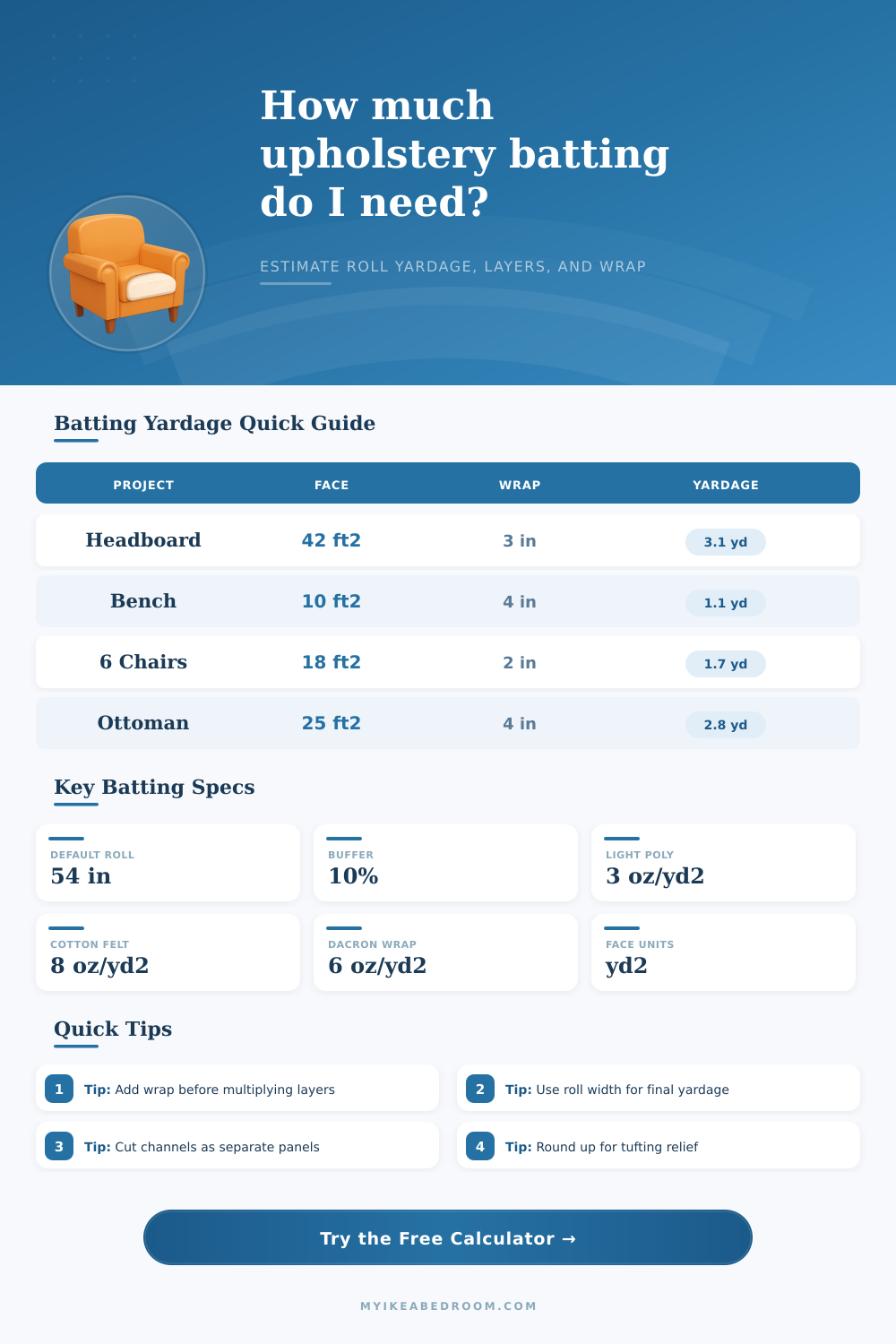
| Queen headboard, 62 by 42 in | 18.1 sq ft | 3 in edges | Use two layers for a smooth fabric face |
| Bedroom bench, 48 by 18 in | 6.0 sq ft | 4 in edges | Wrapped edges reduce hard cushion corners |
| Six dining seats, 18 by 18 in | 13.5 sq ft | 2 in edges | Repeat pieces benefit from nesting cuts |
| Storage ottoman, 36 by 24 by 18 in | 25.0 sq ft | 4 in edges | Boxed coverage includes side band area |
| Round pouf, 30 in diameter | 4.9 sq ft each face | 3 in edges | Curves usually need a larger buffer |
Polyester
Light, springy, easy to wrap around foam and headboard edges. Good when fabric needs a rounded cushion crown.
Cotton
Firm, natural hand with less bounce. Useful on seat decks where the fabric should stay flatter.
Wool
Resilient loft with a dense feel. Often chosen for premium pads and breathable upholstered panels.
Dense Felt
Heavy, compact padding for firm rails, hard corners, and places where shape control matters more than puff.
Batting goes between the frame and a fabric cover. The type of batting you use will determine not only how the finished product feel but also how long the fabric cover will last. Many peoples focus on the fabric but not the batting that will determine whether the edges remains crisp or the corners of the frame round out.
To order the correct quantity of batting, you have to determine this before you order a roll of batting. The calculator will take the measurements of the area that you will cover with the fabric and add the wrap around the sides of the frame. The numbers will then be multiplied by the number of layer of batting that you will use.
How to Use the Batting Calculator
The calculator also includes a buffer in the total amount of batting that will be needed for the project. This calculator will give you the total amount of square yards of batting that will be needed, the amount of linear yards that will be needed based on the width of the batting roll, and the weight of the batting in ounce. The weight and loft of the batting will determine how the batting will lie on the fabric when finished.
For example, if you use a three-ounce polyester batting, you can use it for thin wall panels but will find that the same batting will compress flat under a bench seat cushion. For this same reason, using a heavier bonded polyester or needled cotton batting will give the fabric a gentle crown without the compressing of the batting. You can use the material selector to find the perfect weight of batting for your project.
Wrap allowance is the amount of batting that will go around the sides of the frame. People often do not account for this when purchasing batting. All you have to do is measure the face of the frame, and the tool will add the amount of batting needed to account for the wrap allowance.
For example, a headboard with a thick frame will require a large wrap allowance on each side. Likewise, if a headboard has deep tufting buttons, the wrap allowance should be increased again to account for the depth of the tufting. Use the coverage style drop-down menu to select the batting style that will be used on the frame.
Options include face only, face and back, wrapped edges, or a fully boxed cushion style. The change in selection will alter the amount of batting required for the frame. The number of layers and the loft of the batting will determine the thickness of the batting.
Two medium-loft layers will feel different than a single thick layer of batting. The loft that you select will determine how tall each layer of batting will stand before the fabric pressure on the batting will compress the layers together. The batting material data already includes a compression factor in the calculations to determine the final lofts of the batting.
The width of the roll of batting will determine how much batting will be wasted when cutting the batting for your project. A 54-inch roll of batting will work well for headboards and benches but may not be the best batting for a 36-inch roll if the project is wider than a dining chair. The calculator will divide the total number of square yards by the area in linear yards for the roll width you choose.
The result will then be rounded up to the next quarter yard so that you have enough batting for your project. The batting yardage will also display the metric equivalents of batting yards in centimeters and meters. Some of the projects that can be completed with batting include queen headboards, dining chairs, and ottomans.
A queen headboard will require batting for the face and the wraps on each side of the headboard. For queen headboards, many peoples will select a second layer of batting for the smoothness of the headboard. Six dining chairs may seem like a small project for batting but will require the same batting cut six times.
An ottoman with boxed sides will require more batting than a wrapped edge cushion. This is because an ottoman with boxed sides will have an additional area for the vertical band of batting. The weight of the batting will determine how heavy your order of batting will be when you recieve it.
For instance, felt batting weighing 16 ounces per square yard is heavy but will weigh much less than dense felt. If you are carrying the batting to another location in the house or even to a vehicle, the weight is a consideration. The calculator will show the weight of your batting order when you multiply the number of buffered square yards by the weight of the batting that you choose.
Some of the mistakes that peoples make when buying batting are forgetting the wrap allowance and using too thick a layer of batting for projects with curves. Both of these can be avoided using the presets that this batting calculator will display for you to use in your project. When the batting is compressed between the layers of the fabric, the batting will behave differently.
For instance, a wool batting will settle in place when the fabric is pulled tight but bonded polyester batting will spring back to its original position more readily. The batting breakdown will help you determine the behavior of the batting once it is compressed between the fabric. Using this batting calculator will help you order the correct amount for your project.
It will also allow you to avoid buying too much batting that will result in costly batting scraps.