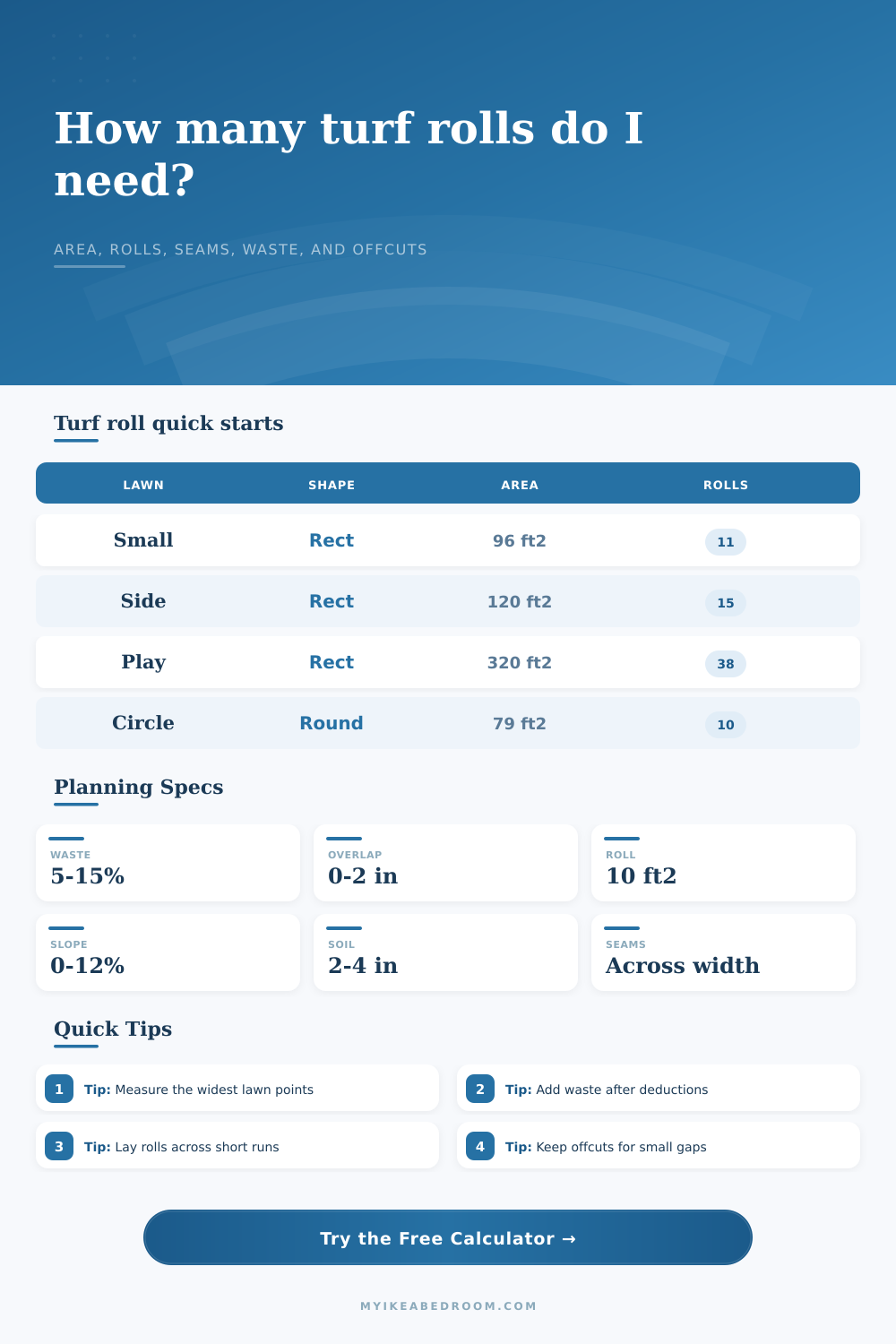
Turf Roll Quantity Calculator
Estimate natural turf lawn area, roll coverage, roll count, seam length, trimming waste, irregular deductions, slope allowance, and offcut area from lawn dimensions and roll size.
Choose a common lawn scenario, then adjust the shape, roll size, seam overlap, waste, deductions, and slope allowance.
Fresh natural turf
Best for: instant green lawn surfaces.
Planning driver: roll size, seam overlap, trimming waste, and delivery grouping.
Check: turf should be laid soon after delivery, so avoid undercounting edge cuts.
Topsoil dressing
Best for: leveling shallow hollows before rolls go down.
Planning driver: depth over the same net lawn area.
Check: soil area follows the lawn area after deductions, not roll coverage.
Compost blend
Best for: light organic matter mixed into prepared soil.
Planning driver: thin layers measured in inches or centimeters.
Check: do not count compost volume as turf roll area.
Leveling sand
Best for: small final corrections under compacted soil.
Planning driver: low spots and edge transitions.
Check: steep slopes may need more surface area and careful roll pinning.
| Roll format | Nominal size | Coverage per roll | Use case |
|---|---|---|---|
| Small garden roll | 2 x 5 ft | 10 ft² | Easy handling for patch repairs and small lawns. |
| Narrow strip roll | 16 in x 6 ft | 8 ft² | Good for side yards and path borders. |
| Wide roll | 2 x 6 ft | 12 ft² | Fewer seams on larger rectangular lawns. |
| Metric roll | 0.5 x 2 m | 1 m² | Common metric planning module for domestic turf. |
| Lawn condition | Suggested waste | Deduction handling | Planning note |
|---|---|---|---|
| Simple rectangle | 5 to 8% | Usually none | Roll count mostly follows area divided by roll coverage. |
| Curved edge | 10 to 15% | Deduct only fixed beds | Curve cuts create pieces that may not fit another edge. |
| Trees and drains | 12 to 18% | Subtract opening area | Small holes reduce area but increase trimming time. |
| Sloped garden | 10 to 16% | Deduct flat obstacles first | Slope allowance accounts for extra surface over plan area. |
| Net lawn area | 10 ft² rolls | 12 ft² rolls | With 10% waste |
|---|---|---|---|
| 80 ft² | 8 rolls | 7 rolls | 9 small rolls or 8 wide rolls. |
| 150 ft² | 15 rolls | 13 rolls | 17 small rolls or 14 wide rolls. |
| 300 ft² | 30 rolls | 25 rolls | 33 small rolls or 28 wide rolls. |
| 500 ft² | 50 rolls | 42 rolls | 55 small rolls or 46 wide rolls. |
| Prep layer | Depth | Volume for 100 ft² | What it affects |
|---|---|---|---|
| Light topsoil dressing | 1 in | 8.3 ft³ | Minor leveling before the turf is rolled out. |
| Root-zone refresh | 2 in | 16.7 ft³ | Improves shallow prepared beds. |
| New lawn bed | 3 in | 25.0 ft³ | Useful when existing soil is low or uneven. |
| Deep preparation | 4 in | 33.3 ft³ | Separate soil volume from turf roll quantity. |
There’s a certain kind of panic setting a phone and a measuring tape down in your yard. How many rolls will I need to order? How many of those heavy-ass rolls do I need? Turf is not paint; there’s no “extra” to buy; no returning half-unopened rolls when the roots have taken hold. Get this calculation wrong, and you’re either staring at a swatch of bare dirt, or you’ll be buying sod that ends up dying in your driveway.
Enter the calculator above: Plug in the size of your lawn (and if necessary the specs of each roll) and let it do the math. No more conversions, no more coefficients to guess at. It transforms an odd-shaped piece of land into a specific number of green-and-grassy rolls, all while saving you from wasting money.
How to Calculate Your Lawn Size
First, remember that area is not the same as volume. It’s easy enough to measure a flat rectangular piece of land, but in reality, most yards don’t behave. Lawns taper off into beds, dip down by drains, or curve around drives. Whether it’s as simple as a square or something more complex like this triangle corner, the system measures area of your shape when you enter it. That’s all well and good, but that’s just half of the equation. After all, there’s stuff beneath your grass surface; and you need to make allowances for it.
People often forget about deductions. Do you have a paved path or a large tree trunk within the proposed lawn? Subtracting its square footage means you won’t be buying turf you’ll never actualy lay. To avoid charging customers for coverage they’re not paying for, such as existing concrete, the calculator lets you specify irregular deduction.
And then there’s waste. Or should I say “mistsakes” and “edges”? That’s what waste basically is. You’ll be cutting straight lines that turn out not quite as straight because the ground isn’t flat. Curves require trimming. Things may get off-kilter; you might have to do some extra trimming around an oddly shaped tree.
Usually a standard five to ten percent waste allowance would of been sufficient for a nice neat rectangular lawn with clean edges. If your lawn is complicated, say it has multiple angled corners or wraps around a circular flower bed, upping that number to a dozen or fifteen percent make sense. It can feel like throwing money down the drain, but it’s insurance against running short, in case of gaps. The page’s reference table explains all this and illustrates how waste increases with complexity.
By far the biggest budget-killer in turf installation is underestimating edge cut. Another thing that throws people for a loop is seams. There’s a seam where every two rolls come together. Some people cut them right up against each other, then tape them so you don’t see any soil through the gaps after the grass has settled in. Other times they overlap the seams by a bit, so you won’t be able to see anything underneath. You can change the overlap loss with the calculator.
An inch or two is nothing in terms of overall square footage, but if you have a big lawn it can add up. This is especially true if you have some skinny little bits of wasted space, like I do. I may only lose half an inch per seam, but even that small amount can add up over a large lawn. Maybe get an extra roll or two to cover all the little places where it didn’t quite fit. Not a huge deal…but when you’re working on a tight budget every little bit helps!
Thinking about what your rolls are going to look like on the ground ahead of time make a difference. And then there’s geometry: If your lawn is 20 feet by 30 feet and it rests on level land, it’ll need X amount of turf. But if that same plot exists on a hillside, you’d have to add more because the steeper the grade, the greater the surface area. To make up for the extra material necessary to blanket the incline, Slope has a feature called the slope allowance. Remember: Grass follows the contours of the landscape, not simply the footprint of the yard. Overlooking slope means coming up short…right at the base of the hill…and realizing you’ve run out of rolls.
Last: What size are the rolls? Big ones are easier because there will be fewer seams and less handling time, but they’re unwieldy (and heavy) in corners and other spots where a large roll can’t fit through. Small ones are flexible, which is great if you have some narrow spots; but they increase the total number of seam, and therefore there’s more opportunity to lose overlap. The roll size can be adjusted on the calculator so you can see how those trade-offs play out. It’s a matter of selecting a solution that suits both the shape of your particular yard, and also your own abilities.
Turfing isn’t just a back-breaking dig-and-lay deal: it’s also a math problem. Doing your sums before you start will ensure that laying the stuff in goes like a dream. You will have no more waste or rushing. You won’t have heartbreak over the patches left empty. It is a manageable job to tackle; it is not one that’ll have you tearing your hair out over the weekend. Measure twice, factor in those bends and let the machine do the hard work while you get on with having some fun in the sun.