Tufted rug yarn takeoff
Tufting Gun Yarn Quantity Calculator
Estimate tufted area, yarn length, yarn weight, skeins or cones, backing waste, trimming loss, and color allocation before loading your tufting gun.
Yarn Estimate Breakdown
Yarn length per 100 g changes the final weight sharply. Use the closest label on your yarn band, cone, or supplier listing.
| Color group | Share | Yarn length | Yarn weight | Packages |
|---|
| Formula step | Input used | Result | Why it matters |
|---|
| Coverage style | Multiplier | Typical use | Planning note |
|---|---|---|---|
| Light wall piece | 0.85x | Decorative wall tuft | Lower density and shorter pile keep weight down. |
| Standard cut pile | 1.00x | General floor rug | Good baseline for most single-strand tufting guns. |
| Plush floor rug | 1.18x | Soft bath mat or bedroom rug | Adds more yarn for a fuller hand and cleaner shearing. |
| Dense carved design | 1.35x | Logo, lettering, sculpted edge | Extra yarn supports trimming and carved color borders. |
| Double-strand fill | 1.65x | Fast thick fill | Use only if your gun and backing feed smoothly. |
| Preset project | Size | Pile and density | Typical package plan |
|---|---|---|---|
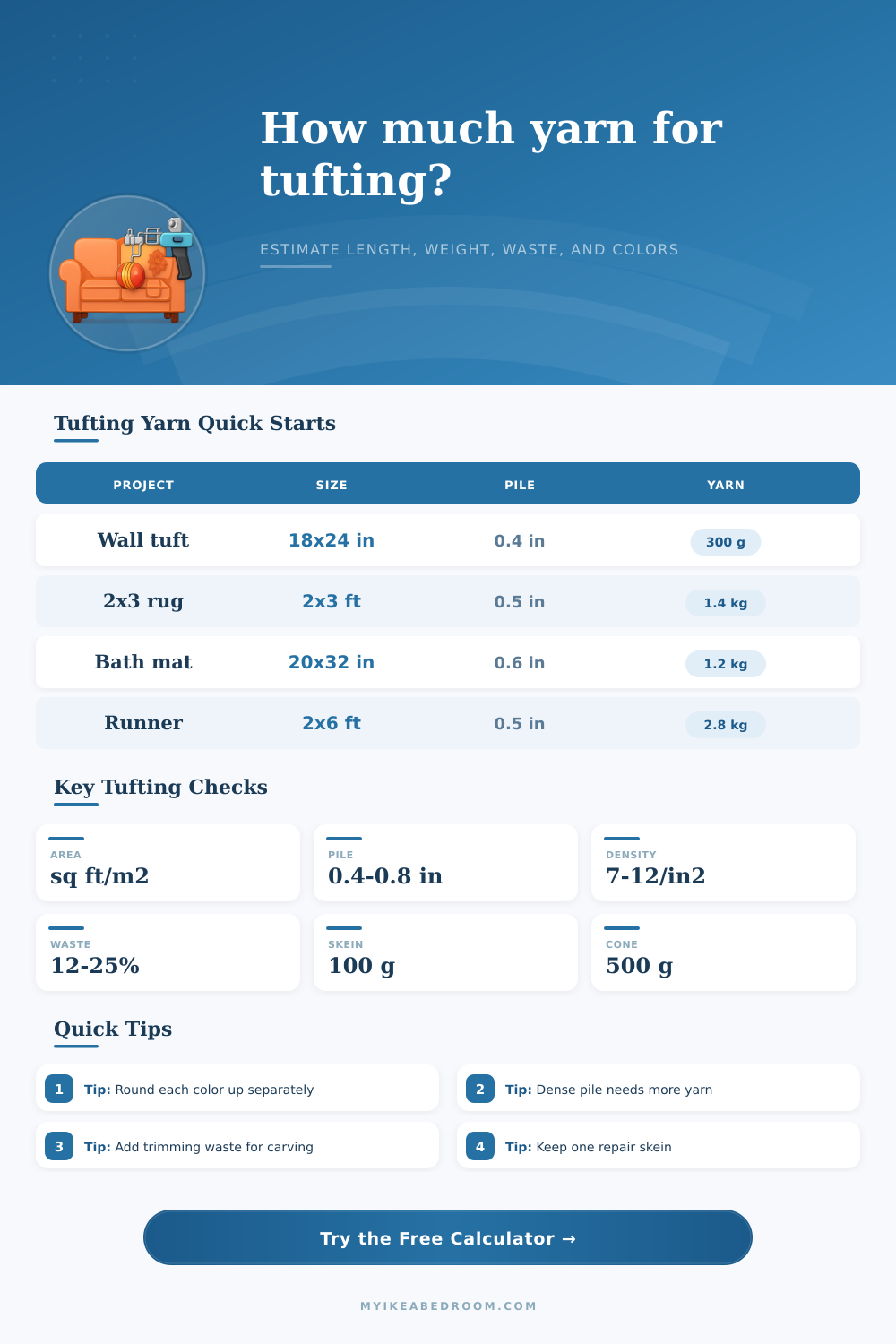
| Small wall tuft | 18 x 24 in | 0.38 in, 7/in2 | 3 to 4 skeins for 2 colors |
| 2 x 3 rug | 2 x 3 ft | 0.50 in, 8.5/in2 | 12 to 15 skeins or 3 cones |
| Bath mat | 20 x 32 in | 0.65 in, 10/in2 | 12 to 14 skeins, cotton or chenille |
| Runner | 2 x 6 ft | 0.50 in, 8/in2 | 25 to 30 skeins or 5 to 6 cones |
| Round rug | 36 in diameter | 0.55 in, 9/in2 | 15 to 18 skeins with separate edge color |
Don’t run out of yarn mid-tuft! Plan ahead, calculate what you need before beginning. More often than not, someone will complete their project only to realize they’re one or two skeins short of completing there design. They’ve made their pattern, added the backing… now there’s just border yet to go. Why? Because most people don’t account for how much fiber it takes, they simply guess at the amount.
Remember: when you tuft, you use MORE yarn then it looks like. A loop goes into the backing material and fills in the grid. Those loops rises to become the pile, and you shave them down to get the finished look. To be confident in your estimate, it’s good to know what goes into it.
How to Plan Your Yarn Needs
The calculator give an estimate based off your numbers. But what do they mean? Makers who is new to making often underestimate how tall the pile should be. A difference of just 1/4 inch doesn’t look like much, but that doubles the length of yarn required for every single stitch! If you’re looking for something thick and shaggy then that increases the amount of yarn necessary at a sharp rate: each stitch takes a longer journey with each needle poke.
Similarly, density affect how many stitches can fit on a single needle. Tufting will go faster if the fill isn’t too tight, but once trimmed it’ll end up looking sparse. If the fill is too tight, it will have a nice professional texture, but there won’t be nearly enough room for all that weight to come out of supply tote before it starts.
Remember, there’s waste (the cost of doing business). There’s backing waste, where you missed a spot and has to patch it back in; there’s waste from moving the rug around on the frame. And then there’s trimming waste. You’ll lose more than you expect when you’re cutting off the loops to make the pile. Each time you carve, each inch of high pile you have, you’re removing fiber that will never become part of the final product. It becomes dust.
Don’t forget this cost; it’s like if you buy wood to build a table but don’t take into consideration how much sawdust you’ll end up with. The complication comes when we talk about color splitting which is frequently overlooked in raw weight estimates. For instance, let’s say you have just enough yarn to knit something with three different colors, but one color happen to be used less than another so now you’re running low on your accent hue. In this situation you’ll have leftover background color.
To handle this the tool rounds up packages based on each color individually. Why? Because you can’t go down to the store and buy half a skein or a fraction of a cone. You either need the entire thing, or you don’t. And those rounding errors accumulates very rapidy as you add multiple colors. If you’re knitting a logo piece that uses five distinct shades then it’s probably going to take more packages than a basic two-toned rug of equal size.
The type of material is also part of this equation. A heavy wool yarn stretches one way; a bulky acrylic another; chenille goes its own route completely from cotton rope. More yarns per meter require less length, but you may need more actualy weight to get the same amount of coverage. Instead of making blanket assumptions, take a peek at what’s in your yarn bands, how many meters are there in each hundred grams?
Making a normal go-to baseline for all things will result in over-buying thick ropes and under-buying finer wools. You should of planned better to avoid buying too much furnitures. This is a craft that’s better planned than improvised. Take away the worry of running short while working on a project; run the numbers first, then load the gun.
Do it right the first time by setting up your work area correctly and buying what you need only once. It’s a more managed process, not a guessing game. The next time you’re finished with the final border and still have some yarn leftover to fix any problems, you’ll understand how it happened, and that peace of mind is worth those precious few minutes spent checking the math.