Tufted Headboard Fabric Calculator
Estimate fabric yardage, cut width, bolt drops, button-cover scraps, tufting take-up, back wrap, overage, and repeat matching for upholstered headboards.
Full Fabric Breakdown
| Tufting style | Typical fabric take-up | Best grid range | Use when |
|---|---|---|---|
| Smooth padded panel | 0% to 4% | 0 buttons | No pulled depressions, fabric wraps only around edges. |
| Vertical channel tufting | 8% to 12% | 4 to 10 channels | Fabric folds mostly in one direction between vertical seams. |
| Shallow button tufting | 10% to 14% | 8 to 20 buttons | Light dimples over medium foam with small covered buttons. |
| Classic biscuit tufting | 12% to 18% | 12 to 30 buttons | Square puff sections need extra slack in both directions. |
| Deep diamond tufting | 18% to 25% | 18 to 40 buttons | Diagonal folds and deep button wells consume the most fabric. |
| Bolt width | Usable width | Typical one-piece fit | Planning note |
|---|---|---|---|
| 45 in | 44 in | Twin width or low panels | Often needs joins for full, queen, and king headboards. |
| 54 in | 53 in | Many tall twin or railroaded queen panels | Common upholstery width with a practical selvedge allowance. |
| 60 in | 59 in | Full panels and some queen heights | Useful when the finished height is near 54 in after wrap. |
| 72 in | 71 in | Wide one-piece layouts | Can reduce seams on deep or shaped upholstered panels. |
| Repeat size | Calculator behavior | Where it matters | Example impact |
|---|---|---|---|
| 0 in solid | No repeat rounding | Velvet, boucle, plain weave | Cut length stays at calculated panel height. |
| 2 to 6 in | Rounds each drop to next repeat | Small geometric or stripe | Usually adds a few inches per fabric drop. |
| 8 to 14 in | Adds visible matching allowance | Florals, damask, large checks | May add one repeat to each joined drop. |
| 18 in or more | Strongly affects yardage | Centered medallion or scenic fabric | Can add a full repeat before overage. |
| Project | Finished face | Typical tuft grid | Fabric planning note |
|---|---|---|---|
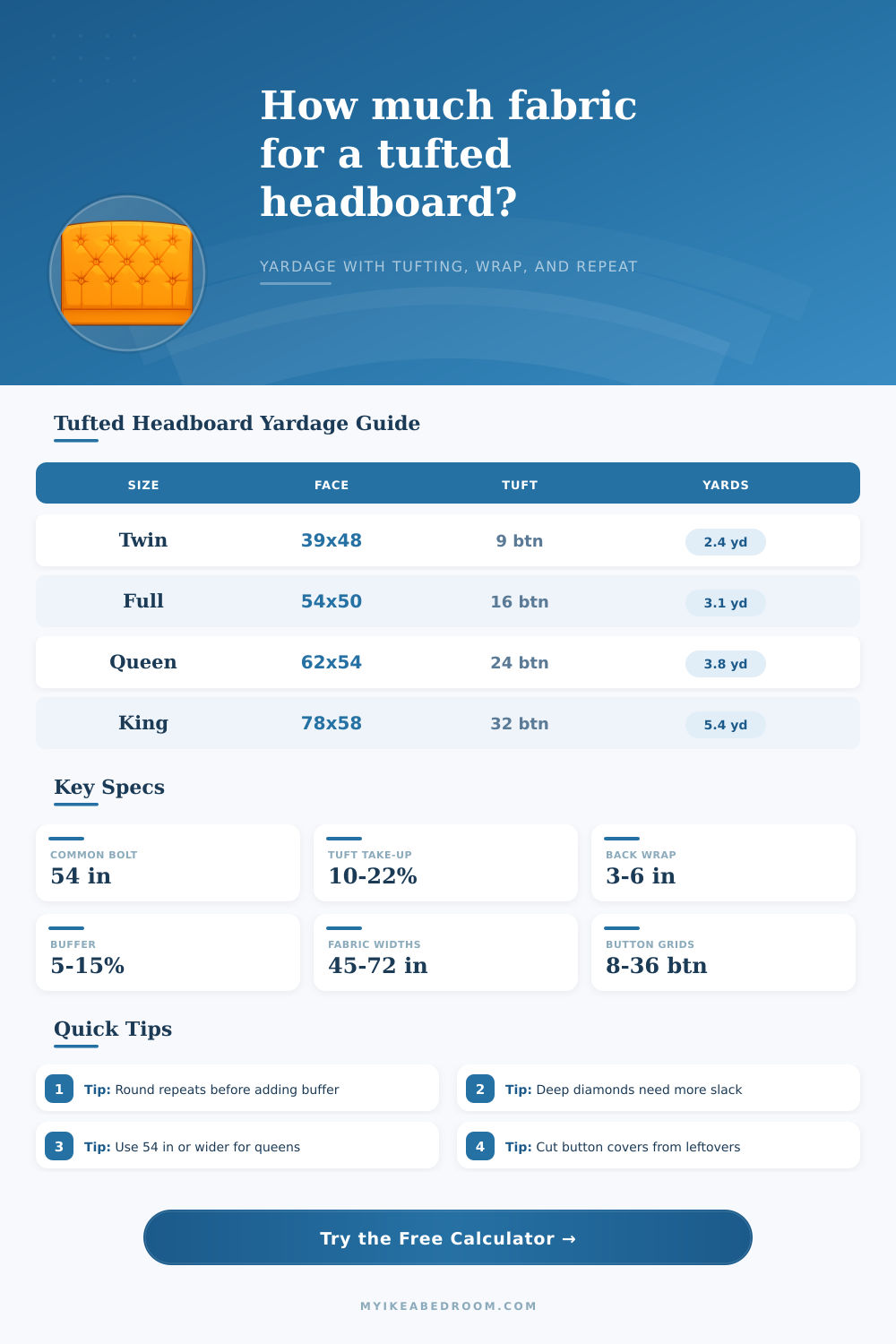
| Twin low channel headboard | 39 x 44 in | 5 columns x 1 row | Often possible from 2 to 3 yards when railroaded. |
| Full biscuit headboard | 54 x 50 in | 4 columns x 4 rows | Use at least 54 in fabric to reduce side joins. |
| Queen classic tufted headboard | 62 x 54 in | 6 columns x 4 rows | Deep tufting and wrap can push cut width beyond one bolt. |
| King tall diamond headboard | 78 x 58 in | 8 columns x 4 rows | Expect multiple drops unless fabric is extra wide. |
A tufted headboard can transforms the appearance of a bedroom, but calculating the amount of fabric needed for a tufted headboard is a difficult task. Many people will measure the face of the headboard to determine the amount of fabric that they will need to purchase. However, if they only measure the face of the headboard, they will run out of fabric.
This is because the fabric must be pulled into the depressions created by the buttons on the headboard. Additionally, fabric with buttons will have the buttons pull on the fabric. Therefore, shallow tufting will require more fabric than a flat surface, but deep tufting will require even more fabric than shallow tufting.
How Much Fabric Do You Need for a Tufted Headboard
Since fabric can be rather expensive, it is essential to calculate the amount of fabric that is needed accurate. The thickness of the headboard will also impact the amount of fabric that is needed. Headboards are made of foam, batting, and a hardboard back.
The fabric must be wrap around the sides of the foam and batting to staple the fabric to the back of the headboard. The thickness of the foam and batting will determine the amount of fabric needed to reach the back of the headboard. Furthermore, if you want the fabric to wrap smoothly around the edges of the headboard, there will need to be extra fabric to account for the thickness of the edges of the headboard.
The thickness of the headboard will impact the amount of fabric needed because the thickness of the headboard will determine how much fabric is used on the sides of the headboard. Another factor that will impact the amount of fabric needed is the pattern of the fabric. If the fabric contains a pattern, such as a floral print or a geometric design, the pattern will need to be aligned along the seams of the headboard.
The fabric will need to be shifted to align the pattern, which will consume some of the length of the fabric bolt. The larger the pattern, the more fabric will need to be purchased to allow for shifting the fabric to line up the pattern. A pattern calculator will help determine the amount of extra fabric that the pattern repeat in the fabric will consume.
The width of the fabric bolt will impact how the fabric will be used on the headboard. Some fabric bolts will be rather narrow in width, requiring several strip of fabric to complete a headboard. Other fabric bolts may be very wide in width, allowing the fabric to be laid horizontal across the headboard.
Using the fabric horizontally will reduce the amount of fabric needed and will eliminate the need for seam on the headboard. The width of the fabric bolt will impact the amount of fabric that is needed because using the fabric horizontally will reduce the total yardage of fabric needed for the headboard. Another piece of fabric that will need to be accounted for is the fabric used for the button covers.
Each button cover will be a small circle of fabric on the headboard. Each circle will need to be large enough for the fabric to gather when the button is pulled tight. If there are many buttons on the headboard, the amount of fabric for the buttons will be a significant amount of the total yardage of fabric.
This amount of fabric for the buttons should be calculated separately from the main headboard because the leftover fabric from the headboard may not be enough to make all of the button cover. The shape of the headboard will impact the amount of fabric that is needed to make the headboard. The shape of the headboard can make the headboard difficult to measure.
For instance, headboard with an arched top or with scalloped edges will be difficult to measure. A headboard with an arched top will require more fabric than a flat headboard because the arch will be longer than the flat measurements of the headboard. A headboard with wingback side will also require more fabric for the sides of the headboard.
The specific shape of the headboard will impact the total amount of fabric needed to make the headboard. Finally, another consideration for fabric needed for a tufted headboard is the overage of the fabric. People should purchase extra fabric to ensure they have enough for the project.
When purchasing fabric for a headboard, people will need to buy extra fabric in case the fabric shifts when stapling the headboard together. Additionally, it is also likely that mistakes will be made when purchasing the fabric. A ten percent overage is common for headboards, but purchasing fifteen or twenty percent of the fabric will ensure that there will be enough fabric for the project, especially if it is a complex project.
By calculating the amount of fabric needed for a tufted headboard before cutting the fabric, people will have the flexibility to change the depth of the tufting, the width of the fabric that will be used, and where the pattern will be placed on the headboard. If people were to cut the fabric before calculating these fabric measurements, they will not have the flexibility to make any changes to the project. Therefore, by using a fabric calculator to determine the amount of yardage needed for the headboard, people will ensure that their headboard project will be a success.