Trundle Bed Pull-Out Clearance Calculator
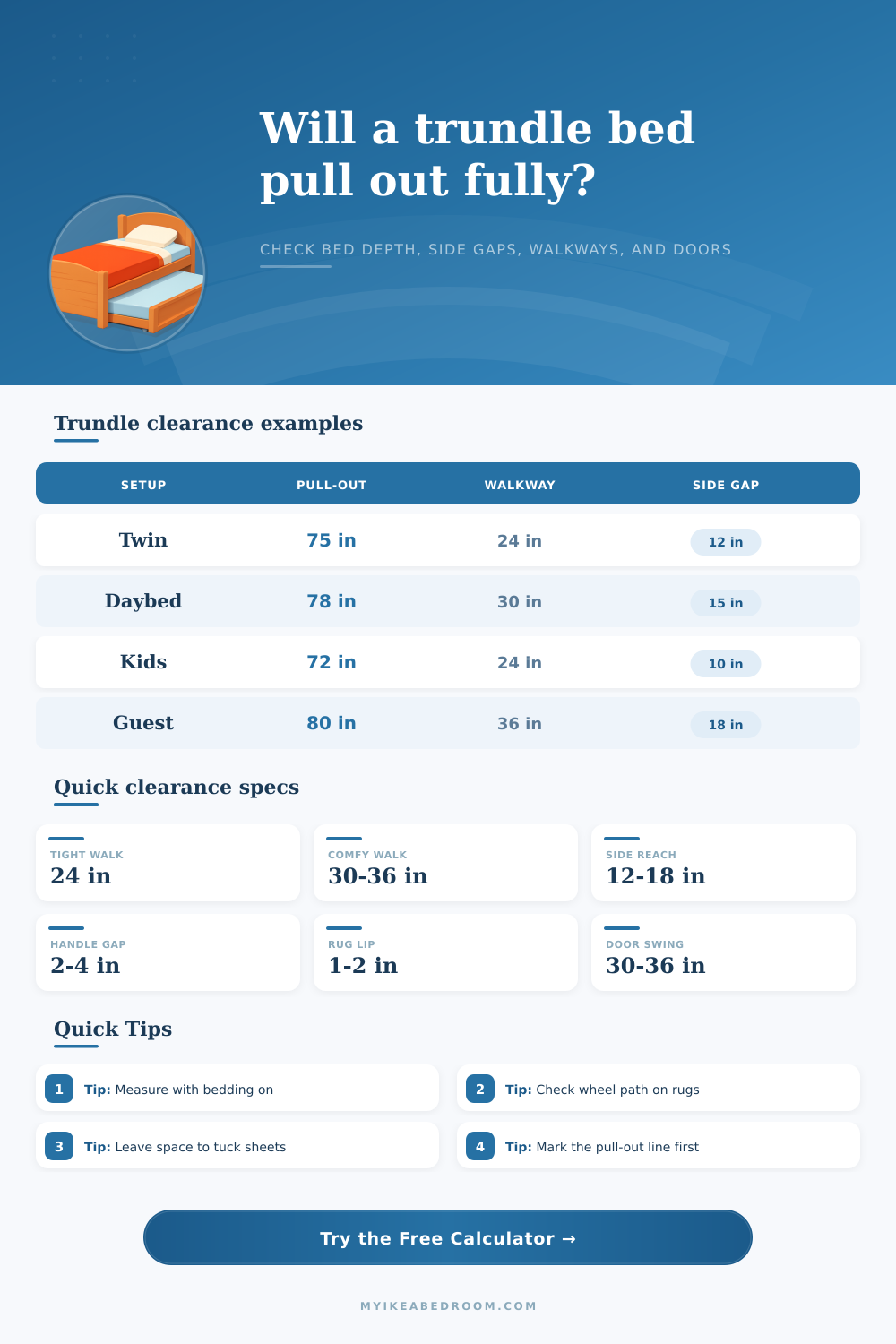
Check whether a trundle bed can roll out fully with enough foot walkway, side access, bedding room, rug clearance, drawer handle space, and door swing separation.
Pick a common bedroom setup, then fine tune every measurement to match the actual bed frame, mattress, rug, doors, and nearby furniture.
| Trundle setup | Typical frame depth | Typical pull-out | Best foot walkway | Notes |
|---|---|---|---|---|
| Twin trundle under bed | 40-43 in | 38-41 in | 24-30 in | Check handles and wheel path before placing a dresser opposite. |
| Daybed with twin trundle | 41-45 in | 39-42 in | 30-36 in | Side bolsters and pillows can add depth when used like a sofa. |
| Pop-up trundle | 40-44 in | 39-43 in | 30-36 in | Needs extra side space for lifting and aligning the pop-up deck. |
| Captain bed plus trundle | 42-46 in | 39-43 in | 30 in | Drawer fronts and pull hardware may protrude beyond the mattress. |
| Low caster trundle | 40-43 in | 38-41 in | 24-30 in | Thick carpet can reduce how easily the bed rolls straight out. |
| Clearance zone | Tight | Comfortable | Generous | Use it for |
|---|---|---|---|---|
| Foot walkway beyond open trundle | 24 in | 30 in | 36 in | Passing, turning, and reaching the far side of the bed. |
| End clearance by head or foot rail | 10-12 in | 15-18 in | 24 in | Sheet tucking, pillow access, and avoiding a boxed-in feeling. |
| Handle and bedding projection | 2 in | 4 in | 6 in | Knobs, blanket overhang, and soft mattress edge bulge. |
| Rug and caster allowance | 1 in | 2 in | 3-4 in | Rolling over rugs, thresholds, and slightly uneven floors. |
| Door or closet separation | 0 in overlap | 6 in spare | 12 in spare | Preventing an open trundle from blocking daily room use. |
| Room or area | Usable depth | Bed setup | Likely result | Planning note |
|---|---|---|---|---|
| Small kids room | 108 in | Twin frame and lower trundle | Tight | Move toy bins and keep the opposite wall clear before sleepovers. |
| Guest room | 120 in | Daybed with twin trundle | Balanced | Usually works if dresser depth is outside the pull-out path. |
| Narrow home office | 102 in | Daybed near desk chair | Move items | Desk chair often needs a temporary parking spot at night. |
| Large shared bedroom | 132 in | Captain bed and trundle | Comfortable | Keep drawer clearance and the trundle path separate if possible. |
| Studio alcove | 114 in | Daybed beside wardrobe | Depends | Door swing and wardrobe depth are usually the deciding factors. |
The closed bed depth tells you how the room works during the day. A trundle that fits open may still feel bulky if the main frame blocks drawers or desk chairs.
Best use: Check everyday traffic first.
The open footprint includes the frame, pull-out deck, hardware, bedding, and a caster allowance. This is the number to mark on the floor with tape.
Best use: Test sleepover mode.
A movable chair or toy bin can rescue a layout, but a dresser, radiator, wardrobe, or closet door should be treated as fixed unless it truly clears the path.
Best use: Separate daily and guest setups.
End gaps matter because trundle beds are low. Extra space near the head and foot makes it easier to pull sheets, reach pillows, and stand up without twisting.
Best use: Improve comfort, not just fit.
Measure the actual pull-out. Published mattress sizes do not include drawer fronts, knobs, rounded rails, bedding, caster swivel, or the small diagonal wiggle needed to start the trundle rolling.
Mark both positions. Tape the closed frame line and the fully open trundle line on the floor. Then open doors, slide drawers, pull out desk chairs, and walk the route.
Watch rugs and thresholds. A trundle that rolls easily on hard flooring can bind on thick carpet. Add allowance where wheels cross rug edges, cords, or floor transitions.
Plan for bedding hands. If someone needs to make the bed while it is open, add more side and foot clearance than the absolute minimum needed for the mattress to fit.
You purchase a trundle bed because it is supposed to save space. When the bottom mattress isn’t needed, it rolls away into its hiding place, leaving your bedroom looking clean and uncluttered.
One day you have a guest and you pull out the frame. Now the room is a maze. You can’t get past dresser. You trip over rug on the way around the wheels. You don’t even have any room to move around the bed!
How to Measure Your Trundle Bed Correctly
Why? The layout failed because you measured only the closed size and forgot about the open footprint. Once you know how many inches deep your bed is, and how wide it’s going to be including hardware, bedding buffer, and travel distance, it’s time for the math. And this time, we don’t want you doing the math. We have a calculator for that.
What? A calculator? Yes. But before you put in the numbers, you need to know what they are. A trundle isn’t just a mattress on wheels. You also has to account for the hardware that projects off the wall, the distance the pull-out travels, the depth of the main frame, and extra space needed for bedding.
So, most people measure only as far as where their mattress sits. Oops. There’s your first error. You forgot about the knob or handle to pull the bed out. Depending on its style, that can add 2-3 inches to the total width.
Then, if you’ve got a nightstand, or even worse, a wall next to the trundle, and that handle doesn’t clear until after the bed is fully extended, the trundle will get stuck half way out and sit at an angle. This is not good when it come time to sleep. So remember: measure everything.
Trundles fail most often due to rugs. That soft-looking rug that looks nice on Instagram is like sand to caster wheels. For this reason, the calculator allow you to include a rug lip allowance. Also, small variances in pile thickness or floor height can make a big difference in rolling force required to pull the bed out. Any binding along its path means you’re either going to drag it (scratching the floor) or wear down your casters quicker. Hard floors is forgiving. Thick carpet needs some extra clearance so wheels don’t dig in and halt their progress halfway through.
Another trap is door swings. Your bed might swing open quite far, but then what about when the bedroom door or closet door opens? That’s called a collision course. With the tool, you can account for any door intrusion (and subtract that arc from your available depth). Duh, it sounds obvious… unless someone brings it up, no one double checks whether the open trundle collides with their closet door. Bottom line, you don’t want the guest having to move furnitures before entering the room and getting to the bed.
Side clearance is important, but few people think about it much. Trundle beds aren’t very tall so you have to bend over to get on and off. There are only ten inches between side of the bed and a wardrobe or wall. That’s not enough for sheet-tucking! Changing pillows gets awkward too. Most balanced layouts aims for at least eighteen inches on each side. That’s plenty of room to move around without feeling cramped. It turns a functional sleep surface into a comfortable one.
For example, the tool comes with reference tables to help explain typical configurations and highlight how style variations such as daybeds or captain beds will adjust necessary clearances. A pop-up trundle needs more horizontal and vertical room than a traditional slide-out trundle because of the mechanism used to raise the deck. This is an important distinction so you don’t end up purchasing a bed that fits width-wise, but not in terms of functionality.
In the end, a trundle is all about making transitions. When the bed is opened, how does the room function? How did it function when the bed is closed? At some point, you have to make compromises, you can’t fully optimize for both ends of the spectrum at once. The calculator lets you see that middle ground by showing those tradeoffs before you start lugging around furniture.
You should of checked things earlier. Measure twice, measure the rug and the handles on the bed, check the swing of the doors. Think through the pull-out path in advance, instead of just the sleeping surface, and your guest will appreciate it.