Treadmill Clearance Calculator
Check the open workout zone, side gaps, rear landing space, ceiling headroom, incline rise, and folded storage footprint for a treadmill in a real room.
Switch units before or after entering measurements. Room length and width use larger room units; treadmill and body dimensions use smaller units.
Clearance Results
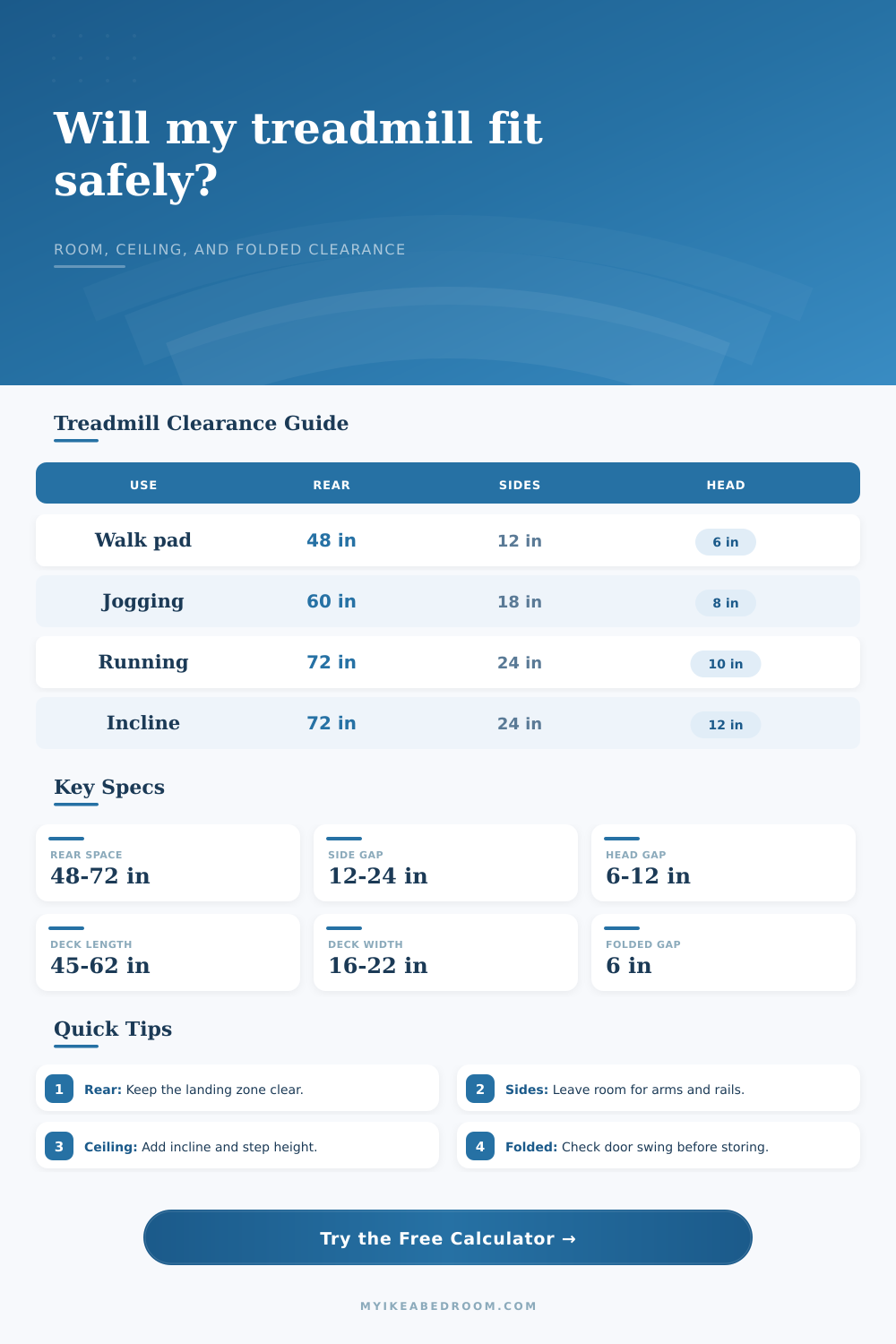
| Use level | Rear clearance | Side clearance | Headroom buffer |
|---|---|---|---|
| Walking pad | 48 in / 122 cm | 12 in / 30 cm | 6 in / 15 cm |
| Light jogging | 60 in / 152 cm | 18 in / 46 cm | 8 in / 20 cm |
| Running | 72 in / 183 cm | 24 in / 61 cm | 10 in / 25 cm |
| High incline | 72 in / 183 cm | 24 in / 61 cm | 12 in / 30 cm |
| Treadmill type | Deck size | Open machine | Typical room fit |
|---|---|---|---|
| Under-desk walking pad | 42-48 by 16-18 in | 50-58 by 22-26 in | Office strip or studio wall |
| Compact folding jogger | 50-55 by 18-20 in | 66-72 by 28-32 in | Guest room or bedroom nook |
| Standard running treadmill | 55-60 by 20 in | 72-78 by 32-36 in | Bedroom, den, or basement |
| Wide incline trainer | 60-62 by 22 in | 78-84 by 36-40 in | Fitness room or garage zone |
| User height | Deck step-up | Incline rise | Ceiling target |
|---|---|---|---|
| 5 ft 6 in / 168 cm | 7 in / 18 cm | 3 in / 8 cm | 84 in / 213 cm or taller |
| 5 ft 10 in / 178 cm | 8 in / 20 cm | 5 in / 13 cm | 93 in / 236 cm or taller |
| 6 ft 2 in / 188 cm | 9 in / 23 cm | 6 in / 15 cm | 101 in / 257 cm or taller |
| 6 ft 5 in / 196 cm | 10 in / 25 cm | 8 in / 20 cm | 109 in / 277 cm or taller |
| Stored location | Folded footprint | Extra clearance | Check before storing |
|---|---|---|---|
| Behind a door | 32 by 34 in | 6 in each side | Full door swing and handle depth |
| Closet alcove | 36 by 34 in | 4-6 in each side | Threshold lip and shelf height |
| Bedroom wall | 38 by 36 in | 6-10 in walking edge | Bed drawer and wardrobe pulls |
| Garage wall | 40 by 38 in | 8-12 in around base | Car door sweep and outlet access |
If you’ve ever bought a treadmill only to discover that your doorways aren’t large enough, you’re not alone. It’s a common error that occurs in three phases:
Unboxing day… Excitement as you unwrap your new purchase. On Day 2, I realized the treadmill is wider than my hallway. Set-up day, Nowhere to go, so you set it up in your living room. Your head are barely above the frame and your arms keep bumping into bookshelves. In other words, now you’re running in a closet.
How to Measure Your Room for a Treadmill
What happened? How did this happen? The answer isn’t about treadmills, per se. It’s about the area surrounding the treadmill. Many folks measure just the footprint of the treadmill without taking into account safety zone. And that safety zone make all the difference.
After you input user’s height and dimensions of your room, the calculator does the math for you. You won’t have to guess how much elbow room is required.
First, you will input width and length of the room. A twelve by ten room might seem like plenty of space. Then again, when you take into account width of the treadmill plus side rails, that ten-foot wall shrinks significantly. The tool looks at not only the width of the deck but also the side rails and shrouds that stick out. They may be mere inches, but those extra inches on either side matters when you’re trying to avoid whacking your ribcage with a hard edge at full sprint.
Most setups lacks rear clearance. When running, you naturaly increase your stride; stopping causes you to keep moving, either backward or forward. Stopping with a wall right behind you cause you to lean forward or shorten your stride. This is bad form. This increases potential for injury. Your landing zone matters. Six feet or more is common for serious runners. That’s what the calculator measures: how much room you need versus how long your room is. A negative number mean not enough room. Better to find out ahead of delivery day. Perhaps consider a smaller model, or rotate the machine.
And then there’s ceiling height, another issue. Eight-foot ceilings are standard in rooms. That sounds fine, except you must account for the incline’s rise, the step-up height from the deck, and user’s height. When a treadmill rises so does the entire front of the deck. On a steeper incline, if you’re tall, your head will approach ceiling too closely, and that’s both unsafe and annoying: you get tunnel vision.
Add your height, the maximum incline rise, and the deck thickness to get the overall vertical stack. You want this number to be less than a few inches because you risk head banging into ceiling. Drop the incline or relocate machine to a higher-ceilinged room. It is a small thing, but it makes a difference in comfort.
The last piece of the puzzle is storage. Since so many treadmills folds, that’s really nice in a tiny apartment. But if you don’t consider swing path when you try to tuck them away in a corner, they can be difficult to get out again. The calculator will let you know if the folded treadmill will fit in a specific area where you want to store it.
And then there’s the issue of the buffer zone surrounding it. Try to jam it right against wall and you might not be able to yank it back down later on. Having an inch or two of space make a big difference in whether or not you can use this machine.
A treadmill is a health investment, as long as you’ll be able to use it. Avoid buying one that might become a source of frustration by taking the time to measure your space and factor in your stride. The last thing you want to do is run down a hallway and duck under furnitures. Buy the machine after planning out the zone.