Toy Storage Cube Quantity Calculator
Estimate how many cube bins and shelf openings you need from toy counts, toy volume, cube size, kid-friendly fill level, growth reserve, room wall width, and shelf height limits.
Pick a household pattern, then replace the counts, cube size, and wall limits with your actual toy collection.
Toy cube layout summary
The calculator will compare storage volume against the wall and height limits.
Wall fit score reflects cube count, spare capacity, bottom-row heavy storage, and whether the suggested shelf fits the measured wall.
| Toy category | Default volume per item | Weight tendency | Best cube placement |
|---|---|---|---|
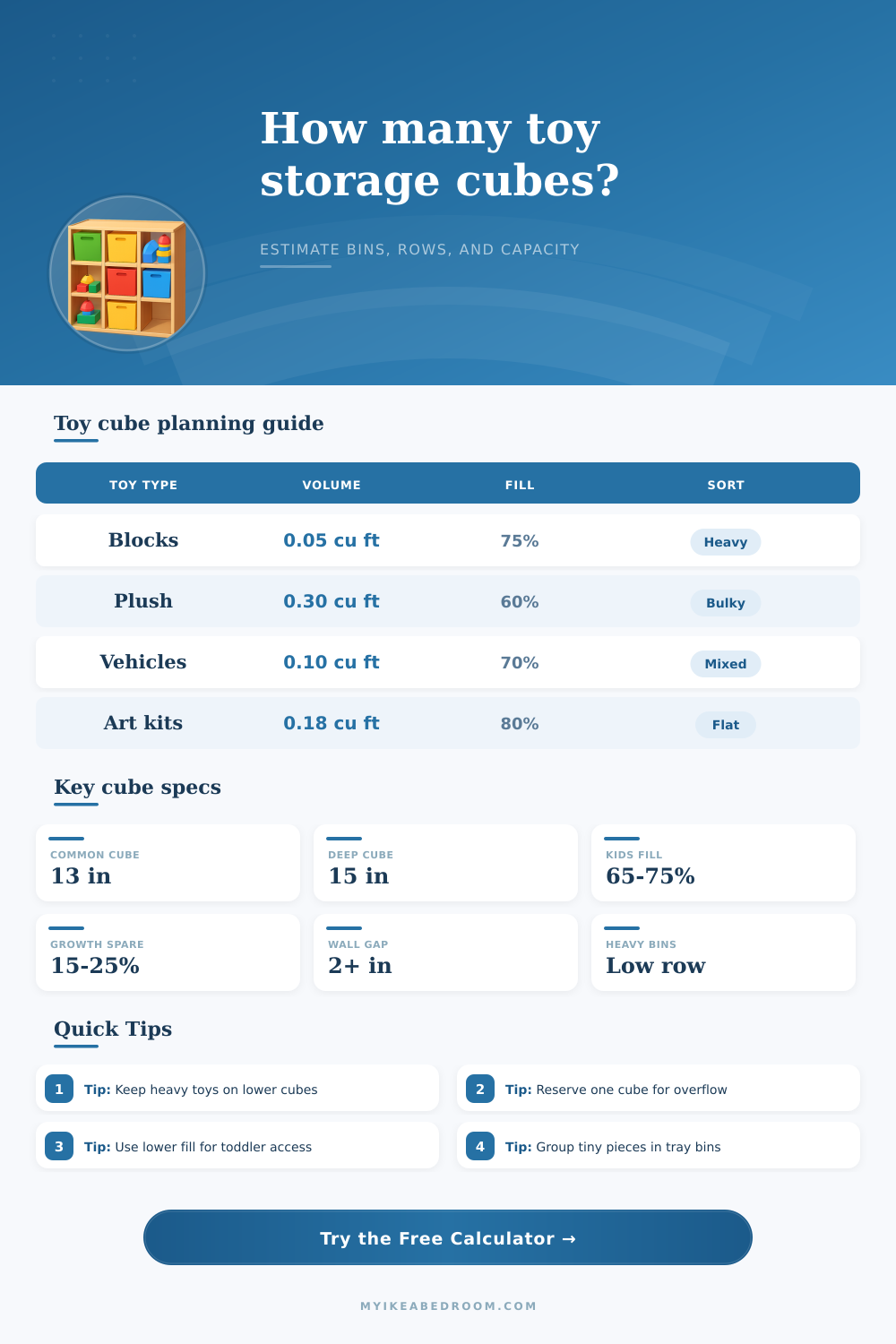
| Blocks, bricks, train track | 0.050 cu ft each | Heavy | Bottom row or shallow tray bin |
| Plush and soft items | 0.300 cu ft each | Light but bulky | Upper or side cubes with lower fill |
| Vehicles, figures, dolls | 0.100 cu ft each | Mixed | Middle rows with broad labels |
| Puzzles, games, books | 0.160 cu ft each | Medium to heavy | Low or vertical bins |
| Craft kits, paper, dress-up | 0.180 cu ft each | Mixed | Grouped cubes or lidded inserts |
| Large bulky toys | 0.800 cu ft each | Bulky | Open cube, floor basket, or deep bin |
| Internal cube | Raw volume | 75% usable volume | Best use |
|---|---|---|---|
| 11 x 11 x 11 in | 0.77 cu ft | 0.58 cu ft | Small parts, figures, compact shelves |
| 12 x 12 x 12 in | 1.00 cu ft | 0.75 cu ft | General toys in small rooms |
| 13 x 13 x 13 in | 1.27 cu ft | 0.95 cu ft | Common fabric bins and playroom cubes |
| 15 x 15 x 15 in | 1.95 cu ft | 1.46 cu ft | Plush, dress-up clothes, sports toys |
| Layout | With 13 in cubes | Approx wall width | Storage character |
|---|---|---|---|
| 2 columns x 4 rows | 8 cubes | 28 to 30 in | Tall narrow bedroom zone |
| 3 columns x 3 rows | 9 cubes | 42 to 45 in | Balanced kids room setup |
| 4 columns x 2 rows | 8 cubes | 56 to 60 in | Low child-access playroom shelf |
| 4 columns x 4 rows | 16 cubes | 56 to 60 in | Shared room or larger collection |
| 5 columns x 5 rows | 25 cubes | 70 to 75 in | Large playroom wall with rotation space |
| Scenario | Estimated toy volume | Recommended cubes | Layout note |
|---|---|---|---|
| Toddler room | 8 to 11 cu ft | 10 to 14 cubes | Keep 4 to 6 cubes low and open |
| Small apartment zone | 5 to 8 cu ft | 6 to 9 cubes | Use active toy rotation |
| Shared playroom | 16 to 24 cu ft | 18 to 28 cubes | Plan labels and overflow cube |
| Brick collection | 4 to 9 cu ft | 7 to 15 cubes | Lower fill improves sorting |
| Craft and puzzle storage | 7 to 13 cu ft | 9 to 17 cubes | Use flat inserts inside cubes |
Measure inside capacity. Fabric bins and cube frames can lose usable width, depth, and height. Measure the bin interior for the most realistic count.
Leave air in daily bins. Kids usually clean up faster when bins are not packed. Use 65% to 75% fill for toys handled every day.
Sort heavy items low. Blocks, train track, books, and dense puzzles should fit into bottom-row cubes so the shelf stays easier to use.
Plan one spare cube. A partly empty cube absorbs new toys, library books, party favors, and projects that have not been sorted yet.
When parents purchase one of those cube shelving units, they do so in state of vague abundance: They have no idea what their kids will do with them for 6 months until they notice all the bins being dumped out, ninety percent full. That’s not a case of bad parenting; it’s a case of poor planning. It’s not that there isn’t enough storage space.
No, the issue is that nobody understands capacity vs. Volume is a complicated thing to understand when dealing with cubes. They look like containers, but they are actualy a maze of dimensions, fill rates, and human reach. Get the math correct first (before assembling the unit), and everybody wins.
How to Plan Your Toy Storage
Now that your toys are contained, you should choose whether or not you want them to really have space to move around. Yes, I know, you can’t count. Just like a box of little tiny plastic cars doesn’t take up as much space as a single stuffy elephant. The volume conversion feature on the calculator (shown above) take this into account and makes sure that you aren’t guessing about whether your boxes of building blocks goes in one bin or three.
Plush toys kind of squish down a bit, while hard toys don’t. That makes a big difference in how many openings you’re going to have to put in your wall. Overestimating how dense those soft objects are means nice-looking shelves, but then trying to cram another gift in there mean everything falls back onto the floor.
Finally, there’s the issue of accessibility. If the shelves contains all your toys and require a step stool, then they gets ignored. The tool allows you to set a maximum height for storage that remains child safe, which effectively forces a realistic layout. Perhaps you find that you don’t fit your dream of a four-by-four grid in the safe reach zone of a three year old.
That’s okay. It means you’ve got a two row unit with a wider footprint, or you’re cool with having some cubes as display-only. The visual diagram will show how many columns you can fit on your wall, including the width of the frame dividers between each compartment. Folks regularly fail to measure for the dividers themselves.
Twelve inch wide cubes aren’t going to take up precisely twelve inches of wall space; they’ll take up twelve plus the border. When multiplied over ten units, that’s several inches of lost space. Leave some room.
People often try to cram as much into each bin as possible, but when you do this, your kid can’t clean up! They’ll dig around inside but they won’t be able to tip it over, so why bother? Use the calculator to select a “fill” percentage, typically somewhere between 65% and 75%.
By setting a fill level, there’s enough room to slide things in. This also factors in the fact that kids’ toys expands over time. They enter a phase, get a gift, and off we go again. Having leftover empty space means if your little one brings home a pile of dress-up clothes or a giant jigsaw puzzle, you have a buffer zone and the whole thing doesn’t come crashing down. That way you don’t need to keep the bottom row completely empty, which is where big, heavy things (like big blocks or big board games) should live anyways. Leaving those areas just a bit emptier stabilize everything.
Another variable is your sort-by style. While broad groupings like “toys” need fewer bins, they creates messier categories. If you sort precisely (e.g. Every book in its own bin), then you’ll get a neater sort, but at the cost of needing many more bins, plus extra brainpower to keep them organized. To account for this, the tool scales up the number of cubes needed as you specify more detailed sorting.
Efficiency vs. Precision: which do you prefer? For most families, there’s a happy medium: cars go with other cars; books goes their own way; and a dedicated tray bin holds all those miscellaneous bits and pieces.
Begin with your biggest toys. What’s the smallest cube that can hold your large truck or big plush animal? Then work in from there based off what fits into the cubes next. If you have bins of any kind, measure inside of the fabric bins; not the outside frame of the shelf. This could of thrown off your estimates by a bin or two.
Don’t worry about wasting space for a cube for overflow. Think of it as insurance against all the birthday gifts and school projects that are bound to come in. Plan for the mess, before it comes, and the cleanup becomes a habit instead of a battle.