Towel Radiator Size Calculator
Size a towel radiator from bathroom area, ceiling height, towel load, heat target, wall width, radiator dimensions, rail spacing, heat source, and delta T output correction.
Presets load common bathroom and towel warmer layouts. Adjust the heat target, dimensions, and rail spacing to match the actual product and wall.
Live radiator fit preview
| Bathroom condition | Metric heat target | Imperial heat target | Use in calculator |
|---|---|---|---|
| Internal powder room | 75 to 90 W/m2 | 24 to 29 BTU/h per sq ft | Use the low end when heat loss is small and towels are light. |
| Typical bathroom | 90 to 110 W/m2 | 29 to 35 BTU/h per sq ft | Good starting range for one outside wall or normal ventilation. |
| Cold exterior bathroom | 110 to 135 W/m2 | 35 to 43 BTU/h per sq ft | Use for large windows, cold walls, or frequent ventilation. |
| Warm floor assisted room | 55 to 80 W/m2 | 17 to 25 BTU/h per sq ft | Use only if another heat source covers part of the room load. |
| Catalog delta T | Approx output factor | What it means | Selection note |
|---|---|---|---|
| 60 C | 1.27 x delta T 50 | Higher water temperature rating | Useful for older high-temperature systems. |
| 50 C | 1.00 x delta T 50 | Common catalog reference point | Default comparison value for many products. |
| 40 C | 0.75 x delta T 50 | Moderate water temperature | Size up if the catalog was quoted at 50 C. |
| 35 C | 0.63 x delta T 50 | Low-temperature system | Often needs larger surface area or a second heat source. |
| 30 C | 0.52 x delta T 50 | Very low water temperature | Check product data carefully before relying on one rail. |
| Rail spacing | Metric spacing | Drying feel | Capacity note |
|---|---|---|---|
| 3 in | 75 mm | Dense rails | Good rail count but thick towels may bunch together. |
| 4 in | 100 mm | Balanced | Common spacing for mixed hand towels and bath towels. |
| 5 in | 125 mm | Open drying | Better air gaps, fewer total rails on the same height. |
| 6 in | 150 mm | Loose and airy | Works well for large towels on taller radiators. |
| Scenario | Typical size | Towels | Output target |
|---|---|---|---|
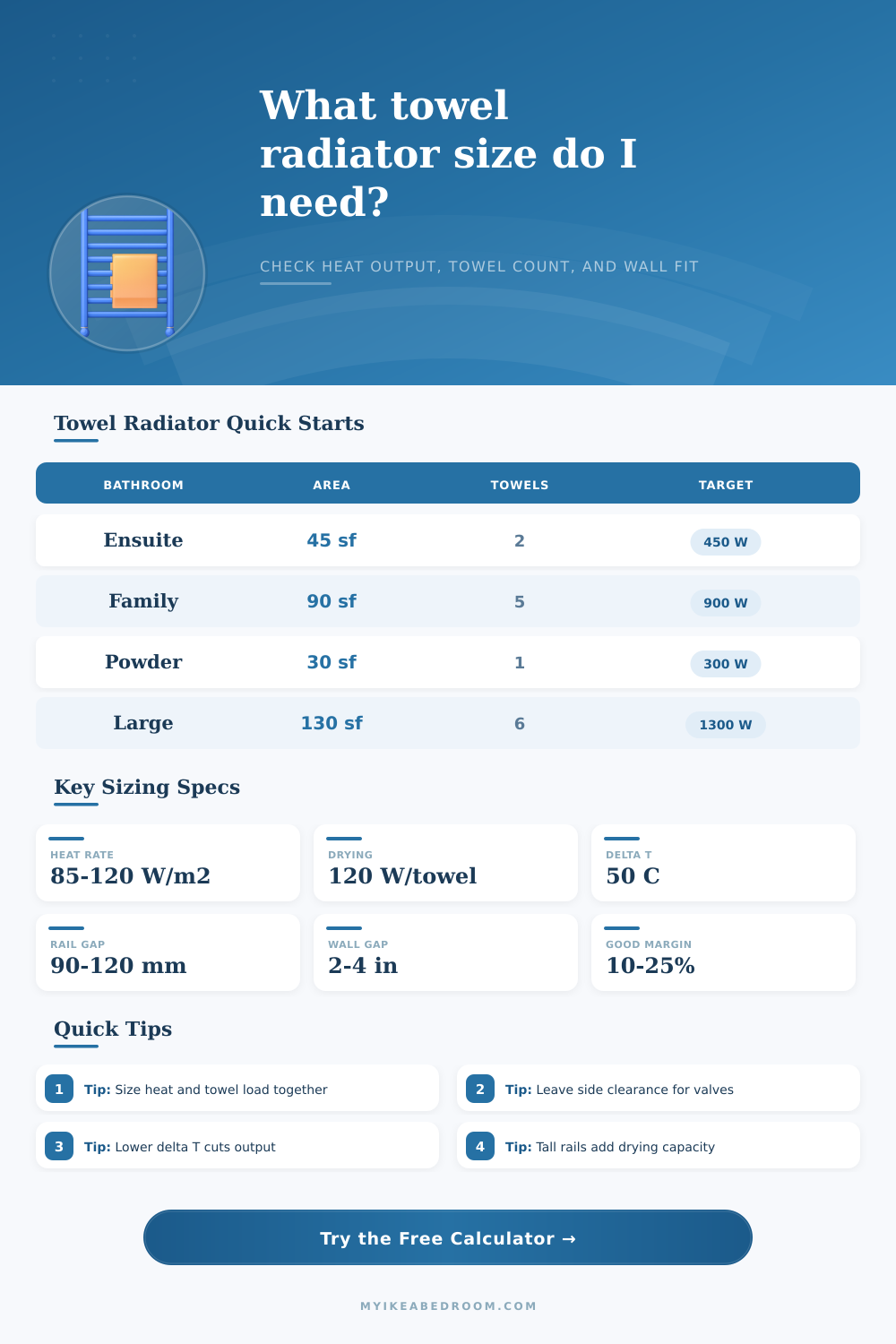
| Small ensuite | 20 x 36 in / 50 x 90 cm | 2 bath towels | 450 to 650 W depending on heat loss. |
| Family bathroom | 24 x 48 in / 60 x 120 cm | 4 to 5 towels | 850 to 1200 W with stronger drying allowance. |
| Tall narrow warmer | 18 x 60 in / 45 x 150 cm | 3 to 4 towels | Works when wall width is tight but height is available. |
| Large primary bath | 30 x 60 in / 75 x 150 cm | 5 to 6 towels | Often needs panel or double rail output density. |
Water ladder rail
Best for: bathrooms tied to a central heating loop.
Watch: output falls when the system runs at low delta T.
Use catalog output at the correct temperature whenever available.
Electric rail
Best for: towel warming when central heating is off.
Watch: wattage may dry towels but not heat a cold room.
Compare fixed electric output against both heat and towel load.
Double towel rail
Best for: family bathrooms with several damp towels.
Watch: projection and clearance around doors and vanities.
Extra depth can help drying while still using a narrow wall.
Panel towel radiator
Best for: rooms where heat output matters as much as towels.
Watch: fewer open hanging gaps than ladder-only styles.
Good option when the margin is negative on a plain ladder rail.
Check the heat load before trusting towel count alone. A rail can hold enough towels and still undersize the bathroom if the room has cold exterior walls or strong ventilation.
Leave real wall clearance for the installed product. Valves, towel overhang, door trim, and hand access can turn a technically fitting radiator into a tight daily-use layout.
Why? The bathroom doesn’t hold on to heat well so you end up with cold towels following your shower. Towel radiators are a popular choice but most do not dry towels effectivey, they’re bought for looks more than function. This calculator will make you consider the true towel-drying capacity and help you learn from others’ mistakes when choosing unit for a DIY job.
Tiles absorb coldness and retain it long after furnace is operating, so bathrooms are high-thermal-mass areas. Before you start hanging wet laundry, make sure you has sufficient wattage to win out over inertia. A common rule of thumb is thirty-five BTUs per square foot. That math applies if there aren’t any exterior walls and no big windows. For a room with a skylight, or one that gets north-facing light, you’re fighting extra hard against chill. Because you’re heating air, volume counts, and the tool compensates for ceiling height. The higher up, the more air you have to warm diluting the heat down at floor level (where you happen to be standing).
How to Choose the Right Towel Radiator
The way users calculate drying towels is wrong. Users count how many bars there is on a ladder rail, and conclude that’s how many towels they can dry at once. That’s not true. To dry well, you need air flow, and you need consistent radiant heat touching the fabric surface. On tightly packed rails, towels forms into groups that insulate themselves from the heat source. This calculator allows for roughly one hundred twenty watts per towel, but only because it considers that the radiator has a dual use: keeping the room at a steady temperature while removing moisture.
Then there’s the issue of wall fit. Even if you know how far away from door frame the vanity sits, it could still mean that you’re out of room for cleaning and/or valves. Valves requires clearance so they don’t leak when stressed. And we want some breathing room (two to four inches) on both sides so your towels won’t bang into wall every time you hang them up. That way the paint isn’t damaged and air can circulate along the edges of the rails. Before you cut anything, use the tool’s visual preview to see how tight the fit will be.
How it heats matter a lot. Delta T is the difference between water temperature and the room temperature. This applies to water-heated systems like radiators. Their output is rated based off a standard delta T of fifty degrees. That’s reduced if your house has a moddern, low-water-temperature heat pump or condensing boiler. The tool adjusts down for this reduction otherwise you’d overestimate performance. Electric rail output can be more easily predicted by watts, though many times electric rails just don’t have enough output to get a cold room up by themselves.
Rail spacing is a technical spec that’s really about your own comfort. More bars = looks fuller (tighter spacing), while fewer bars means there’s more space between towels so they don’t touch and sag (wide spacing). You want the air to pass through the towel folds? Then it dries faster, even though you have less bar. It is a trade-off. A towel radiator is all about setting expectations: do you expect steam off your clothes in under an hour or lukewarm wet feeling after three hours? Running some numbers on how much heat you lose and how wide your wall is allows you to go beyond guessing.
Because, why should you come out of the shower cold when everyone else at home is nice and warm? You should of known that earlier.