Toilet Water Usage Calculator
Estimate toilet water use from household members, flushes per person per day, gallons per flush, and a dual-flush weighted average, with gallons and liters shown by day, month, and year.
🏠Household presets
📏Water-use inputs
Toilet water usage result
⚙Formula cards
📊Toilet water usage reference tables
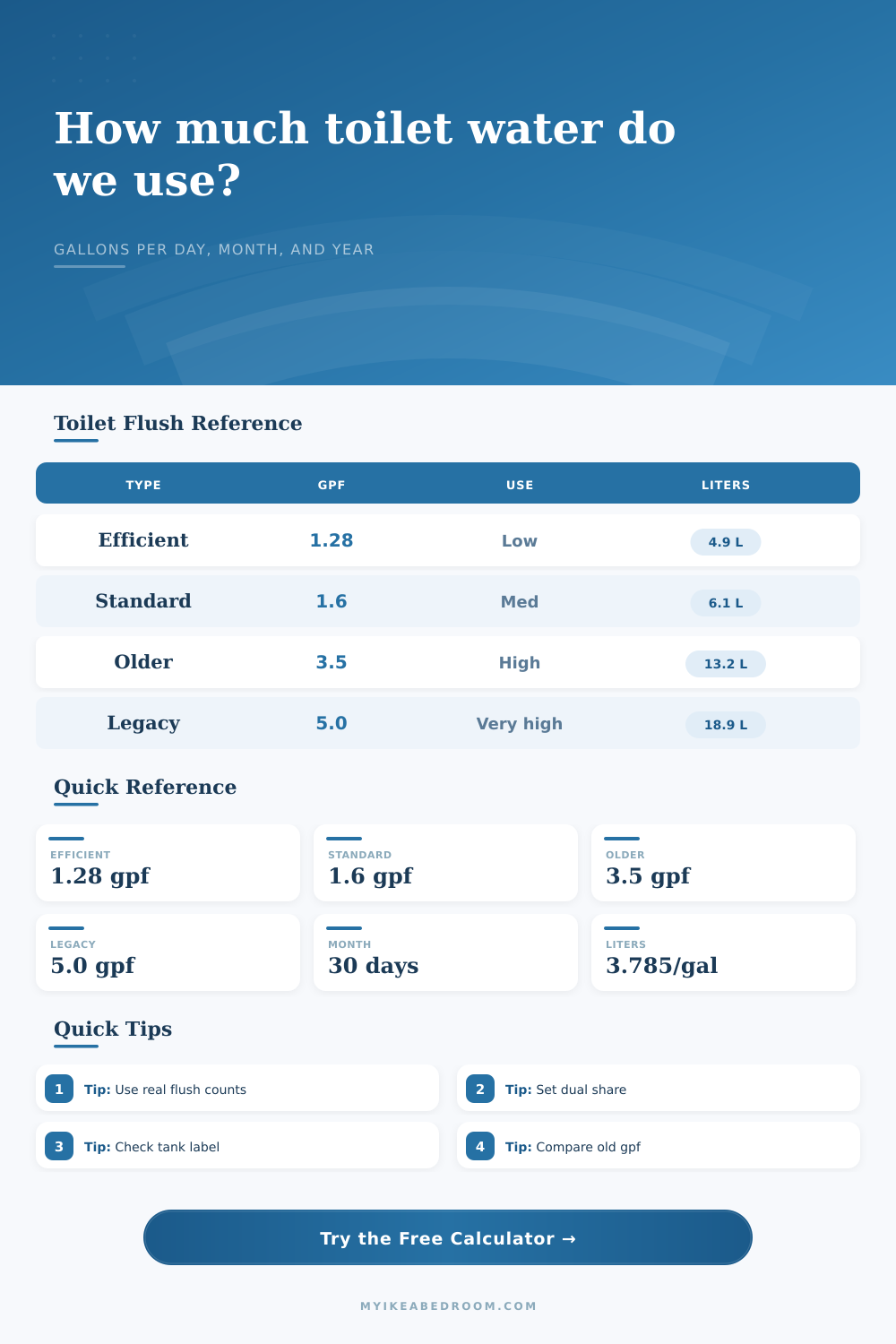
| Reference gpf | Liters per flush | Daily use at 20 flushes | Best use in calculator |
|---|---|---|---|
| 1.28 gpf | 4.85 L per flush | 25.6 gal / 96.9 L | Efficient single-flush or full-flush reference for newer fixtures. |
| 1.6 gpf | 6.06 L per flush | 32.0 gal / 121.1 L | Common standard reference when the tank label says 1.6 gpf. |
| 3.5 gpf | 13.25 L per flush | 70.0 gal / 265.0 L | Older toilet reference for comparing replacement impact by water volume. |
| 5.0 gpf | 18.93 L per flush | 100.0 gal / 378.5 L | Legacy high-use reference for very old fixtures or conservative comparisons. |
| Full flush gpf | Reduced flush gpf | Reduced share | Weighted average gpf |
|---|---|---|---|
| 1.6 | 1.1 | 25% | 1.48 gpf / 5.58 L per flush |
| 1.6 | 1.1 | 50% | 1.35 gpf / 5.11 L per flush |
| 1.28 | 0.8 | 60% | 0.99 gpf / 3.75 L per flush |
| 1.28 | 0.8 | 70% | 0.94 gpf / 3.57 L per flush |
| 3.5 | 1.1 | 40% | 2.54 gpf / 9.61 L per flush |
| Household pattern | Members | Flushes per person | Total flushes per day before guests |
|---|---|---|---|
| Single adult home | 1 | 5.0 | 5.0 daily flushes |
| Couple home | 2 | 5.0 | 10.0 daily flushes |
| Family weekday | 4 | 5.5 | 22.0 daily flushes |
| Large household | 5 | 6.0 | 30.0 daily flushes |
| Guest-heavy day | 2 | 5.0 | Add guest flushes separately for visitors. |
| Preset | Input pattern | Weighted gpf | Approx daily total |
|---|---|---|---|
| Single efficient toilet | 1 person, 5 flushes, 1.28 gpf | 1.28 gpf | 6.4 gal / 24 L |
| Couple 1.6 gpf | 2 people, 5 flushes, 0.5 guests | 1.60 gpf | 16.8 gal / 64 L |
| Family efficient dual | 4 people, 5.5 flushes, 45% reduced | 1.06 gpf | 24.4 gal / 92 L |
| Family older 3.5 gpf | 4 people, 5 flushes, 1 guest | 3.50 gpf | 73.5 gal / 278 L |
| Legacy 5.0 gpf home | 3 people, 5 flushes, 1 guest | 5.00 gpf | 80.0 gal / 303 L |
💡Usage tips
When you pay your water bill, you might ask: Where did all this money go? Was it those long showers? Did I leave something running while I was out? If only there were a easy answer. Usually, what happens in the toilet happens to your wallet. Each time you flush the toilet, water goes down the drain. And a single toilet in a home can be responsible for a large amount of a household’s indoor water usage (particulary if it’s an older model (or if family members is heavy flushers)).
How do you know how many gallons of water are going down the toilet each day? It’s not as difficult than you think. It depends on your household size, and how efficienty your toilets and other fixtures operates. This calculator does the math for you, converting gallons per flush into yearly and daily amounts.
How Much Water Do You Flush?
Before anything else, take stock in the age of your pipes. Was your home built before the mid-nineties? If so, chances are you’re still using toilets which use five gallons (or even more!) at each flush. Yikes, that’s a lot of water to go down the drain all at once. Nowadays, most efficient toilets only require one point two eight gallons; the national standard is now just one point six. So if you have an old-school five-gallon flusher and an efficient new model, then basically each time you tinkle almost four gallons of pure H2O are going straight down the toilet; literally!, without ever seeing the light of day. In a year’s time, this difference becomes thousands of gallon of lost opportunity.
The story gets more complicated within the household dynamic. A family of four with kids who don’t remember the tank might have a very different water footprint than one single adult in an apartment. Most people use between five to six flushes per day, but obviously that changes depending off your health, diet and other factors like how much guest traffic passes through your house. Do you often host dinner parties? Do you work from home? If so, all those additional flushes really start adding up (fast). To account for this, the tool allows you to toggle guest usage (a factor many people forget about until they get hit with a bigger-than-expected bill). It’s a little input, but it adds up at the end of the day when you’re trying to focus on precise consumption.
The second wrinkle, dual-flush systems, make this even more complicated, since amount saved will depend directly on what people do. For instance, the system may provide an option for a shorter flush, but unless someone uses that feature, they won’t save anything. This makes the weighted average dependent upon the % of reduced flushes (see reference table on the page). With 50% of flushes being the smaller option, your effective GPF drops a lot. It becomes something that really makes you think, does everyone in my house use the technology? Or are we all just used to flushing full strength and doing it anyway?
Leaks are another important piece of the puzzle. Even though that running toilet isn’t flushing, it’s wasting hundreds of gallons per day by way of a faulty fill valve or flapper. Because the calculator assumes only flush-based usage, it can’t take this background drip into consideration. Are you seeing lower-than-expected results? It’s probably a mechanical (not mathematical) problem. A quick dye test in the tank will tell you if there is water seeping into the bowl when it shouldn’t be.
Water use reduction has more to do with awareness than any tools we might install. When you lay out your daily gallon amount right there before your eyes, conservation moves from the abstract into the concrete. It’s no longer just something you should of done; it suddenly becomes something that you can measure and see. Every flush makes you aware of yourself. It ceases to be an unnoticed background sound and becomes a limited resource. Knowing how much water you’re using helps you choose wisely. You can upgrade to a higher-efficiency model or just change your habits when it comes time to push the handle. The water will pour down the drain, but at least you’ll know how much it cost you to let it happen.