Toddler Bed Rail Height Calculator
Check the exposed rail height above the compressed mattress, usable rail coverage, entry opening, mattress-to-rail gap, rail top height, and floor drop for a toddler bed or low child bed.
Choose a starting setup, then adjust the actual deck height, mattress thickness, compression, rail dimensions, side coverage, and access opening.
What this calculator checks
Current summary: Add dimensions to compare rail height, coverage, gaps, and the open climb-in area.
The height result is measured above the compressed mattress edge, because bedding, mattress pads, foam, and body weight can reduce the usable barrier.
This tool is a planning aid only. Always follow the bed and rail manufacturer instructions, age limits, mattress thickness limits, and hardware requirements.
| Measured exposed height | Typical status | Best use | What to recheck | Practical note |
|---|---|---|---|---|
| Under 5 in | Short | Not a good planning result | Mattress thickness and rail model | A thicker mattress can erase much of the rail height. |
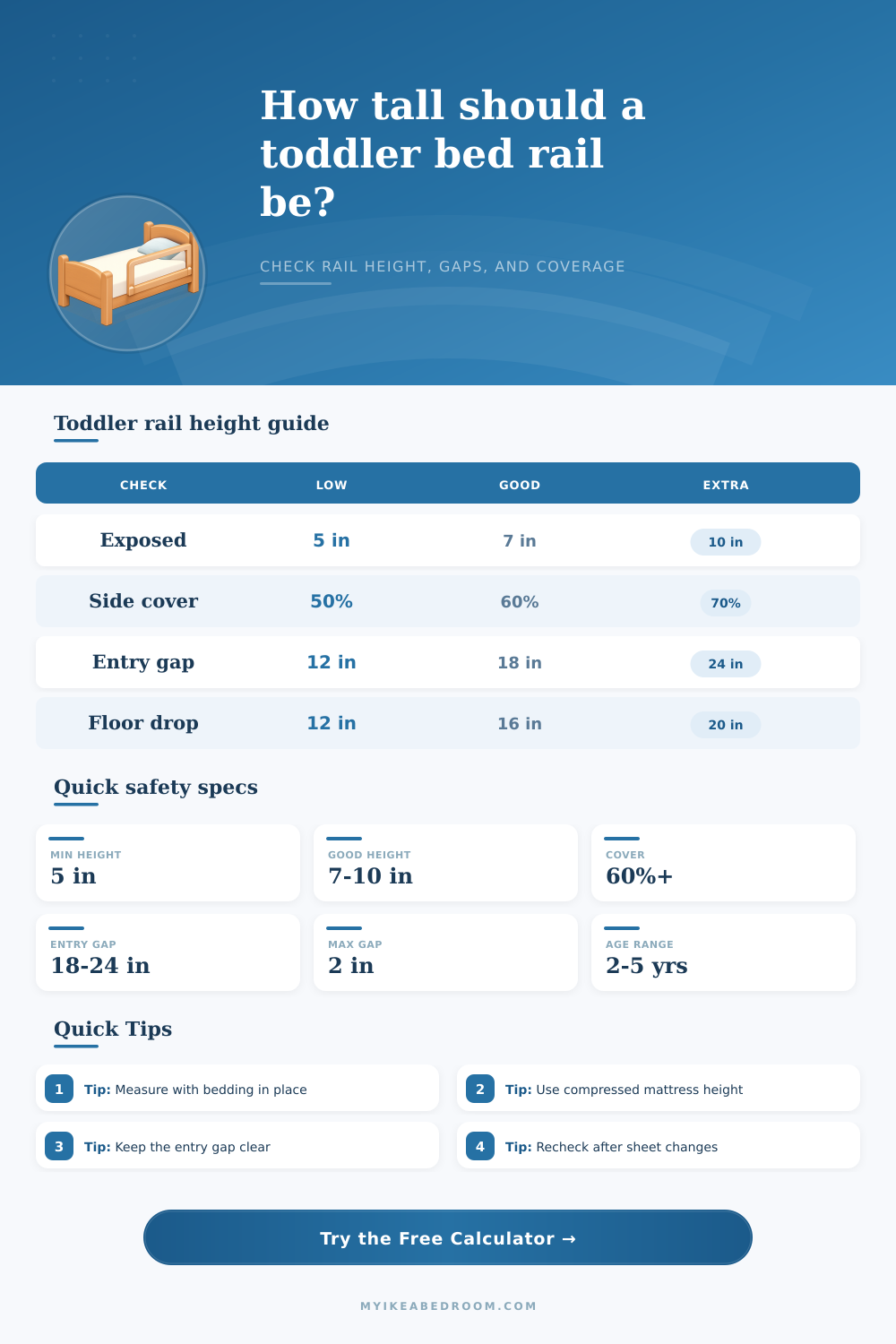
| 5 to 7 in | Minimum range | Calm sleeper, low bed, firm mattress | Compression and bedding changes | Recheck after mattress pads or thicker protectors are added. |
| 7 to 10 in | Comfortable | Average rolling toddler | Entry gap and climb-over behavior | A taller rail still needs a usable open climb-in area. |
| Over 10 in | Tall | Active sleeper with adequate entry opening | Whether child tries to climb over it | Do not trade roll-out protection for a tempting climbing barrier. |
| Sleeping length | Rail length | Coverage | Entry opening | Planning use |
|---|---|---|---|---|
| 52 in crib mattress | 28 to 34 in | 54% to 65% | 14 to 22 in | Typical toddler bed conversion rail. |
| 63 in small child bed | 36 to 44 in | 57% to 70% | 18 to 27 in | Works for longer junior mattress setups. |
| 75 in twin mattress | 42 to 54 in | 56% to 72% | 21 to 33 in | Common with portable rails on a low twin bed. |
| Floor bed | Short bumper | Partial | Wide entry | Low drop reduces fall height but does not remove gap checks. |
| Rail top above deck | Mattress thickness | Compression | Exposed height | Result |
|---|---|---|---|---|
| 12 in | 5 in | 0.5 in | 7.5 in | Comfortable for many toddler beds. |
| 12 in | 8 in | 1 in | 5 in | Right at the common minimum height. |
| 13 in | 10 in | 1 in | 4 in | Likely needs a taller rail or thinner mattress. |
| 16 in | 9 in | 1.5 in | 8.5 in | Good height if gaps and anchors also pass. |
| Setup | Main height risk | Gap risk | Coverage goal | Extra measurement |
|---|---|---|---|---|
| Convertible crib rail | Mattress support set too high | Rail end at corner post | 55% to 65% | Confirm manufacturer mattress setting. |
| Portable rail | Deep mattress reduces rail | Rail can pull away from edge | 60% to 75% | Check strap path and anchor spacing. |
| Soft bumper | Bumper compresses sideways | Bedding can shift it | Partial | Use only within product age and mattress limits. |
| Low floor bed | Less height needed for fall drop | Wall gap can remain hidden | Varies | Measure the wall side after bedding is tucked. |
Measure the installed bed. Product dimensions are useful, but the real exposed rail height depends on support height, mattress thickness, bedding, and compression at the edge.
Check gaps after pressure. Press the mattress toward the rail, then measure the largest opening where the child could roll or wedge against the side.
Keep the entry useful. A narrow opening can make a toddler climb over the rail, while a very wide opening reduces side coverage near the sleep zone.
Repeat after changes. Recalculate when you add a mattress pad, rotate the mattress, move the bed, remove hardware, or switch to thicker bedding.
Sleeping: Sleep, you think when you see your kid standing up in their new bed, feet on the floor, eyes bugging out as they look down; The physics of it are serious business. The question isn’t just about the fall itself but how a small body interact with a raised surface in the middle of the night.
That is why a rail needs to be measured for height, rather then checked off a list. Because measurement has something to do with both math and people. And most parents think, if there’s a rail, then my kid is protected. Except that that’s not always true, and it all comes down to what remains visible above mattress after everything settles.
How to Keep Your Child Safe in Bed
By plugging in your mattress thickness and deck height into the calculator, it does the math for you so you don’t have to guess at how much material will actualy shield your child. But to understand why these inputs should matters, think about bed as part of a system instead of a static object.
The first thing most people overlook is that mattresses compress. A five-inch-thick firm foam topper may say ‘five’ on the box, but after a restless sleeper turns over towards edge, it may only be four inches thick. By measuring rail height at its uncompressed peak, you’re designing based on something that isn’t there. What you should of know is what it looks like above the compressed surface (that’s where the kid is going to put their head and shoulders while they sleep). A three-inch difference in perceived height can make all the difference between a safe barrier and a climbable ledge.
Another variable (and one that’s harder to quantify) is side coverage: If you have a rail that spans almost the entire length of bed, but it’s too narrow in the entrance area, then the toddler will perceive it more like a playground feature than a barrier to be crossed. Ideally, you want an opening wide enough for easy access but small enough to discourage climbing over. It’s a delicate balance.
Toddlers are quite good at finding ways around obstacles we don’t expect, what appears solid from a seated position mid-day might become an appealing hand hold seen through a 3-year-old’s eyes at midnight when he decides to climb into the ceiling.
The reference table presents typical height ranges; common wisdom says the sweet spot is typically going to be within a range of seven to ten inches of exposed rail. Anything below five may as well not exist. Particularly if there’s additional bulk from bedding. Anything above ten inches starts looking like it might tempt someone to climb up and over, that brings up a whole other set of concerns.
Ultimately, it’s less about building the tallest possible wall than it is about building the appropriate wall for your individual child’s mobility profile. If your little one is a relatively calm sleeper, then he doesn’t need as much vertical protection as your active climber who will find any number of rungs upon which to climb himself to the next level.
Another thing to consider are anchors. Rails that attach under mattress and can be carried around aren’t always attached securely enough to prevent shifting. This creates gaps that seem closed at first but are actualy quite dangerous. Many people forget to double-check their measurements once they add some sheets and maybe a mattress protector. These extra layers makes the sleep surface higher, which makes the side rails seem lower even though bed frame itself hasn’t moved.
It’s a slight change that occurs gradually over time: mattresses soften up, bedding piles on, etc. The remedy here is to view the set-up as a livig thing that needs occasional remeasuring. Check it out every several months and make sure those first calculations still valid in the face of day-to-day use.
In the end, safety isn’t so much about keeping anything from happening. It is about planning for things to happen by accounting for compression and planning for movement. You must know that a bed is as much a shifting landscape as it is a fixed structure. That kids change, materials move and there will be things in their way unless you plan for it.
And when you do, you’re not just purchasing peace of mind, you’re building an area for them to sleep, free from something that feels like it must be overcome. It is a place where they can get some shut eye and you can, too, confident that what’s blocking them is precisely where it should be.