Tile Mortar Calculator
Estimate thinset mortar bags, dry weight, coverage after waste, bed volume, and a practical trowel notch recommendation for tile floors, walls, showers, fireplaces, mosaics, and large-format layouts.
Load a common tile mortar setup, then adjust area, tile size, notch, substrate flatness, back-buttering, bed thickness, bag coverage, and waste.
1/2 x 1/2 in
Uses the bag coverage entered above.
1/2 x 1/2 in square
Based on tile size, surface, and flatness.
Normal
Back-buttering and flatness affect bag count.
0 ft3
Compressed mortar volume after waste.
| Notch size | Typical tile match | Common coverage range | Bed note |
|---|---|---|---|
| 3/16 in V-notch | Mosaic sheets and small wall tile | 60 to 90 sq ft per bag | Thin ridges, low buildup |
| 1/4 x 1/4 in square | Subway, backsplash, 6x6, light wall tile | 55 to 80 sq ft per bag | Good for flatter small tile |
| 1/4 x 3/8 in square | 12x12, 8x24, medium floor tile | 40 to 60 sq ft per bag | More mortar under wider tile |
| 1/2 x 1/2 in square | 12x24, 24x24, large-format tile | 30 to 45 sq ft per bag | Often used with back-buttering |
| 3/4 in U-notch | Thick stone, plank tile, heavy buildup | 20 to 30 sq ft per bag | High mortar volume |
| Mortar type | Best fit | Coverage behavior | Calculator use |
|---|---|---|---|
| Standard thinset mortar | Dry areas and compatible ceramic tile | Normal spread rate | Use bag coverage from label |
| Polymer-modified thinset | Porcelain, walls, floors, and many wet areas | Slightly richer bed | Default general setting |
| Large and heavy tile mortar | Large-format tile and thicker tile | Lower slump, thicker ridges | Pair with larger notch |
| Rapid-setting mortar | Small sections and time-sensitive repairs | Similar coverage when mixed correctly | Measure areas carefully |
| Mosaic / small tile mortar | Mosaics, shower pans, and small formats | Finer bed, many ridges | Use small-notch coverage |
| Condition | Mortar allowance | Back-butter guide | Planning note |
|---|---|---|---|
| Corrected flat substrate | Lowest | 0% to 50% | Best coverage from each bag |
| Flat substrate | Normal | 50% to 80% | Typical wall and floor planning |
| Fair substrate | Moderate extra | 75% to 100% | Dips and ridges use more mortar |
| Uneven substrate | High extra | 100% | Flattening first is usually better |
| Project | Tile format | Starting notch | Waste input |
|---|---|---|---|
| Kitchen backsplash | 3x6 or 4x12 wall tile | 1/4 x 1/4 in square | 8% to 10% |
| Bathroom floor | 12x24 porcelain tile | 1/2 x 1/2 in square | 10% to 12% |
| Shower floor | 2x2 mosaic sheet | 3/16 in V-notch | 12% to 15% |
| Large-format wall | 24x48 porcelain tile | 1/2 x 1/2 in square | 12% to 18% |
| Fireplace surround | 8x8, stone, or handmade tile | 1/4 x 3/8 in square | 12% to 15% |
Key in the mortar first: Burn a thin layer into the substrate with the flat side of the trowel before combing ridges. That improves contact and keeps coverage more predictable.
Check actual coverage: Lift a freshly set tile and inspect the back. Large-format floors and wet areas often need higher contact than a dry decorative wall.
Calculating the correct amount of mortar is necessary in order to avoid loose corner and cracked grout that can result from using too much or too little mortar. The amount of mortar that you should purchase is based off the size of the tile that you will be using, the condition of the surface that you will be placing the tiles upon, how flat the surface is, and how much extra mortar you will put on the back of the tile (known as back buttering). Many individuals purchases too little mortar for their project, which causes them to run out of mortar prior to completing their project.
The opposite can also happen, where many people purchase too much mortar for their project, they waste their money by buying extra bags of mortar that they will not use. A calculator can help to provide individuals with a clear picture of the amount of mortar that is necessary to complete their project using the size and number of the tiles that they plan to use, the condition of the projects substrate, and the type of mortar that they will use. The area of the project is one of the main inputs into the calculator that will determine the amount of mortar that will be used under each tile.
How Much Mortar You Need for Tiling
Beyond the area that is to be covered, there are other measurable variables that will impact the amount of mortar that is used. For instance, the shape and thickness of the tile will be factor in the mortar that is used. Large format tiles will require deeper ridges of mortar to ensure that the tile remains level with the other tiles in the project, whereas small mosaic tiles will sit upon thinner bed of mortar.
The size of the notch in the trowel that is used to lay the mortar is another of the variables in the mortar calculator. A 1/2 inch square notch will leave more mortar onto the tile than a 3/16 inch V-notch trowel. The flatness of the substrate upon which the mortar will rest is another of the variables to the mortar calculator.
Substrate with dips in certain areas will require more mortar to be poured into those low spots. Thus, a floor that is not flat will require more mortar then a floor that is flat and evenly. Back-buttering is another variable that will affect the amount of mortar to be purchased.
Back-buttering is a process in which a skim coat of mortar is poured onto the back of each of the tiles that will be used in the project. Thus, the percentage of the tiles that will be back-buttered can be entered into the calculator to provide an accurate estimate of the amount of mortar that will be used. The percentage of waste that may occur in the project is another of the variables that is to be accounted for in the mortar calculator.
For instance, waste results from the need to cut tiles to fit into certain areas within the project, the breakage of some of those tiles during cutting, and the setting of mortar that becomes too stiff to use. Waste percentages are higher for projects like floors and showers due to the need to trim more of the tiles. The mortar calculator considers the type of mortar that will be used in the project as one of the variables.
Polymer-modified thinsets tend to spread differently than rapid-set mortars. The calculator will provide individuals with several different outputs related to the mortar that is to be purchased for the project. One of the outputs of the calculator will be the number of bags of mortar that should be purchased.
This number should be rounded up to the nearest bag of mortar to avoid running out of mortar prior to the completion of the project. Second, the calculator will provide an estimate of the dry weight of the mortar that will be required for the project. The third output of the calculator is the coverage of the project after accounting for waste.
The final output of the calculator is the bed volume of the mortar that will be used in the project. The bed volume is the thickness of mortar that will be used underneath the tiles. This measurement is important in projects in which the height of the floor or threshold must be matched to another of similar height.
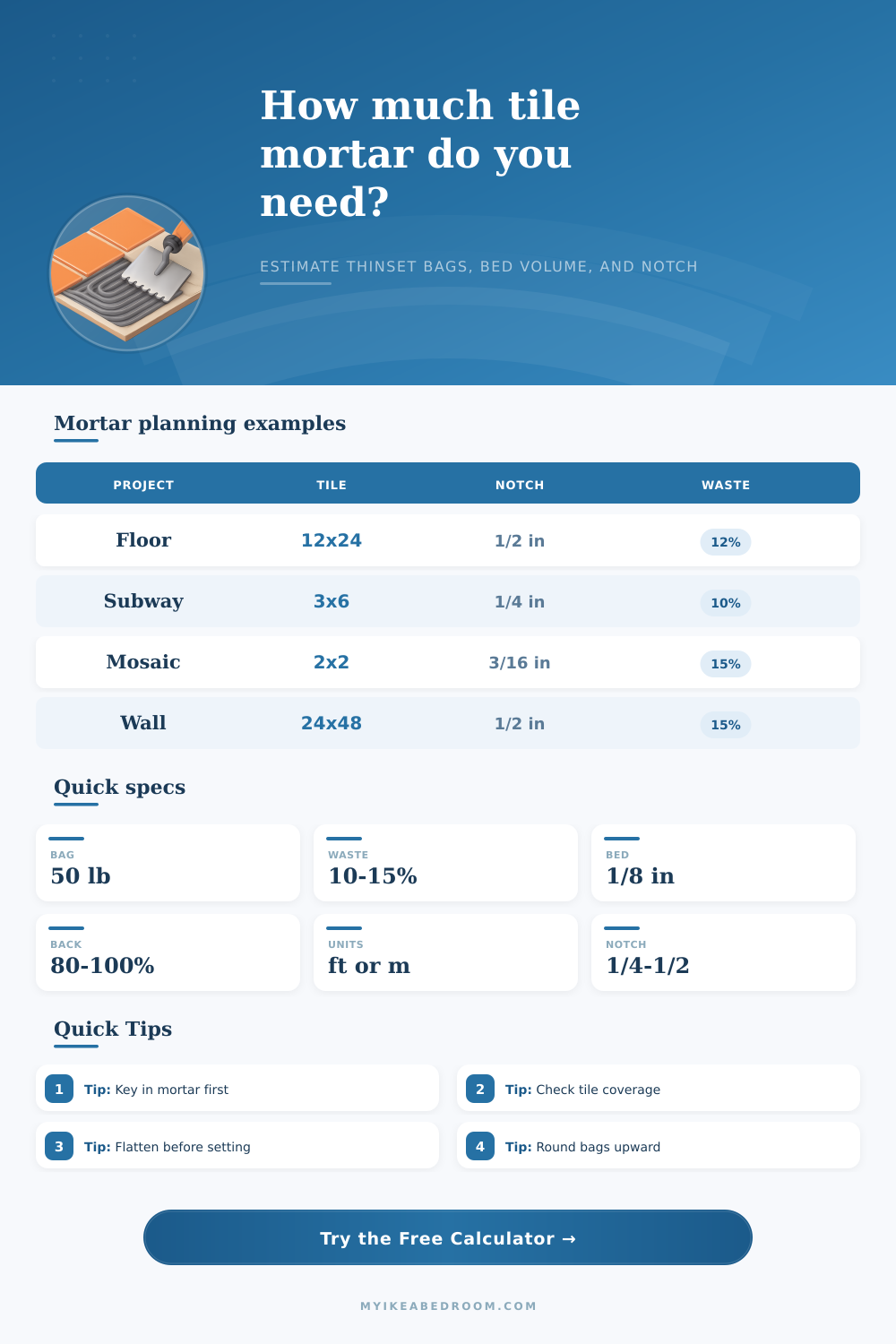
The tables that are provided to the user regarding mortar calculators provide information about the amount of mortar that will be consumed based upon the different size notches in the trowel and the type of tile that will be used in the project. For instance, one of the tables may show that a floor tiled with 12-by-24 inch tiles will require a half inch square notch, while another of the tables may show that a subway tile used on a backsplash may only require a quarter inch notch. Other tables show the amount of mortar that will be consumed by a 50-pound bag of mortar based upon the flatness of the substrate and whether the tiles will be back-buttered.
The variables that relate to the project as an actual building project may differ from the specifications for mortar quantities that are printed on a bag of mortar. For instance, bathroom floors are often sloped towards the drain. Such a slope in the floor will require the use of extra mortar for that portion of the floor.
Furthermore, large format tiles may be installed on a wall. In this instance, the wall should be relatively flat in order to allow for even distribution of pressure to be placed onto each of the mortar beds. Showers may include waterproofing layers that are placed onto the floor.
The mortar that is used for the tiles may adhere differently to those waterproofing layers. Though these variables are not accounted for in the mortar calculator, they should be considered in the determination of the amount of mortar that should be purchased. Some of the mistakes that individuals may make when setting mortar on tiles relate to the concept of treating all of the projects surfaces the same.
For instance, individuals may use the coverage specifications provided on the bag of mortar without considering that some of the tiles within the project will be back-buttered. Thus, individuals will find themselves without mortar after completing their project. Another of the mistakes that may be made in mortar calculations is in the selection of the notch size for the mortar.
If the notch size is selected too small, the mortar may not be able to handle the weight of the large format tiles that are to be placed into the project. The coverage of mortar can be tested by placing the tile upon a surface and observing if the mortar has transferred onto the back of the tile. The weather in which the project is to be completed can impact the amount of mortar that is available for the project.
For instance, if the weather is hot and dry, the mortar may lose moisture quickly. The loss of moisture from the mortar will impact the spread of the mortar. Thus, the mortar calculator does not factor in the weather and the mortar must be mixed in smaller amounts on warm days.
Additionally, rapid-set mortars have a limited amount of time to set the mortar, so those mortars are best used for smaller repairs. The general goal of using a mortar calculator is to find a range of mortar that can allow individuals to complete their project without either running out of mortar or wasting mortar. Once individuals know how many bags of mortar will be needed, the dry weight of that mortar, and the volume of mortar that will be bedded between the tiles and the projects substrate, individuals can make a determination of whether the notch size of the trowel is appropriate to the type of tile that is to be used in the project.
The use of a mortar calculator makes such a determination easier to make for an individual.