Blanket edge yarn planner
Tassel Quantity for Blanket Calculator
Estimate tassel count, adjusted spacing by edge, folded strand cut length, total yarn length, yarn weight, skein count, corner tassels, waste, and finished drop for blankets, runners, scarves, and throws.
| Edge | Edge length | Interior tassels | Adjusted spacing |
|---|
| Step | Formula | Result | Planning use |
|---|
| Preset | Typical size | Tassel setup | Best use |
|---|---|---|---|
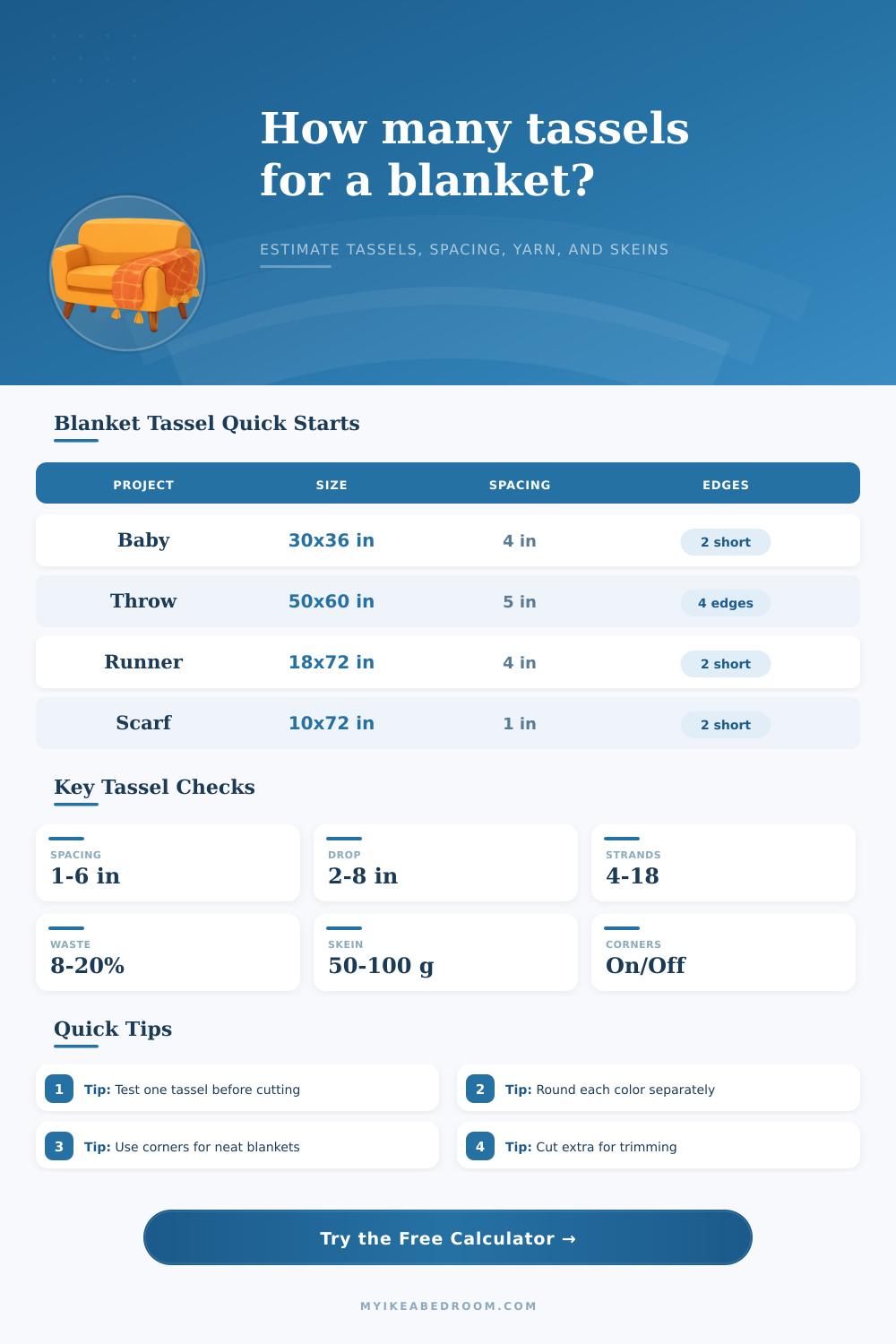
| Throw blanket | 50 x 60 in / 127 x 152 cm | 5 in spacing, 8 strands, four edges | Classic couch throw with balanced corners. |
| Baby blanket | 30 x 36 in / 76 x 91 cm | 4 in spacing, 6 strands, two short edges | Softer, lighter tassels without a heavy perimeter. |
| Bed runner | 18 x 72 in / 46 x 183 cm | 4 in spacing, 10 strands, two short ends | Decorative tassels only where the runner hangs. |
| Scarf edge | 10 x 72 in / 25 x 183 cm | 1 in spacing, 8 strands, two short ends | Dense fringe style with many small tassels. |
| Chunky throw | 48 x 60 in / 122 x 152 cm | 6 in spacing, 6 strands, bulky yarn | Large visible tassels with fewer total cuts. |
| Spacing range | Visual density | Typical strands | Notes |
|---|---|---|---|
| 1 to 2 in / 2.5 to 5 cm | Fringe-like | 4 to 8 | Best for scarf ends, shawls, and narrow borders. |
| 3 to 4 in / 8 to 10 cm | Full decorative edge | 6 to 12 | Good for baby blankets, afghans, and small throws. |
| 5 to 6 in / 13 to 15 cm | Classic throw edge | 8 to 14 | Balanced for medium blankets and picnic throws. |
| 7 to 9 in / 18 to 23 cm | Minimal accent | 10 to 18 | Use larger tassels so the wider spacing looks intentional. |
| Yarn option | Weight proxy | Drop allowance | Practical note |
|---|---|---|---|
| DK or light worsted | 0.34 g/m | Low knot loss | Use more strands if the tassel looks thin after combing. |
| Worsted weight | 0.48 g/m | Moderate knot loss | Reliable baseline for crochet blanket edges. |
| Bulky yarn | 0.72 g/m | Higher knot loss | Reduce strand count before increasing spacing too far. |
| Cotton rope | 1.40 g/m | Highest knot loss | Heavy and crisp; check that the blanket edge can support it. |
The blanket is finished. So there you go: you’ve completed the blanket. Colors match, stitches look tidy, and you’re all set to wrap yourself in it. But now what do you do with that hank of leftover yarn? How many tassels should you make?
This is where most crafter pause, because we tend to eyeball it. And when we guess, we inevitable buy more than we need… or run out halfway through. That’s where the calculator comes in (above). When you input your measurements, it do the rest of the work for you: no more wasting time converting between inches and strands, no more fiddling with waste percentage calculations. You go from vague supply-anxiety to a clear, useful shopping list.
How to Plan Your Tassels
Spacing determines everything about the edge. Do you crowd in your tassels, making the blanket look more like a fringed scarf then a substantial throw? Do you space them out too far and does the border seem spotty and unfinished? For most worsted-weight throws, a standard 5 inch gap works well since it strikes a good balance between material cost vs. Visual weight. If you’re making a baby blanket where the tassels needs to be kept short and delicate, you may want to space things tightly. For chunky knits, where each tassel need to have some breathing room, you can use wider gaps. The tool will adjust the spacing automaticly to fit whole tassels neatly along both sides while leaving no awkward leftovers.
Yarn choice also makes a difference here. Each strand of yarn carry mass, so a heavy rope eats up yardage much faster then a thinner yarn. A finer DK yarn will take more strands to create the same fluff as a heavier cotton rope. They also tend to make fatter knots (something many folks overlook). So if you’re working with bulky wool then that means longer strands to compensate for the amount consumed by the knot. That’s why we built it into the calculator. So you get what you want out of your final tassel instead of something half an inch or two inches shorter.
When ordering supplies, don’t forget about waste rate! Your yarn isn’t vanishing, it’s being eaten by trimmings and knots and all those times you try something new that doesn’t work out. Set waste to 0, and you’re taking a gamble. Twelve percent seems like a fair midpoint between “never make the same mistake twice” and “oops.” That leaves room for cutting mistakes as well as that first sample tassel you should of always make to get the hang of trimming and tying with your particular yarn. There will be things you didn’t know about how your yarn acts up in a knot. Maybe it pulls back farther then expected, or maybe it frays really badly if you cut it too cleanly. Ten hours on the internet can’t teach you what one test tassel will.
The one thing that can be confusing when planning are the corner tassels. Do you want them to form a big bunch on each corner? Or would you prefer no tassels so there is just a clean line where they meet at the corner? I like adding them because then there aren’t any weird places where two edges touch without a tassel. You can flip that option in the tool and see how many more tassels that will take. It is a small thing, but it makes a difference when looking at the whole thing for symmetry.
And by the end it’s really not even about sewing yarn onto fabric, it’s about having an intentional border, right? Now that we know exactly what length of yarn to use and where each tassel will be placed, it starts to feel like a design, rather than guess work. Each thread has a reason and every edge follows a plan, a plan carried out with confidence as the last stitch is sewn. The plan has math that adds up and tassels that dangle true. At long last, a blanket can lie down to rest on the couch as designed.