🪡 Tapestry Needle Size Calculator
Match fabric count, stitch-over, and thread strands to the right blunt needle size for Aida, linen, evenweave, or canvas.
📌Quick presets
Tap a preset to load a common stitch setup, then fine-tune the count, strands, and fabric family if your project uses a different thread weight or stitch-over rhythm.
⚙Needle inputs
Needle match results
📊Needle size by count
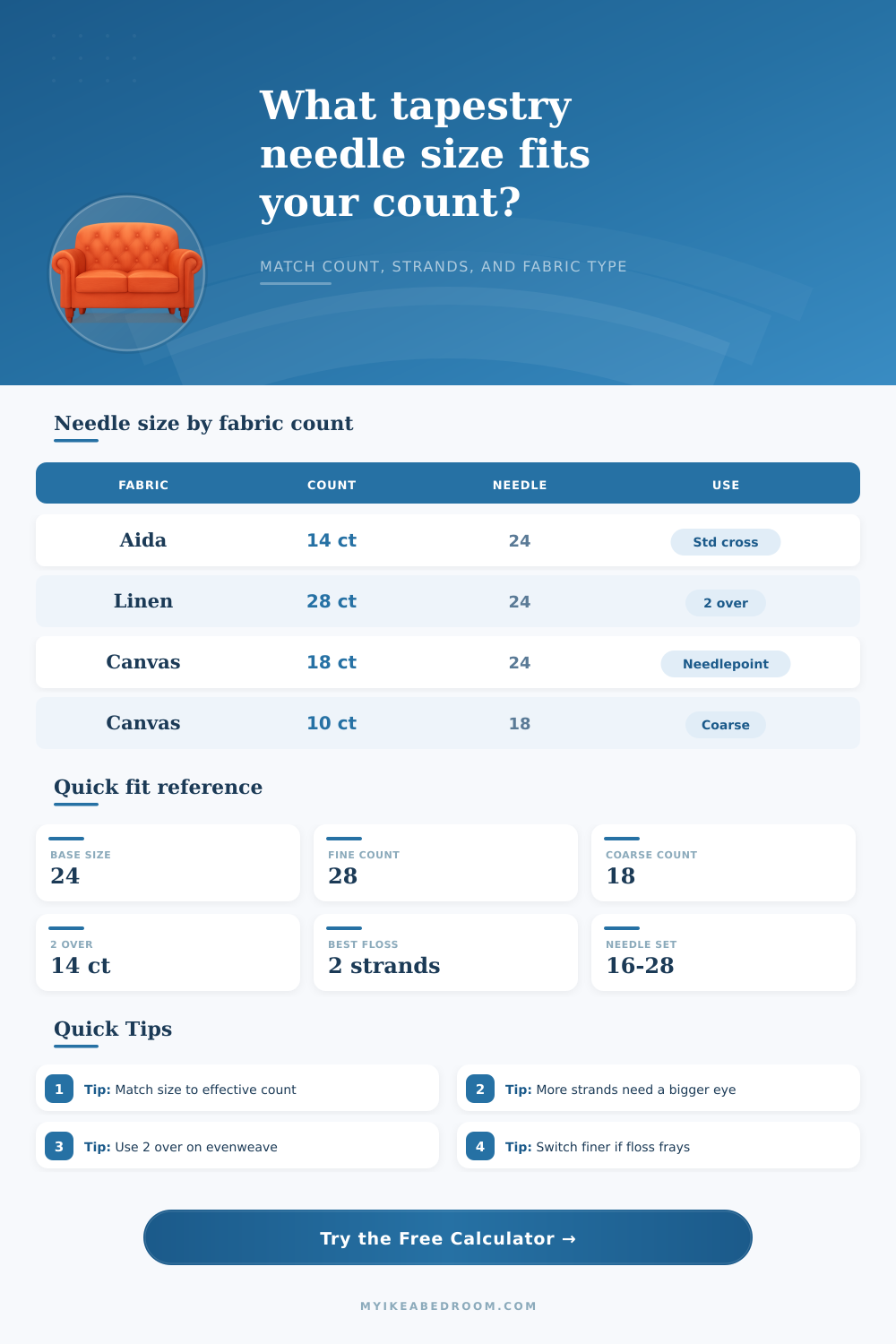
Use this table as the anchor for the calculator. The exact result shifts a little when thread strands, wool, or metallic thread ask for more or less room in the eye and the shaft.
| Fabric / mesh | Count band | Needle size | Typical use |
|---|---|---|---|
| Aida | 11-14 ct | 24 | Std cross stitch |
| Aida | 16-18 ct | 26-28 | Finer stitch |
| Evenweave | 28 ct over 2 | 24 | Balanced coverage |
| Canvas | 10-14 mesh | 18-22 | Needlepoint fill |
🧵Fabric family reference
These cards show the role each fabric family plays. They also explain why the same count can point to a different needle when the stitch path changes from one thread, to two-over, or to wool canvas work.
Aida and cross stitch
Best for 11 to 14 count with two strands. It is the most familiar match for beginner samplers and clean charted stitches.
Evenweave and linen
Over 2 gives a visual count similar to 14 to 16 count fabric. Move finer or thicker based on strand bulk and stitch tension.
Needlepoint canvas
Canvas needles stay blunt, with the mesh count doing most of the sizing work. Heavier canvas usually wants a larger body needle.
Wool canvas work
Wool yarn needs a roomier eye and a sturdier shaft. This category pulls the calculator toward the thick end of the tapestry range.
📋Thread strand guide
Strand count matters just as much as fabric count. Two strands are the everyday benchmark, but one strand, pearl cotton, or wool can all justify a different final needle choice.
| Thread setup | Best needle | Feel | Adjustment |
|---|---|---|---|
| 1 strand floss | 26-28 | Very fine | Go one finer |
| 2 strands floss | 24-26 | Balanced | No shift |
| 3-4 strands | 22-24 | Roomier | Go thicker |
| 5-6 strands | 18-22 | Full eye | Go much thicker |
📝Common project pairings
Use these pairings when you want a quick starting point before checking the exact count. They work well for the most common bedroom-friendly counted stitches and decorative wall pieces.
| Project type | Fabric | Thread | Needle |
|---|---|---|---|
| Sampler | 14 ct Aida | 2 strands | 24 |
| Motif detail | 16 ct Aida | 2 strands | 26 |
| Textured line | 28 ct linen | 2 over | 24 |
| Needlepoint block | 13 mesh canvas | Wool | 18 |
💡Needle choice tips
Tip: If the thread starts shredding, move one size finer so the eye and shaft create less friction on the return pass.
Tip: If your stitches feel too loose or the hole stays open, move one size thicker so the fabric opens less around the needle.
Tip: For evenweave and linen, remember that two-over stitching changes the effective count and usually changes the final size too.
Tip: Keep a size 24 and a size 26 nearby. Those two cover many Aida, linen, and fine cross-stitch projects without guesswork.
Tapestry needles work differently than knitting needles. In bigger numbers, you use even smaller sizes. The needle size depends on the fabric you sew on.
That simple detail commonly trips up newcomers
How to Choose the Right Tapestry Needle Size
Tapestry needles have broad eyes and round blunt points. You use them mainly for needlepoint, petit point, cross stitch and plastic canvas embroidery. DMC Tapestry Needles measure 1¾ to 2 inches long and are made of nickel-plated steel.
You find them in nine packs with different sizes. Big tapestry needles are usefull also for DIY furniture projects, like wrapping jute twine around Ivar chairs, finished with wood stain and polyurethane.
Size 28 is the smallest for standard tapestry needles. For cross stitch you most commonly choose sizes 24 and 26. Needles of 18 and 20 work for traditional tapestry and Bargello canvas.
Sizes 22 and 24 you use mainly in cross stitch and petit point. For thick and rough fabrics commonly serve sizes 13 and 14.
Almost all tapestries you do on double point canvas of 10 hpi, and the favorite needle is size 18. Tapestry needles of 18 fit well for bargello patterns, because they perfectly work with DMC Tapestry Wool and needlepoint canvas or plastic canvas. Needle size commonly matches to that of the canvas, 18ct canvas goes with needle 18.
As a rule of thumb you keep a tapestry needle of size 24, that holds up to 6 threads of embroidery floss and enters in 14ct Aida. If the string resists to go through the right needle, take one size bigger. For instance on 14 mesh canvas test #18 instead of #20.
A bit bigger, it easily will open the hole.
Pony Black Tapestry needles offer sizes 24, 26 and 28. The packs of 24 and 26 hold 6 needles, while the 28 has 5. Those matte steel needles have long eyes and blunt points, so they work perfectly for cross stitch and needlepoint.
Tulip needles use different sizes than standard. 22, 24 and 25 instead of 26 or 28.
Small needles are said to be 1-2 sizes smaller than average tapestry needles, but that depends on the definition of small. John James petite needles have the same width as standard, but are much shorter with a bigger eye. Some have a special opening at the eye, that allows you to quickly enter the string simply by sliding, without precise aim.
If the needle has a big eye, it will work well with at least aran weight yarn. Always smart to buy a cheap pack with several sizes.