Tablecloth Drop Length Calculator
Calculate the finished tablecloth size and actual side drop for round, square, rectangular, and oval tables, including table height, desired style, floor clearance, hem allowance, seam allowance, and fabric width.
Choose a realistic table setup, then adjust the exact tabletop, drop, cloth, hem, and fabric width measurements.
Balanced dining drop
The recommended cloth size is based on table size plus two equal drops, one on each side.
The available cloth is checked against the target, then the shorter actual side drop controls the final look.
Fabric yardage includes hems and panel seams so a sew-your-own cloth does not finish too short.
| Use | Typical drop | Floor clearance result | Best for |
|---|---|---|---|
| Short cafe or kids table | 6 to 8 in / 15 to 20 cm | Large open gap below cloth | Washable daily use and easy chair movement |
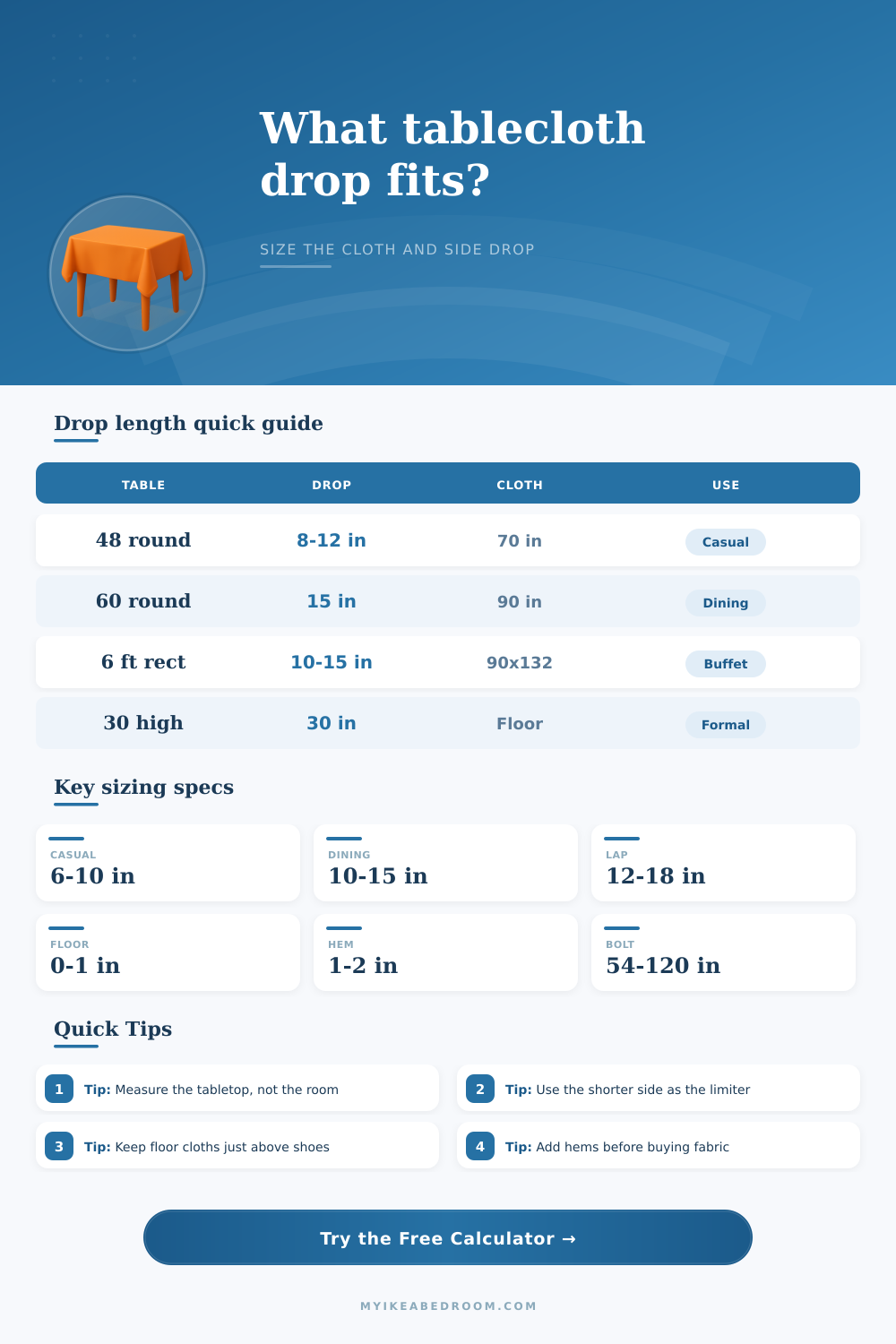
| Casual dining | 8 to 12 in / 20 to 30 cm | About 18 to 22 in on a 30 in table | Breakfast tables, apartments, family meals |
| Standard dining | 10 to 15 in / 25 to 38 cm | About 15 to 20 in on a 30 in table | Seated meals where the cloth rests near the lap |
| Formal long drop | 16 to 24 in / 41 to 61 cm | About 6 to 14 in on a 30 in table | Holiday dining, display tables, layered linens |
| Floor length | Table height minus 0 to 1 in | Skims just above the floor | Buffets, banquet tables, trade display tables |
| Table shape | Measure first | Finished cloth formula | Actual drop check |
|---|---|---|---|
| Round | Table diameter | Cloth diameter = table diameter + 2 x drop | (cloth diameter - table diameter) / 2 |
| Square | One side | Cloth side = table side + 2 x drop | (cloth side - table side) / 2 |
| Rectangle | Length and width | Cloth length and width each add 2 x drop | Check both sides; the smaller drop controls the look |
| Oval | Longest length and widest width | Use rectangle formula as the practical finished size | Rounded ends may hang slightly softer than straight sides |
| Table size | Casual cloth | Dining cloth | Long or floor cloth |
|---|---|---|---|
| 36 in round | 52 to 60 in round | 60 to 70 in round | 90 in round for near floor |
| 48 in round | 70 in round | 80 in round | 108 in round for floor length |
| 60 in round | 80 in round | 90 in round | 120 in round for floor length |
| 72 x 30 in rectangle | 52 x 90 in | 60 x 102 in | 90 x 132 in for banquet drop |
| 96 x 30 in rectangle | 52 x 114 in | 60 x 120 in | 90 x 156 in for floor length |
| Fabric width | Good for | Panel note | Yardage planning cue |
|---|---|---|---|
| 44 to 45 in / 112 to 114 cm | Small runners, napery, narrow overlays | Most dining cloths need multiple panels | Add seam allowance for every joined panel edge |
| 54 to 60 in / 137 to 152 cm | Square tables, cafe cloths, narrow rectangles | Can make many 52 to 60 in wide cloths from one panel | Round cloths over 60 in usually need piecing |
| 72 to 90 in / 183 to 229 cm | Large overlays and standard banquet widths | Often avoids a center seam on rectangular tables | Check print direction before rotating panels |
| 108 to 120 in / 274 to 305 cm | Floor length rounds and wide banquet cloths | Useful for seamless large tablecloths | Cut length plus hems may be the only yardage needed |
Everyday short
Best when chairs slide in and out often or the cloth is washed frequently.
6-10 inDining balanced
Looks intentional at a seated table without falling into chair seats.
10-15 inFormal long
Adds coverage for special meals while leaving some lower table leg visible.
16-24 inFloor length
Hides legs and storage below buffet, display, or banquet tables.
0-1 in gapCheck the shortest drop. On rectangle and oval cloths, the smaller of the length-side and width-side drops decides whether the cloth looks too short.
Add sewing allowances before cutting. Finished cloth size is the visible target; cutting size must include hems and any panel seam allowances.
Have you ever ordered a tablecloth online or been in a fabric store staring at bolts thinking it’s too long on one end and not quite long enough on the other? It isn’t usualy because of the pattern or color. More often than not, it’s the difference between having the fabric hang down the proper amount (called “drop”), past the edge of the table. Whether it drape to just the right amount can transform the feeling of a space. Too short, it’ll look tacky; too much dragging along the ground will lead to spills (and maybe trips) if you don’t want that formality.
Enter the length of your table into calculator above and let it do the math for you. You won’t have to guess about conversions and coefficients anymore. Aside from how it looks, drop length also determines how users interact at the table. A casual meal require a drop of six to ten inches, which keeps the fabric away from laps and chairs, making it easy for diners to come and go without disrupting the place settings. That can work nicely for kids’ meals or on breakfast tables when use comes before looks rather than the other way around.
How to Choose the Right Tablecloth Length
At the far end of the spectrum, standard dining, the drop change to ten to fifteen inches, keeping the fabric close to the diner’s lap. While this adds an element of specialness to the dining experience, it doesn’t interfere with anyone’s ability to get up and move. Most families will find this comfortabley during meals and holiday celebrations. Remember to watch your seam settings and hem allowances.
A lot of folks will say “I want this much fabric to drop” and purchase an exact match. Then they don’t remember to account for seams and hems needed to sew the tablecloth together. When making your own cloth, be sure to account for each inch of seam and hem in calculating total yardage before you cut. You’ll see from the reference table that joining panels (as opposed to buying on a single bolt) is affected by bolt width. Fabric sold as yards gets cheaper as it narrows. But, it takes longer to do and you have to take care to match patterns.
Other types are floor length. For these, you’re trying to cover up anything under the table (storage) as well as the table legs themselves. These is commonly seen on event tables or buffets. With this style, all that’s needed is to measure how far the table top is from the ground. Then subtract an inch or two for clearance so no-one will catch their foot on the hem.
Sounds easy enough but if your floor isn’t even you can mess it up fast. Measuring the table height correctly make all the difference with these kinds of projects. An inch off could of been the difference between a great looking skirt and something people fall over. Round tables aren’t the only ones with this variable: oval and rectangular tables does as well. You now need to consider 2 different lengths of drops. The longer side is for the long sides; the other, for the short ends.
The shorter end determines the visual weight. Sometimes sizing your cloth solely based off the length of the table will result in a poorly draped width. Always be sure the smaller dimension has enough coverage. This is a small detail but makes a big difference in the final look. These are the very measurements that determine whether to sew your own or purchase a pre-made.
Pre-mades have the advantage of standard sizing because they come in predetermined lengths. With custom, you get to play with all the factors. Determine exactly how far it will fall, what kind of hem it has, etc. Whether you’re having a fancy dinner party or a more casual lunch, take the time to think through these numbers so the tablecloth matches the experience.
The proper drop frames the conversation and the cuisine. It turns an ordinary space into a purposeful part of the design. Consider the table top first then determine the tone. Let the math lead you there and achieve that sweet spot drape.