Table Overhang for Seating Calculator
Check whether a tabletop overhang gives enough knee depth, apron clearance, chair-arm pass-through, and edge comfort for everyday seating.
Choose a common seating condition, then tune the measurements from the table edge, apron face, tabletop underside, chair arms, and knees.
These cards compare your current geometry against common fixes without changing the form values.
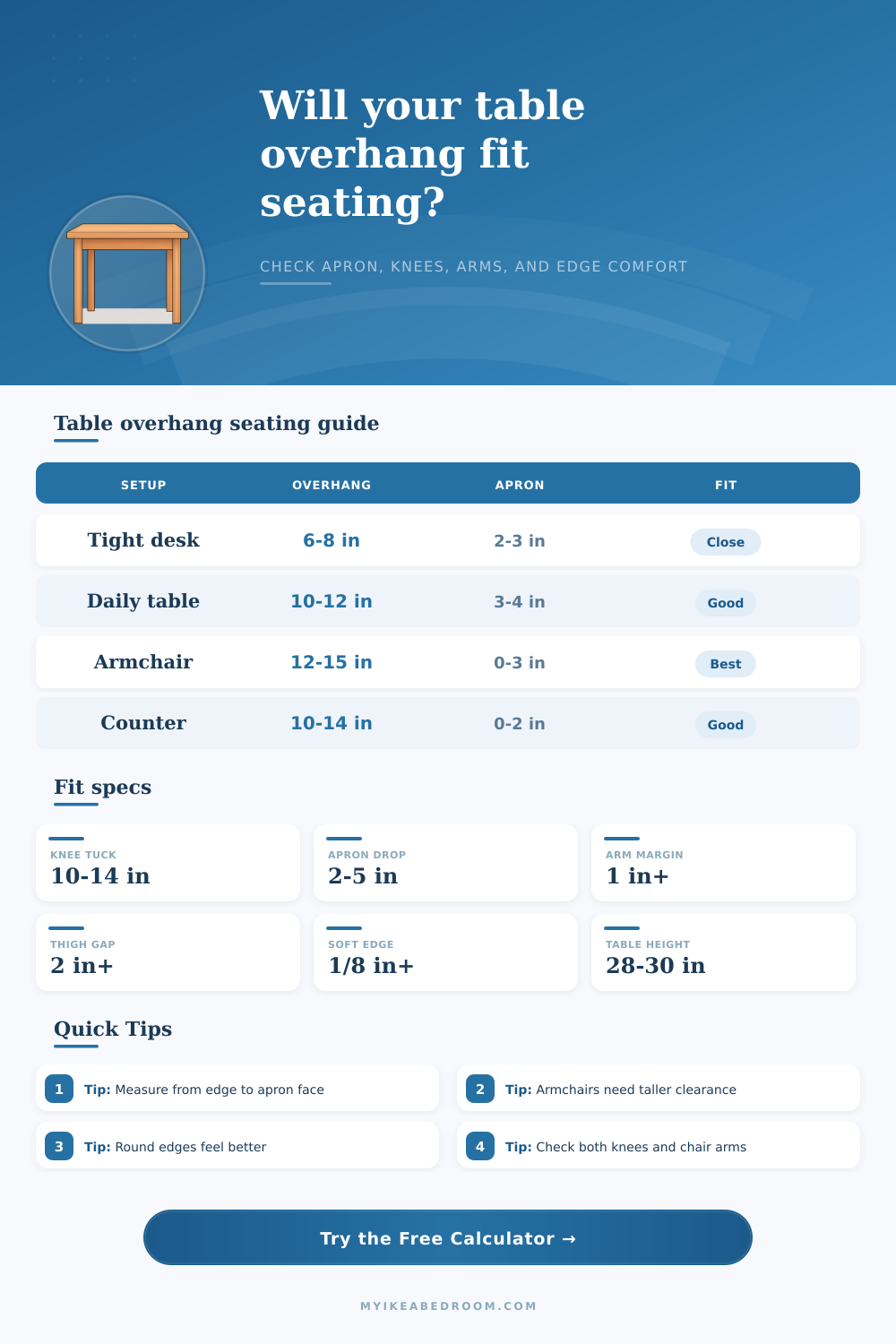
| Use case | Good overhang | Apron note | Best for |
|---|---|---|---|
| Occasional desk or console | 6 to 9 in | Keep apron shallow if knees tuck in | Short sits, laptops, kids work |
| Daily dining side | 10 to 12 in | 2 to 4 in apron drop usually works | Armless chairs and standard tables |
| Relaxed dining or bench | 12 to 15 in | Deeper overhang offsets wider rails | Long meals and bench seating |
| Armchair seating | 12 to 16 in | Vertical arm clearance matters most | Upholstered or dining armchairs |
| Counter or island stool | 10 to 14 in | Avoid low rails at the knee line | Stools, breakfast bars, worktops |
| Dimension | Typical range | Risk if tight | Calculator check |
|---|---|---|---|
| Tabletop height | 28 to 30 in dining, 34 to 36 in counter | Low tops compress thigh clearance | Sets the clear underside height |
| Tabletop thickness | 0.75 to 1.5 in common | Thick tops reduce underside clearance | Subtracts from finished height |
| Apron drop | 2 to 5 in below the top | Deep apron hits knees and chair arms | Creates apron bottom height |
| Chair arm height | 24 to 27 in dining armchairs | Arms may strike apron before chair tucks | Compared with apron bottom height |
| Seated knee height | 22 to 25 in for many adults | Knees rub apron or underside | Compared with vertical opening |
| Edge profile | Comfort effect | Best use | Calculator factor |
|---|---|---|---|
| Sharp square edge | Highest pressure on forearms | Display tables, not long work sessions | Subtracts comfort points |
| Eased edge | Balanced everyday comfort | Dining, desk, homework table | Neutral baseline |
| Rounded bullnose | Softest at the wrist and forearm | Long sitting and kids tables | Adds comfort points |
| Chamfered bevel | Moves pressure away from the sharp corner | Modern tables and thin tops | Small comfort boost |
| Waterfall or thick softened edge | Comfortable if the radius is generous | Thick tops and islands | Boosts edge score |
Measure the obstruction, not just the top. Tabletop overhang for seating is the distance from the front edge to the apron, rail, leg face, pedestal shoulder, or bracket that your knees actually meet.
Check chair arms separately. A table can have enough knee clearance and still fail if the apron bottom sits lower than the chair arms when you slide the chair in.
Table overhang are a measurement that determine the amount of space between an edge of the table and the table’s structural components. The amount of overhang that a table feature will determine how much room a person has to sit at the table. If there is to little overhang, a person’s knees may bumps into the apron or the leg of the table.
However, if there is too much overhang, the table may become unstable when placed on the floor. However, the primary concern for a person sitting at the table is the amount of spaces for there legs and arms. The usable space at a table is not determine by the size of the tabletop.
How Table Overhang Affects Sitting Space
Instead, how far the tabletop is from the first point of obstruction determines the usable space. These points of obstruction may be apron rail, table legs, or pedestal supports. A person must identify these components of the table because they play a significant role in determining how much usable space there is for a person.
An apron rail is a piece of wood that help support the tabletop. It is positioned underneath the tabletop and take up space for a person’s legs. The height of a table and the depth of it’s apron plays a significant role in the total amount of space available to a person.
Tables may be tall, but the thickness of the tabletop and the depth of the apron may take up part of the total space for a person. Tables that has thick aprons and deep tabletops take up alot of space, leaving a person with limited space for there legs. Hence, when considering the usable space for a person to sit at a table, both the height and apron depth must be consider.
The dimension of the chairs that will occupy the space in front of the table also play a role in the total usable space for a person to sit at the table. Most chair have armrests. These armrests may prevent a chair from being tuck under the table.
If the width of the chair armrests is more than the distance between the table legs, the chair will not be able to be tucked under the table. If the apron of the table is lower than the armrests of the chair, a person will have to sit further away from the table. You should measure the dimensions of both the table and the chair to ensure that the two component work together to provide a comfortablly environment for the person.
The edge of the tabletop also affect the way a person will feel while sitting at the table. If the edge of the table is sharp, it may press against the person’s forearm while they eat. An eased or rounded edge will distribute the pressure on the person’s forearms more even.
Such an edge will make the table more comfortable for the person. Hence, a designer must consider the edge of the tabletop when designing a piece of furnitures that people will be use. Finally, environmental factor may also play a significant role in how a person interact with the table.
The slope of the floor or the thickness of the rug may affect the height of the table and the chair. Both the chair and the table should be measured in the specific environment in which they will be used. It is best to test the furniture in the area where the furniture will be placed to ensure that the table overhang is set up in a way that will allow the person to sit at the table without feeling restrictive based off the table’s structure.