Table Linen Size Calculator
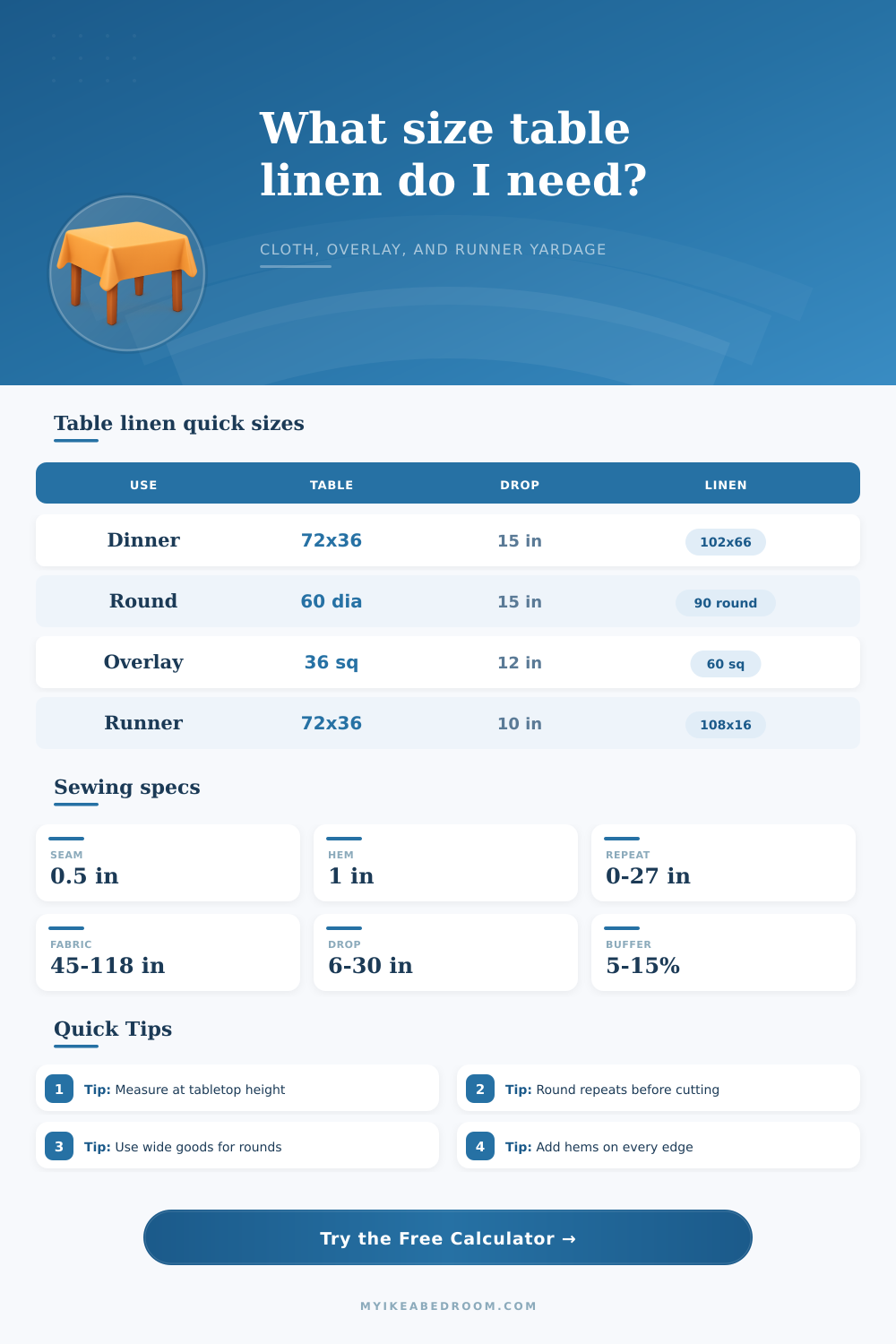
Plan a tablecloth, overlay, or runner from table shape, finished drop, corner style, seam and hem allowances, fabric width, pattern repeat, and quantity.
Start with a common dining, banquet, overlay, cocktail, oval, or runner setup, then adjust the sewing allowances and fabric width.
| Table size | 8 inch drop | 15 inch drop | Floor length guide |
|---|---|---|---|
| 48 x 30 in small dining | 64 x 46 in | 78 x 60 in | 108 x 90 in for 30 in height |
| 60 x 36 in dining | 76 x 52 in | 90 x 66 in | 120 x 96 in for 30 in height |
| 72 x 30 in 6 ft banquet | 88 x 46 in | 102 x 60 in | 132 x 90 in for 30 in height |
| 96 x 30 in 8 ft banquet | 112 x 46 in | 126 x 60 in | 156 x 90 in for 30 in height |
| Table diameter | Seated drop | Half drop | Floor length guide |
|---|---|---|---|
| 30 in cocktail | 54 in cloth | 72 in cloth | 90 in cloth for 30 in height |
| 36 in round | 60 in cloth | 72 in cloth | 96 in cloth for 30 in height |
| 48 in round | 72 in cloth | 90 in cloth | 108 in cloth for 30 in height |
| 60 in round | 84 to 90 in cloth | 108 in cloth | 120 in cloth for 30 in height |
| 72 in round | 102 in cloth | 120 in cloth | 132 in cloth for 30 in height |
| Linen type | Typical finished size | Best table | Planning note |
|---|---|---|---|
| Dining runner | 14 to 18 in wide, table length plus 12 to 24 in | Rectangle or oval | Use the drop as end overhang, not side drop. |
| Short runner | 12 to 16 in wide, just inside table length | Console or buffet | Useful when the runner should not hang over the ends. |
| Square overlay | 54, 60, 72, or 90 in square | Round or square base cloth | Often layered diagonally for contrast and corner points. |
| Buffet topper | Table length plus 12 to 20 in | Sideboard or serving table | Choose a shorter drop if doors or drawers need clearance. |
| Fabric width | Works well for | Seam expectation | Layout caution |
|---|---|---|---|
| 45 in fabric | Runners, small overlays, napery | Most tablecloths need panels | Check repeats before centering motifs. |
| 54 in fabric | Decorator runners, narrow banquet cloths | Medium cloths often need 2 panels | Allow seam allowance on every panel join. |
| 72 in fabric | Many dining cloths and overlays | Fewer seams for rectangle cloths | Large rounds may still need a joined panel. |
| 90 to 118 in fabric | Round, banquet, and full-drop linens | Often single width | Confirm usable width after selvage trimming. |
Best for: full table coverage.
Finished size equals tabletop plus two drops in each direction.
Best for: layered color or smaller topper coverage.
Use the same math as a cloth, but choose a shorter drop.
Best for: table center protection.
Length uses end overhang; width is chosen independently.
Best for: curved tables and cocktail bases.
Panel count depends on the widest cut diameter or oval width.
Center the seam plan first. If the cloth needs more than one panel, place a full-width panel in the center and split side panels evenly so the seams look intentional from each place setting.
Keep repeat math separate from drop math. Calculate the finished linen size from the table and drop, add hems, then round the required fabric length up to the next full pattern repeat before adding the cutting buffer.
To determine the correct table linen, you must first calculate the amount of fabric you will needing. The amount of fabric you require for your linen will include the dimension of the table, the drop of the linen, the hem of the linen, the seam of the linen, and the repeat of the fabric patterns. A dedicated table linen calculator will make this calculation for you by taking into account each of these variable.
The first variable to consider is the shape of the table. If the table are rectangular or square, the calculator will account for the length and the width of the table. If it is round, the table linen will use the diameter of the table.
How to Work Out the Fabric You Need for Table Linen
For oval table, the calculator will use the longest and the shortest measurement of the oval table. The shape of the table will determine how the other variable are structured within the calculator. The drop of the linen is the length that the linen will hang down from the table.
For breakfast table, the drop will be between six and eight inches to protect the table’s surface. For dinner tables when people is seated, the drop will be between twelve and fifteen inches to clear the backs of the chair. For formal event, the drop will be twenty-four inches or more.
Such a large drop will affect the movement of the linen as people walk past the table. Within the calculator, the calculator will convert the drop of the linen into the finished length and the finished width of the table linen. The hem and seam allowance will increase the total amount of linen you require.
If the linen has a one-inch hem on every edge, two inch each will increase the length and the width of the linen. If you join two panels of linen together, the seam allowance will be doubled because there will be a seam allowance on both side of the linen. For very wide linen, there will be no seam.
For narrow linen, the table linen calculator will let you know the number of panels of linen and the number of seam you will need. The more panels of linen you use, the more yardage of linen you will need because there will be more seam allowance. If the linen feature a fabric pattern that repeats, the length of the linen will need to be rounded up to the next pattern repeat because you cant cut a portion of the pattern.
The pattern will be positioned in such a way that it will not look undesirable on the linen. If the linen features no pattern, you will enter a zero in the field for the pattern repeat because there will be no adjustment to the length of the linen because of this factor. The fabric width and the orientation of the linen will affect how the linen is laid out on the table.
The standard orientation of the linen is the length of the linen equaling the length of the fabric. For railroad orientation, the width of the linen will be the length of the cloth. This orientation may allow you to avoid seam if the linen is to be placed on a long table.
The linen calculator can calculate the yardage for both orientations of the linen. You will enter the quantity of linen you will make into the linen calculator to calculate the total yardage of linen you will require. Multiply the yardage of one linen by the number of linens you would like to make.
Perform this calculation once you have the yardage of linen that accounts for the drop, the hems, the seams, and the pattern of the linen because this will ensure the calculator accurately calculate the total amount of linen you will need. Many people will make mistake when measuring the size of the tables for the table linens they plan to make. People will often measure the wrong height for the drop or will not remember where to take the measurement.
You must measure the drop of the linen from the edge of the table to the floor. The finished size of the linen will not be the size of the linen that is cut; otherwise, there will not be enough linen for the hems. The linen calculator will avoid these mistake because it will show the size of the linen that should be cut and the finished size of the linen separately.
Using a table linen calculator allows you to make informed decision about the design of the linen for the tables. For example, you can decide whether the linen will hang to the floor or whether the linen will end below the seats at the table. You can decide whether the linen will be a runner that leaves the sides of the table bare or an overlay that rests on the larger tablecloth.
By knowing the finished size of the linen before you begin to cut the fabric, you can be certain you have enough linen to complete your project.