Table Lamp Quantity for Room Calculator
Estimate how many table lamps a room needs by balancing room area, target light level, lamp lumens, shade loss, task zones, bedside pairs, existing overhead light, and placement spacing.
Choose a realistic starting point, then adjust the dimensions, lamp type, shade loss, task-zone count, and existing light for your layout.
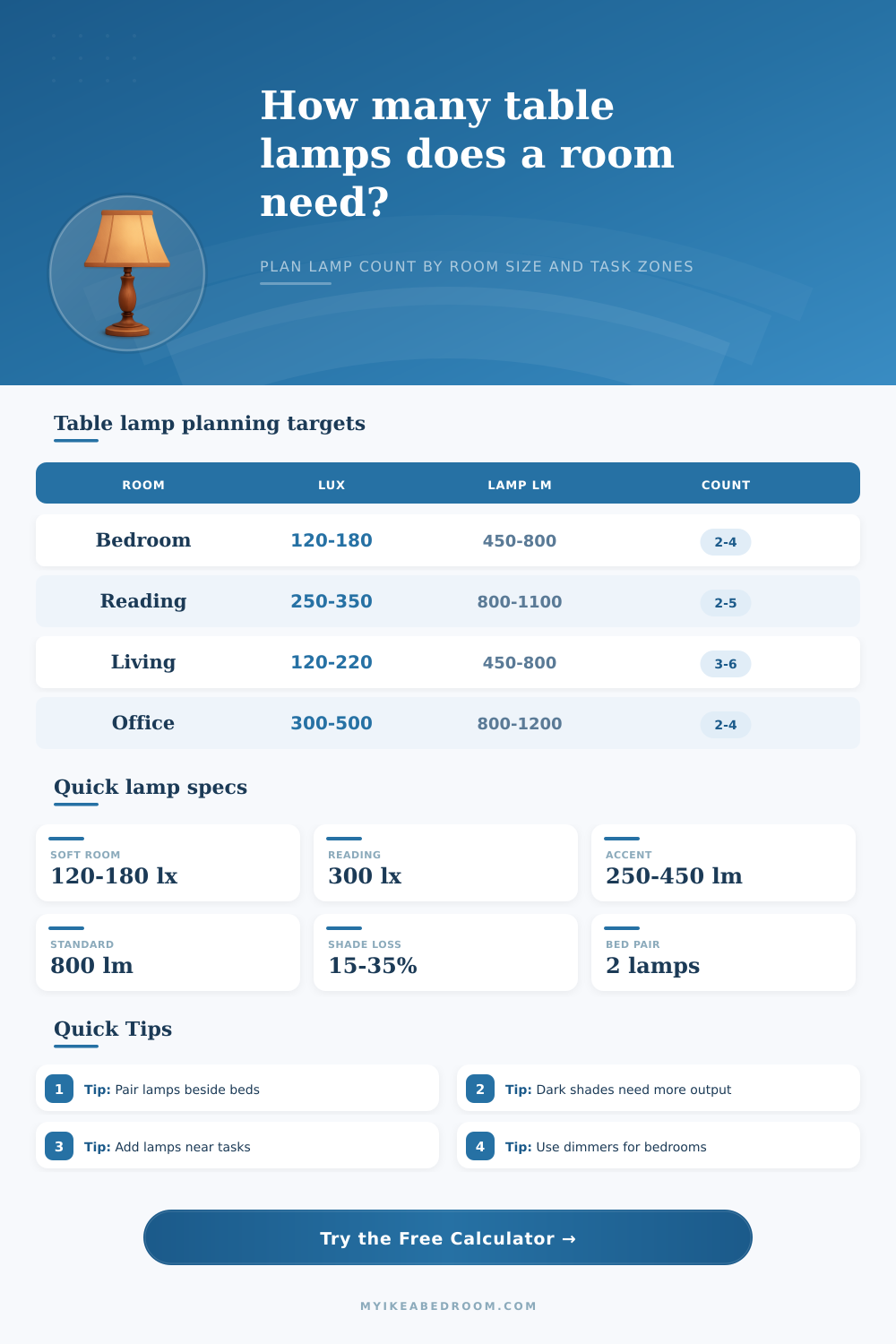
| Room or Zone | Typical Target | Table Lamp Role | Count Check |
|---|---|---|---|
| Relaxed bedroom | 120 to 180 lux | Bedside pair plus optional dresser or chair lamp. | Usually 2 to 4 lamps. |
| Reading bedroom | 250 to 350 lux at task zones | Task lamps carry the brighter zones while room light stays calm. | Usually 3 to 5 lamps. |
| Living room | 120 to 220 lux | Side-table and console lamps create pools of light around seating. | Usually 3 to 6 lamps. |
| Home office support | 300 to 500 lux near work | Table lamps supplement a desk lamp or overhead fixture. | Usually 2 to 4 lamps. |
| Nursery | 80 to 150 lux | Dimmable lamps keep night care soft but usable. | Usually 2 to 3 lamps. |
| Dorm or studio | 150 to 220 lux | Few lamps do more jobs, so task placement matters. | Usually 1 to 3 lamps. |
| Lamp or Shade Type | Typical Raw Lumens | Delivered Factor | Best Calculator Use |
|---|---|---|---|
| Small accent lamp | 250 to 450 lm | 0.75 to 0.95 | Console, dresser, shelf, and low-glare night lighting. |
| White fabric drum shade | 600 to 900 lm | 0.78 to 0.85 | Common bedroom and living room table lamps. |
| Linen or paper shade | 450 to 900 lm | 0.70 to 0.78 | Warm diffuse light where brightness is secondary. |
| Dark shade lamp | 800 to 1600 lm | 0.58 to 0.68 | Decorative lamps that need stronger bulbs to contribute. |
| Directional task lamp | 450 to 1100 lm | 0.85 to 0.92 | Reading, desk work, hobbies, vanity, or changing table. |
| Uplight table lamp | 800 to 1600 lm | 0.65 to 0.75 | Rooms with pale ceilings that can bounce light back down. |
| Placement Need | Useful Range | Why It Matters | Adjustment |
|---|---|---|---|
| Nightstand pair | 2 lamps | Balances both sides of a bed and supports two readers. | Round odd counts up if symmetry matters. |
| Sofa side tables | 6 to 10 ft apart | Keeps seating pools connected without making one bright corner. | Add a console lamp if spacing is too wide. |
| Reading chair | 1 lamp per chair | Task light should land close to the book or work surface. | Use a higher-lumen lamp before adding room-wide lamps. |
| Dark shade | 20% to 40% loss | Decorative shades absorb useful light and can underperform. | Raise lumens or add another lamp. |
| Tall ceiling | Above 9 ft | Reflected lamp light travels farther before reaching surfaces. | Use buffer or more distributed lamps. |
| Open-plan room | Zone by zone | One count may hide dead corners and bright clusters. | Split the room into seating and task areas. |
| Room Example | Area | Target | Typical Lamp Plan |
|---|---|---|---|
| 10 × 10 ft guest room | 100 ft² | 150 lux | 2 bedside lamps plus 1 dresser lamp if there is no ceiling light. |
| 12 × 14 ft bedroom | 168 ft² | 150 lux | 2 nightstand lamps and 1 reading or dresser lamp. |
| 12 × 16 ft living room | 192 ft² | 180 lux | 2 side-table lamps, 1 console lamp, and 1 reading lamp. |
| 10 × 12 ft kids room | 120 ft² | 150 lux | 1 bedside lamp, 1 desk lamp, and soft overhead support. |
| 10 × 10 ft office | 100 ft² | 350 lux | 1 focused desk lamp plus 1 to 2 ambient table lamps. |
| 15 × 20 ft living room | 300 ft² | 180 lux | 4 to 6 table lamps, split across seating and console zones. |
Best baseline: two matching nightstand lamps, then add a dresser or chair lamp only if the lumen gap remains.
Symmetry can be more important than a perfectly minimal count.
Best baseline: lamps near each seating cluster, not all along one wall.
The spacing result helps catch dark corners before furniture is moved.
Best baseline: task lamps for work zones plus softer table lamps for ambient fill.
Raising every lamp to task brightness can make a bedroom feel harsh.
Best baseline: fewer lamps with higher usefulness at bed, desk, and sofa positions.
Use the task-zone count to avoid adding lamps where no one sits or reads.
Count useful positions first: A table lamp should sit where it serves a bed, chair, desk, dresser, console, or sofa end. If the calculator recommends five lamps but your room has only three useful surfaces, raise lamp output or keep some lumens in overhead lighting.
Separate ambient and task light: Use lower, warmer lamps for the room feel and brighter directional lamps for reading or work. That gives better control than making every table lamp equally bright.
In determining the numbers of table lamp that are needed in a given room, there are several different factors that should be considered. The number of table lamp that a room should have is depending upon the needs of that particular room. Factors that influence the amount of light that a room require include the size of the room, the height of the ceiling, the color of the walls, and the activities that occurs in that room.
The size of the room is one of the main factor to consider. Larger rooms require more light then smaller rooms; the light levels need to be distributed even throughout the area of the floor that is occupied by that room. The shape of the room is also another consideration of the area.
How Many Table Lamps Do You Need in a Room
A large area with a long and narrow-shape may experience dark areas of the room even if there is a large number of square feet of floor area in that room. The height of the ceiling is one more factor that relates to the amount of light that is required by that room. As with taller rooms, the light from the lamps will travel more far to those individuals in the room, and thus will be less intense before it reaches the eyes of the individuals in that room.
The color of the walls and bedding of the room can also impact the amount of light that the table lamps should provide in that room. If the walls and bedding are light colors, more light will be reflected off to those surfaces into the room. If, however, the color of the bedding and walls is dark, those dark surfaces will absorb the light instead of be reflected into the room.
In this case, more lamps may be needed or you should replace the light bulb of those lamps with those that contain more light. Another factor of consideration is the shade in which the lamp have. If the shade of the lamp is white, it will allow more light to exit the lamp than if it has a dark or textured shade.
Thus, if the shade of the lamp will block much of the light that the lamp create, more lamps will be needed to provide the required amount of light to the room. Another determining factor of the number of table lamps that should be placed in a room are the task zone within that area. Task zones is areas within the room in which an individual will perform a specific task.
Tasks like reading will require lamps with more bright than other tasks. Thus, more lamps may be needed in those task zones within a room. An additional factor that should be considered is the amount of light that the overhead lights currently provide in the room.
If the overhead lights are very bright, the table lamp dont need to provide as much light as if there were no overhead lights in the room. Thus, the brightness provided by the overhead lights can be factored into the calculation of how many table lamps are needed for that room. However, another consideration is the placement of the table lamps; it is common for individuals to desire symmetry in the lamps in a room.
Thus, more lamps than mathematically calculate may be needed to provide such symmetry to the room. The way that the lamps are to be spaced in the room may also factor into the number of lamps that are needed. If the lamps are too far apart from one another, there will be dark area in the room.
If the lamps are too close to one another, some areas of the room may be lit while other areas may be left in the dark. Each area in which individuals will be standing or sitting should have a table lamp within reach. Finally, the purpose of the room may be another factor.
If the room is to be a calm area in the home, lamps with lower brightness setting may be all that are needed. However, if the function of the room include reading, for instance, one bright lamp may be needed in that task zone in addition to the table lamps that are calculate to be needed for the remainder of the area of the room. Thus, while the table lamp calculator provide an estimated number of table lamps that may be needed for a space and function, the actual number of lamps may need to be adjust according to the purpose of the room and the way in which it will be furnished.