Swing Set Clearance Calculator
Estimate the clear open zone around a backyard swing set using swing arc, beam height, side clearance, equipment footprint, fall zone area, and metric conversions.
Load a common setup, then adjust beam height, seat drop, swing spacing, slide projection, side clearance, and surfacing depth.
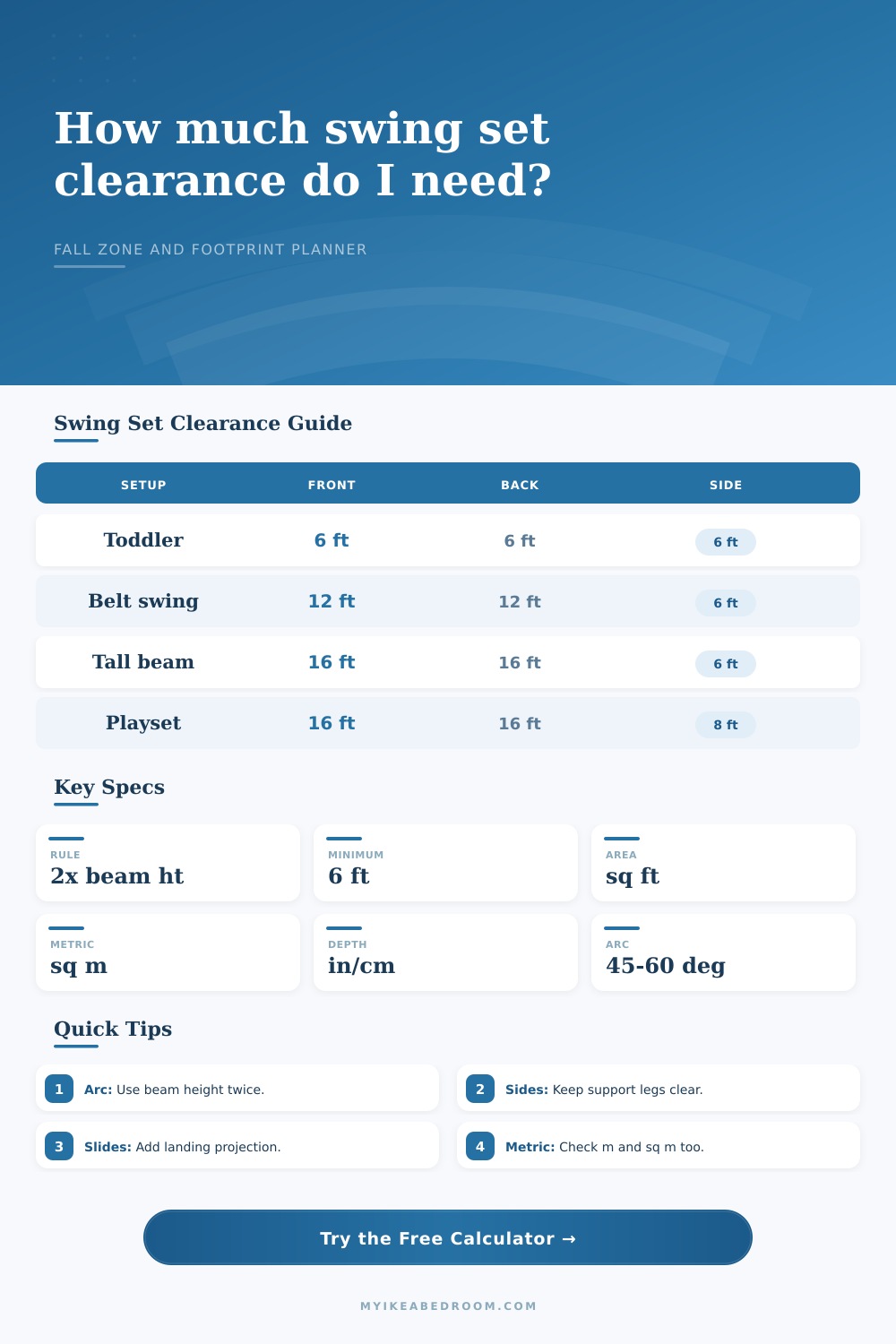
| Beam height | Twice height rule | Metric equivalent | Planning note |
|---|---|---|---|
| 6 ft | 12 ft front and 12 ft back | 3.7 m each way | Works for many toddler and compact frames. |
| 7 ft | 14 ft front and 14 ft back | 4.3 m each way | Common for smaller belt swing frames. |
| 8 ft | 16 ft front and 16 ft back | 4.9 m each way | A practical baseline for many backyard swings. |
| 9 ft | 18 ft front and 18 ft back | 5.5 m each way | Use for taller beams and stronger swing arcs. |
| 10 ft | 20 ft front and 20 ft back | 6.1 m each way | Needs a large open run without paths or fences. |
| Planning item | Formula basis | Use in calculator | Metric conversion |
|---|---|---|---|
| Swing arc reach | Seat drop x sine of angle | Checks moving seat travel before adding open space. | ft x 0.3048 = m |
| Equipment footprint | Beam length x frame depth plus slide reach | Shows how much space the structure itself occupies. | sq ft x 0.0929 = sq m |
| Clear zone width | Beam length plus two side clearances | Protects both support sides and swing positions. | ft x 0.3048 = m |
| Clear zone depth | Frame depth plus projection plus front and back | Defines the total run of open fall zone. | ft x 0.3048 = m |
| Loose-fill volume | Area x surface depth | Optional material volume for impact surfacing depth. | cu yd x 0.7646 = m3 |
| Setup | Typical equipment footprint | Clearance priority | Planning note |
|---|---|---|---|
| Toddler A-frame | 8 x 6 ft | 6 ft minimum plus arc | Low beams still need clean space around moving seats. |
| Two belt swings | 12 x 8 ft | Twice beam height | Usually driven by front and back clearance. |
| Three-swing beam | 16 x 9 ft | Side clearance and spacing | Check beam length against seat spacing before placing posts. |
| Tower with slide | 14 x 15 ft | Slide landing and swing arc | Add slide projection to the total fall zone depth. |
| Monkey bar set | 18 x 14 ft | Open route around bars | Depth often grows because bars and platforms extend the frame. |
It’s like you’re zoning a mini-park in your back yard. It’s not a municipal playground so the stakes aren’t as high… But it still obeys the exact same physics. Your property lines mean nothing to gravity.
When most parents imagine a swing set, they imagine a few seat and a metal frame. They don’t imagine the hidden geometry of motion. And that’s what leads to a dented fence; or a scraped knee, instead of a fun afternoon.
How to Set Up Your Swing Set Safely
So there’s the general rule of thumb; double the height of the beam for clearance both front and back. If your swing beam is eight feet high, that means you’ll need sixteen feet of clearance in front of the beam and sixteen feet of clearance behind the beam. That’s to account for the arc of the swing plus the momentum of a kid who pushes off with more force then they mean to. It’s conservative (which is good when concrete walls are involved).
Once you enter the exact height of your beam into the calculator above, it will do the rest of the math for you. No need to stare at a tape measure and try to figure out sine waves in your head.
How much does Seat Drop matter? More than most folks think. A wider arc mean a higher seat. A tighter arc means a lower toddler bucket seat. An older kid’s belt swings, which create a higher seat and a wider arc. This is where you can tinker with the drop distance of the tool. Enter the chain length, which is how far out from the beam to the middle of your seat. Six foot drop is typical. Each inch increase the horizontal reach. So not taking into account this variable is how you end up with a swing that hits the shed on the third push.
Remember to leave side clearance. The baseline is six feet in both directions from the support legs. That’s for the little ones who might run across the swing. But it also keeps people from jumping off sideways and colliding with anyone else.
The wider the beams, the more swings you can fit on them. However, that means a bigger overall footprint. If your swing beam fits a tight yard (like a three-swing), make sure there is some space between seats. Kids don’t want to knock elbows at play.
Sand is the last line of defense. The impact surface use loose fill, such as woodchips or sand, to absorb energy. How much do you need? Enter the size of your overall fall zone area into the calculator, along with how deep you want it. Typical loose fill depth is nine inches.
That sounds like so much. But depth will compress. Depth compresses over time. The thinner the layer, the less protection it provides. The thicker the layer, the less severe your injuries are likely to be.
Don’t just think about dirt! Think shock absorption. The thinner the layer, the less protection it provides. The thicker the layer, the less severe your injuries are likely to be. Don’t think just dirt! Think shock absorption.
If you’re accustomed to working in imperial units, the metric system can get confusing. Don’t worry: the tool does all the converting for you. One square foot is about zero point zero nine square meters. That’s a small conversion factor, but it adds up when you are shopping for mulch by the cubic yard.
Before finalizing your plan, switch to the units you’ll actualy work with so you don’t misread a dimension. Remember: A yard is not as long as a meter. If you do, you’ll either end up with a gap in your safety zone or buy too much of some material.
It isn’t just about how far away something is, but where things are located. Is there a patio? There is a trunk of a tree. Is there a garden bed? Ideally those would be beyond the measured area. A fence may appear within reach from the swing. But a child falling forward needs that extra buffer. Better to reposition the set than trim the yard later.
Draw a box, but draw one you cannot see. Open it up and make everything inside the box soft. Make everything else on the outside hard and structured. Use the numbers to help form the shape. Use the judgement calls to fit in your life.
Begin at the top, follow the arch and respect the space. That is how you have the fun and avoid having to fix it. You should of used the tool first.