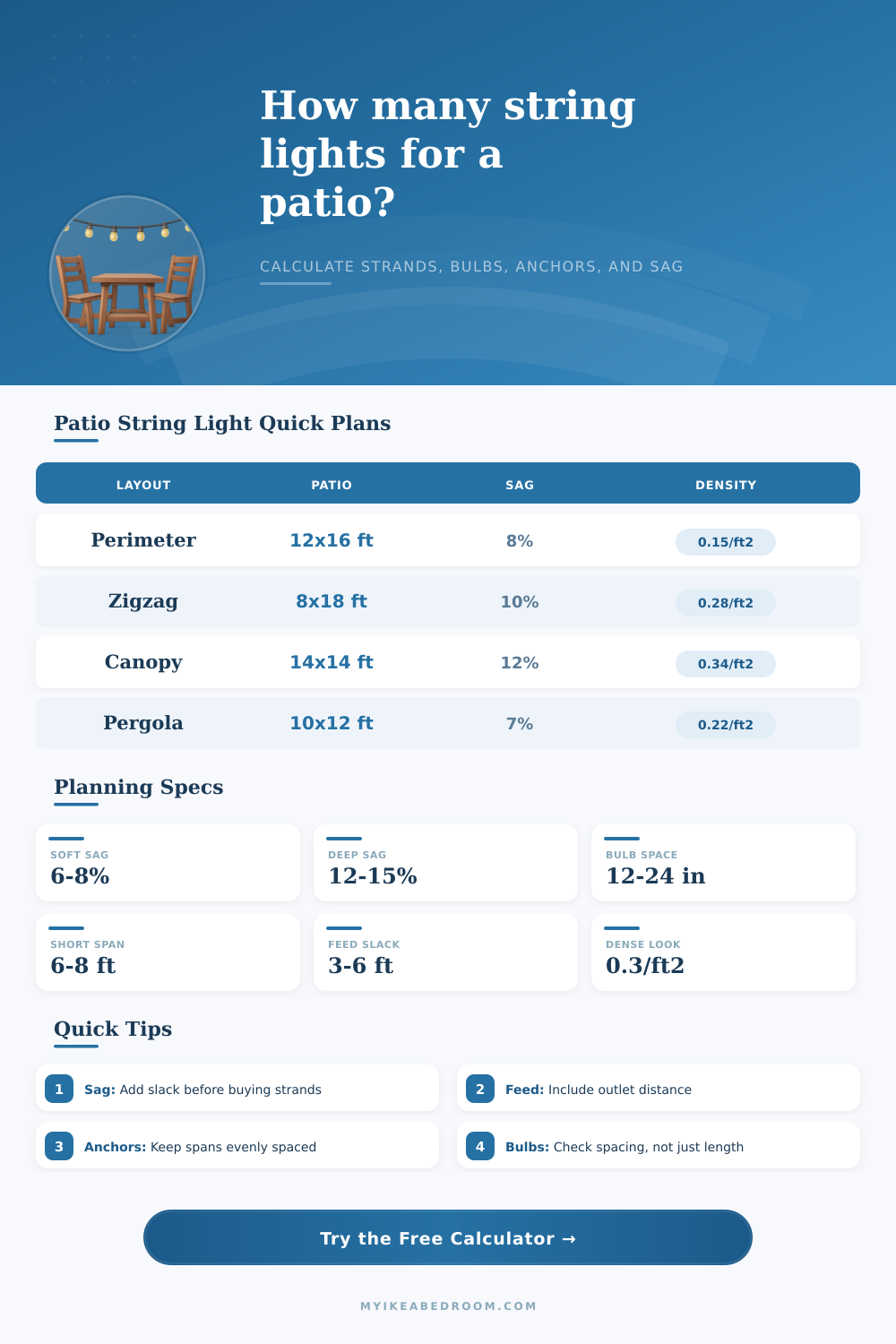
Patio string light layout planner
String Light Quantity for Patio Calculator
Estimate patio string light run length, sag allowance, strand count, bulb count, anchor spacing, coverage density, drop height, and outlet feed distance for perimeter, zigzag, canopy, radial, and pergola layouts.
| Layout pattern | Run length formula | Good anchor plan | Best use |
|---|---|---|---|
| Perimeter outline | 2 x length + 2 x width | Four corners plus midpoints on long sides | Low-glare border light around seating. |
| Zigzag lengthwise | Length rows plus width turns | Opposite-side anchors in pairs | Long balcony, dining patio, and narrow terraces. |
| Zigzag widthwise | Width rows plus length turns | Pairs across the long side | Wide patios where the short span is easier to support. |
| Canopy grid | Length rows plus width rows | Grid anchors or pergola points | Dense overhead coverage across the full patio. |
| Radial center hub | Hub radius x anchor count | Center hub plus outer anchor ring | Cafe canopy look over a square or courtyard. |
| Pergola rafter runs | Rafter count x length plus edge return | Each rafter or beam becomes an anchor lane | Covered patios and pergolas with straight runs. |
| Sag percent | Visual arc | Extra length on 50 ft | Planning note |
|---|---|---|---|
| 0 to 4% | Taut line | 0 to 2 ft | Best only when the cable or guide wire is intentionally tight. |
| 5 to 8% | Soft relaxed line | 2.5 to 4 ft | Common patio look with controlled droop between anchors. |
| 9 to 12% | Visible cafe arc | 4.5 to 6 ft | Good for longer spans where the curve is part of the look. |
| 13 to 18% | Deep swag | 6.5 to 9 ft | Use higher anchors and check walking clearance below bulbs. |
| Bulb spacing | Bulbs per 48 ft | Lighting feel | Typical patio role |
|---|---|---|---|
| 12 in / 30 cm | 49 bulbs | Bright and continuous | Dense canopy, party patio, or dark courtyard. |
| 18 in / 45 cm | 33 bulbs | Balanced glow | Dining zones and medium zigzag layouts. |
| 24 in / 60 cm | 25 bulbs | Classic bistro spacing | Perimeter, pergola edge, and casual patios. |
| 36 in / 90 cm | 17 bulbs | Subtle accent points | Low-density borders and small balconies. |
| Patio preset | Starting size | Suggested layout | Anchor guidance |
|---|---|---|---|
| 12 x 16 patio | 192 ft2 | Perimeter or simple zigzag | Use corners plus long-side midpoints. |
| Apartment balcony | 72 to 144 ft2 | Lengthwise zigzag | Pairs across railing and wall points keep rows even. |
| Pergola dining area | 100 to 180 ft2 | Pergola rafters | Each rafter can carry a straight run with light sag. |
| Courtyard canopy | 180 to 300 ft2 | Grid or radial hub | Use more anchors to keep spans under 10 ft. |
| Large party patio | 300 ft2 plus | Canopy grid | Split into two powered zones if runs become long. |
Here is the problem: You’re standing out on your patio and you think maybe those bistro lights won’t stretch far enough. Three strands are too much. One’s not enough. If only you knew how long it would run beforehand, rite? Well now there’s no need to guesstimate. Knowing the square footage doesn’t tell you how light behaves through space. Just plug your dimensions into the calculator and let it crunch numbers for you. It’ll handle the math so you don’t have to calculate sags while holding a ladder.
Unlike rugs and drapes, string lights is specified by linear footage different than square footage. For instance, a perimeter pattern (a straightforward circuit around the edges) is space-efficient and requires fewer anchor. But if it’s a thick canopy, then we’ll need to zigzag or use a grid, at which point it all changes. Each additional row increase the overall run of cable; a grid can triple amount of cable needed to light an equal area. The tool will adjust formulas depending on what pattern you choose, so there are no gaps in its logic and you won’t buy more wire then necessary.
How to Calculate String Light Length
Sag affects safety and looks. Many fail to account for sag until after buying…yet sag is important: Too little make bulbs hang too low (too near passersby) and too much will make a taut line look sterile. The calculator wants to know what percent you want to allow for the sagging of the wire. Typically, this is 6-12% to account for the arc created by the wire’s own weight pulling down on it. That added length covers the arch of the wire’s length. For example, if your anchors is spaced 20 feet apart, add almost a foot in additional cable for just one segment. Each piece may be only a small increment but across the entire patio it can amount to another strand.
Many people calculate their straight-line distance and order only that much cable. Then, when they try to string it, they discover they are short. The distance between anchors also affects this equation. Wires hanging loose can flap around in breeze; they’ll make your bulbs crack or make your lights flicker. For balance and stability, keep your span lengths below ten feet. This calculator will display the average span distance (total run divided by number of anchors). Anything above twelve feet? You probably want fewer sag, or perhaps an additional hook to raise it up higher.
How many lights isn’t quite as important as where those lights is held. One more reminder: how far is it between your outlet and where that first piece of decor starts? Is there three feet of wire or is it fifteen because you’re plugging in around the corner? You’ve got to subtract that slack from whatever length of string you get. So don’t buy a fifty foot strand when you only have a fifty foot run, cause now what do you plug it INTO? Having some slack here means no extension cord at your party time.
Enter the length of your total feet. How many full strands will you need to buy? And how many bulbs? The tool estimates number of bulbs (after estimating the total feet) and tells you just how many whole strings to purchase. One less guess equals one less wasted dollar, and one less wrong hook, and just the right glow. You should of checked twice.