Steam Generator Size Calculator
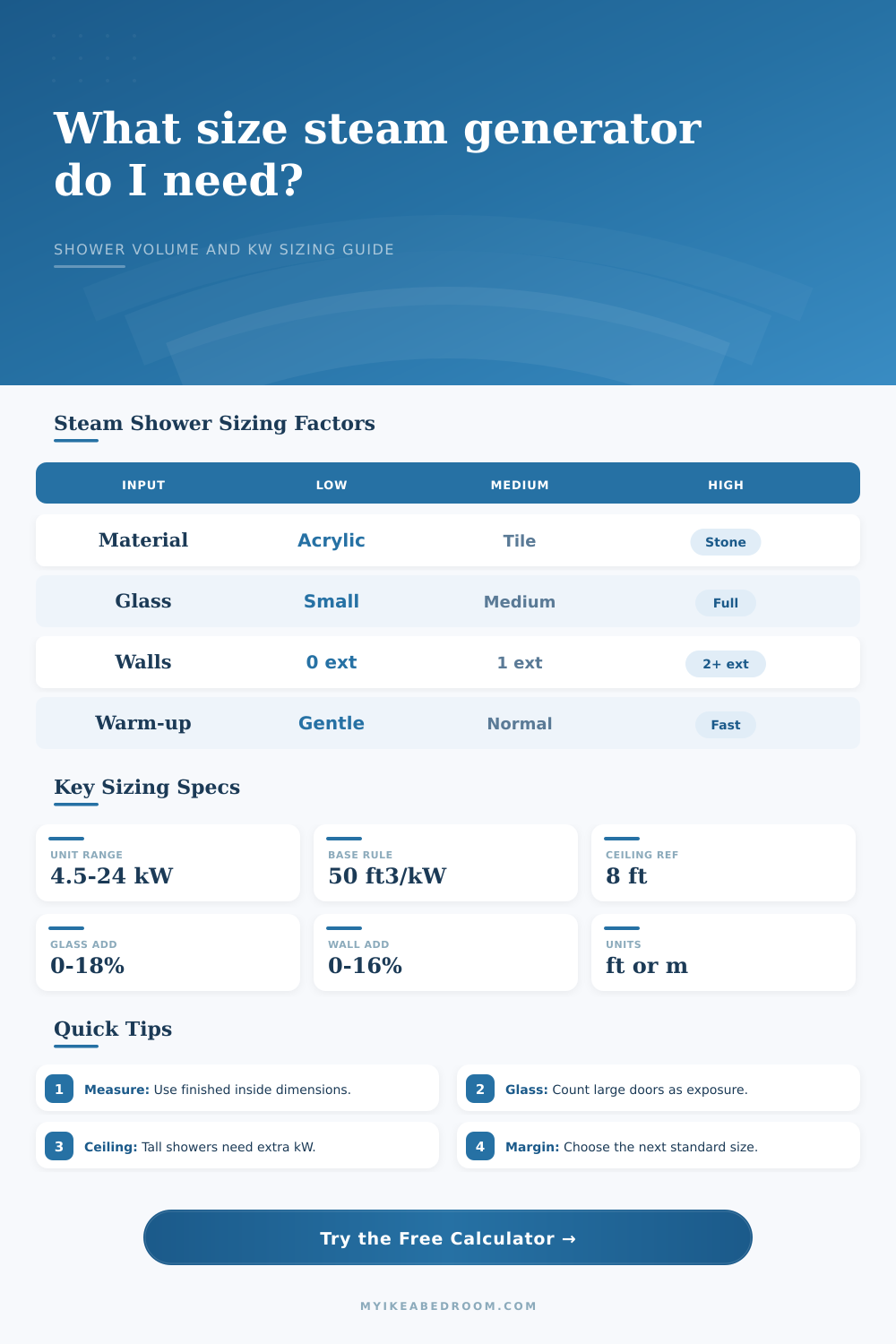
Estimate shower steam generator kW from finished dimensions, wall material, ceiling height, glass exposure, exterior walls, and preferred warm-up speed.
Choose a starting point, then fine-tune the exact measurements and sizing factors for your shower.
Switch units at any time. The calculator sizes internally in cubic feet and also reports metric volume.
Steam Generator Sizing Result
| Nominal kW | Base volume at 50 ft³/kW | Metric volume | Typical measurement fit |
|---|---|---|---|
| 4.5 kW | Up to 225 ft³ | Up to 6.4 m³ | Compact alcove, low glass |
| 6 kW | Up to 300 ft³ | Up to 8.5 m³ | Small ensuite shower |
| 7.5 kW | Up to 375 ft³ | Up to 10.6 m³ | Medium tiled shower |
| 9 kW | Up to 450 ft³ | Up to 12.7 m³ | Walk-in with glass door |
| 12 kW | Up to 600 ft³ | Up to 17.0 m³ | Large stone or tall shower |
| 15 kW | Up to 750 ft³ | Up to 21.2 m³ | Oversized glass enclosure |
| 18 to 24 kW | 900 to 1200 ft³ | 25.5 to 34.0 m³ | Very large residential steam space |
| Surface condition | Sizing factor | What it means | Measurement note |
|---|---|---|---|
| Acrylic shell | 0.90× | Lower heat absorption | Use inside pan and wall dimensions |
| Ceramic tile | 1.00× | Baseline sizing | Works for common backer-board showers |
| Porcelain tile | 1.10× | Slightly higher thermal mass | Count tile ceiling if present |
| Glass tile | 1.15× | More heat loss and surface load | Include glass mosaics across large walls |
| Natural stone | 1.35× | High heat absorption | Use the higher factor for slab or thick tile |
| Concrete masonry | 1.45× | Very high thermal mass | Use when heavy walls remain exposed |
| Glass exposure | Added load | Best used for | Count this area |
|---|---|---|---|
| None | +0% | Solid enclosure | No large glass panel |
| Door only | +5% | Standard hinged or sliding door | One entry face |
| One large wall | +9% | Partial wet-room glass | One broad panel |
| Corner glass | +13% | Two exposed faces | Door plus side panel |
| Full enclosure | +18% | Mostly glass steam shower | Multiple full-height panels |
| Preset scenario | Finished size | Factor driver | Likely kW range |
|---|---|---|---|
| Compact acrylic alcove | 36 × 36 × 96 in | Low surface load | 4.5 to 6 kW |
| Small tiled ensuite | 42 × 48 × 96 in | Tile plus glass door | 6 to 7.5 kW |
| Primary walk-in | 60 × 48 × 102 in | More floor area | 7.5 to 10.5 kW |
| Stone bench shower | 72 × 60 × 96 in | Stone thermal mass | 12 to 15 kW |
| Glass spa enclosure | 84 × 60 × 108 in | Glass and tall ceiling | 15 to 21 kW |
The amount of energy required are calculated by figuring out how much energy it takes to turn water into vapor. That number has to consider the materials surrounding the shower area. Pick the wrong size and you’ll wait too long to have warm steam or your wasting money buying a big unit.
There’s a little online calculator which figures out what the proper kilowatt rating should be for your shower size. It adjusts the baseline based off the materials used to build the shower. Not all materials absorbs and retain heat equally… So just knowing the volume isn’t enough information to know how much energy will be required to get the air to temperature. An acrylic shower warm faster than an identical volume built using concrete or marble. Those materials require more energy to warm up the same space. To adjust for those differances, the calculator use the baseline volume times a number based on the material. Just pick the material type and let the system adjust the power rating based on that. The reasoning here is that denser stone will act like a heat soak and make a difference in the performance.
How to Choose the Right Size Steam Generator
The efficiency of your steam are affected by glass. Glass lets heat out. The more large glass panel you have, the more heat your steam will lose. So does a simple door versus a full glass enclose. Whether you have a simple door or a full glass enclosure matter for how much heat escapes. The more transparent, the less you can hold in the heat. It calculates how much glass exposure you have. If you have lots of glass, the system add a load factor to the calculation to account for heat loss. You are warming the air AND warming the boundaries of the room. A lot of folks forget about the rooms material and just consider the size of the air space. That results in an incorrect size since all that energy is going into warming up the boundaries.
The amount of air that has to be heated depend on ceiling height. For typical home applications, most units are sized for an eight-foot ceiling. Higher ceilings requires additional space heating. You can enter your actual ceiling height into the calculator. That will increase the cubic footage and raise the suggested power rating. More air means it takes longer to saturate the space.
Check the reference tables which link the volume range to kilowatt ratings. A small shower with a glass door might get by with a nine-kilowatt unit. If you add some high ceilings and stone bench, you’ll want a 12- or 15-kilowatt unit. Otherwise, you’re going to be disappointed with low levels of steam production.
Cold air comes from cold exterior walls. A central shower will be warmer than a shower that faces an unheated attic or a garage. The calculator include these cold boundaries. Each exterior wall contribute a certain percentage to the overall load. It’s a penalty for putting the shower on an exterior wall. Maybe you like the view, but the view will cost you power. The calculator balances the trade-offs and lets you see the true cost of your decisions.
One factor that will affect your sizing is your personal preference on how slowly or fast you want it to warm up. The faster your warmup time is the bigger size you need. Think of this as driving down the road versus starting from zero and stomping on the gas pedal. They both get you there but one burns more fuel.
Consider applying some margin for error to the calculated load. Add an additional ten or fifteen percent if you’re not positive on your measurements and don’t know if tiles are going to be 1/2″ or 3/4″ thick. Better to have too much than to little. This will give you an estimate of the required standard size as a result.
There are only certain sizes of generators. They are not custom sizes. The tool then estimates what you need and rounds up to the next size. If the generator’s rating is only slightly higher than what you need, it wouldn’t of been strong enough to do the job. So you want the next size up (not the closest). That way the system are sized to meet the maximum load at all times and won’t cycle on and off. Cycling is bad for the equipment and annoying for the user.
Moisture control, temperature control, these are the keys to Steam showers. Powering the Generator depend on it. Account for your materials, measure carefully. Then turn to the tool to do the math. Let it calculate the rest. Your shower will be a functional space… but it will feel high-end.
Begin with numbers, trust the physics. Get the mist right this way.